



All signal. No feed.
4DA reads the internet for developers — privately, locally. Your codebase decides what's relevant.
It scans your codebase — Cargo.toml, package.json, go.mod, Git history — and scores every article, advisory, and release from 20+ sources against what you actually build. An item needs 2+ independent signals to survive. Everything else is rejected.
Benchmarked across 9 developer personas against a 245-item labeled corpus — 1,997 scored evaluations: 93% of content is rejected, and 98.9% of labeled noise is correctly rejected. Those are measured numbers, and you can reproduce them in one command. Your real rejection rate — computed from your own data, not ours — is shown in the Signal tab.
Saves and dismissals build a preference profile you can inspect, pin, or forget — and teach the Brief what to stop showing you. Relevance scoring itself stays grounded in your actual stack. And when the engine improves, it re-judges everything it already holds: yesterday's noise becomes tomorrow's signal.
The fastest way to try it
Already using Claude Code, Cursor, or Windsurf? One command:
npx @4da/mcp-server
This scans your project, detects your stack, and gives your AI assistant live vulnerability scanning, dependency health, upgrade planning, and ecosystem intelligence. No API keys. No accounts. Works standalone — no desktop app required. Full MCP documentation.
How It Works
Scoring
5 independent signal axes. An item must pass 2 or more to surface. Single-axis matches are hard-capped at 28% — no matter how strong one signal is, it cannot pass alone.
| Axis | What it measures |
|---|---|
| Context | Semantic similarity to your active codebase |
| Interest | Alignment with your declared topics |
| ACE | Real-time signals from your Git commits and file edits |
| Dependency | Direct matches against your installed packages |
| Learned | Reserved — held out of scoring until it can be validated against your explicit feedback |
What passes the gate goes through 12 quality multipliers: content depth, novelty detection, competing tech penalties, title-body coherence, and intent scoring from recent work. Every constant is calibrated across 9 simulated developer personas with 245 labeled test items.
LLM Verification
After keyword scoring, an LLM layer verifies the top items against your full developer context — stack, dependencies, recent commits, anti-technologies, and engagement history. Strict 1-5 rubric:
- 5 = MUST-READ: Security alert for YOUR dependency, breaking change YOU must act on
- 3 = WORTH KNOWING: Useful tool that fits YOUR exact stack
- 1 = NOISE: Mentions your tech but isn't actionable
This is where the gold surfaces — articles the keyword pipeline misses because there's no keyword overlap, but the LLM understands the conceptual relevance to your specific project.
You own the compute. Use Ollama for free local inference (fully private), or bring your own Anthropic/OpenAI key. 4DA never pays for your compute, never stores your keys remotely, never makes API calls you didn't configure.
Anti-Gaming
Content creators who learn the scoring algorithm still can't game it:
- Title-body coherence: titles must deliver on what they promise. Claim "React + Rust + Tauri" but only discuss React? Penalty.
- Keyword concentration: repeating "Rust" four times in a title hurts your score.
- Confirmation gate: keyword-stuffing hits one axis. Without matching the user's codebase, installed packages, AND recent work — the gate rejects it.
- Grounded scoring: relevance keys on your actual dependency graph and stack — not popularity, not engagement. There is no behavioural signal to farm; content scores only when it matters to what you actually build.
No algorithm can be gamed when the scoring signal comes from your local filesystem. Your Cargo.lock doesn't lie.
Privacy & Trust
4DA is local-first and direct-to-provider. There is no 4DA-operated server, no analytics, and no user account system. Your indexed content, scores, and intelligence live in a SQLite database on your machine.
The only outbound traffic:
| Category | Where | Why |
|---|---|---|
| Source adapters | HN, GitHub, Reddit, arXiv, etc. | Fetching public content you configured |
| LLM providers | Anthropic / OpenAI / localhost Ollama | Only if YOU set up BYOK keys |
| License validation | Keygen | Only if you activated a paid license |
| Updater | GitHub Releases | Signed via minisign, once per session |
| Crash reports | None | 4DA sends no crash reports. Export a scrubbed diagnostic bundle locally, on demand. |
That's the whole list. There is no 4DA telemetry endpoint because there is no 4DA cloud.
Don't take our word for it:
| Network Transparency | Every outbound connection, with source code references |
| Trust Architecture | Why local-first means you don't need to trust us |
| Privacy (Plain Language) | One-page, no-legalese privacy summary |
| Security Audit Guide | Map of trust-critical code paths for auditors |
| Build from Source | Compile it yourself and verify the binary |
Download
Pre-built binaries — no Rust toolchain required.
| Platform | Download | Auto-updates |
|---|---|---|
| Windows | .exe installer | Yes |
| macOS | .dmg (Apple Silicon & Intel) | Yes |
| Linux | .AppImage / .deb | Yes |
Every release publishes SHASUMS256.txt and per-file .sha256 sidecars. Verification instructions.
Windows users: SmartScreen will prompt on first launch (new application, building reputation). Click More info → Run anyway. Full details.
Or install the MCP server for Claude Code / Cursor / Windsurf:
npx @4da/mcp-server
Build from Source
git clone https://github.com/4DA-Systems/4DA.git
cd 4DA
pnpm install
pnpm tauri dev   # First build: 5-15 min. Dev server: localhost:4444.
Prerequisites: Rust (1.93.1 via rust-toolchain.toml), Node.js 20, pnpm 9.15. Platform-specific: Windows needs VS Build Tools 2022 with C++ workload. Full build guide.
First-run setup (API keys, context dirs, sources): Getting Started.
System Requirements
4DA runs on modest hardware. Private semantic search is built in — no GPU, no API key, and no first-run download required.
| Baseline (free) | + Cloud AI (BYOK) | + Local AI (offline) | |
|---|---|---|---|
| RAM | 4 GB | 4 GB | 16 GB (8B model); 32 GB for 12–14B |
| CPU | any 64-bit | any 64-bit | 6–8 cores |
| GPU | not needed | not needed | optional (recommended for speed) |
| Disk | ~500 MB | ~500 MB | + 5–9 GB per model |
| Network | install only | install + your AI provider | install + one model download (or none with Ollama) |
- OS: Windows 10 (1803+) / 11, macOS 10.15+, Ubuntu 22.04+ (WebKitGTK 4.1).
- One installer (~110 MB). The local embedding model ships inside it — no separate download, works fully offline on first run.
- Baseline = private on-device semantic search. Cloud AI adds AI-written briefings + deeper reranking via your own API key. Local AI runs everything offline (Ollama or a downloaded model).
Architecture
Your Codebase                    External Sources
     |                                |
     v                                v
+-----------+                +--------------+
|    ACE    |                |  20+ Source   |
| Scanner + |                |  Adapters     |
| Git Watch |                |  (background) |
+-----+-----+               +------+-------+
      |                            |
      v                            v
+------------------------------------------+
|         5-Axis Scoring Engine            |
|                                          |
|  context --+                             |
|  interest --+- confirmation gate (2+/5)  |
|  ace -------+                            |
|  dependency-+  x quality x novelty       |
|  learned ---+  x domain  x intent        |
+------------------+-----------------------+
                   |
                   v
          +-----------------+
          |  What survived  |
          +-----------------+
| Layer | Technology |
|---|---|
| App Shell | Tauri 2.0 (Rust backend + WebView) |
| Frontend | React 19 + TypeScript + Tailwind CSS v4 |
| Database | SQLite 3.45+ with sqlite-vec (vector search) |
| Scoring | Custom pipeline → build-time Rust codegen |
| Embeddings | OpenAI text-embedding-3-small / Ollama |
| LLM | Anthropic Claude / OpenAI / Ollama (BYOK) |
Pricing
Free — $0 forever. No credit card. No account. No expiration.
- All 20+ sources, full 5-axis scoring engine, AI daily briefings (BYOK), natural language search (BYOK), Developer DNA profiling, Score Autopsy (5-axis breakdown), signal chain analysis, channels, the OSV security floor, Learned Preferences, MCP server (14 tools), CLI
Signal — $12 AUD/month, $99 AUD/year, or $299 AUD once for a Lifetime license (14-day free trial).
- Everything in Free, plus: blind spot detection with AI assessment, and knowledge gap detection — the analysis layer computed from your dependency graph and reading history
Free is not a demo. It's the full scoring engine, all sources, Learned Preferences, and MCP integration.
The STREETS Playbook — 7 modules on turning developer skills into independent income — is free on the open web. No download, no email.
Features
Intelligence
- 5-axis scoring with multi-signal confirmation gate (93% rejection, 98.9% noise accuracy across 9 test personas — reproducible)
- Domain profile: graduated tech identity (primary stack → dependencies → detected → interests)
- Content DNA: classifies content type (security advisory, release, tutorial, hiring, etc.)
- Novelty detection: demotes introductory content, boosts new releases and security advisories
- Role-aware scoring: security engineers see security content prominently; experience level adjusts tutorial/depth balance
- Intent scoring: recent Git/file activity influences what surfaces
- Knowledge gap detection: finds blind spots in your dependency understanding
- Anti-gaming: title-body coherence, keyword concentration, adversarial resistance built into the pipeline
Sources — 20+ adapters, all running locally
- Hacker News, GitHub, Reddit, YouTube, arXiv, Stack Overflow
- Lobsters, DEV.to, Product Hunt, Twitter/X, Bluesky, Hugging Face
- Papers with Code, crates.io, npm, PyPI, Go modules
- CVE/OSV vulnerability databases, custom RSS feeds
Analysis
- Signal chains: tracks evolving stories across sources
- Reverse mentions: finds where your projects are discussed
Decision Intelligence
- Record and query architectural decisions across sessions
- Tech radar: adoption signals from decisions + content trends
- Decision enforcement: AI agents check alignment before suggesting changes
Agent Autonomy
- Cross-session, cross-agent persistent memory
- Session briefs: tailored startup context for any AI tool
- Delegation scoring: should the agent proceed or ask you?
- Developer DNA: exportable tech identity profile (markdown, SVG, or shareable card)
MCP Integration — 14 tools for dependency security, intelligence, decisions, and agent memory
Plug your intelligence system directly into Claude Code, Cursor, Windsurf, VS Code (Copilot), or any MCP-compatible tool.
npx @4da/mcp-server
9 tools work standalone with zero setup (vulnerability scanning, dependency health, upgrade planning, ecosystem news, pre-task briefings, decision memory, agent memory). 5 more activate with the desktop app (scored content feed, actionable signals, knowledge gaps, feedback learning, developer DNA). Every tool reliably returns useful data. Full tool reference.
CLI
Reads from the same database as the desktop app. No extra setup.
4da briefing               # Latest AI briefing
4da signals                # All classified signals
4da signals --critical     # Critical/high priority only
4da gaps                   # Knowledge gaps in your dependencies
4da health                 # Project dependency health
4da status                 # Database stats
Screenshots
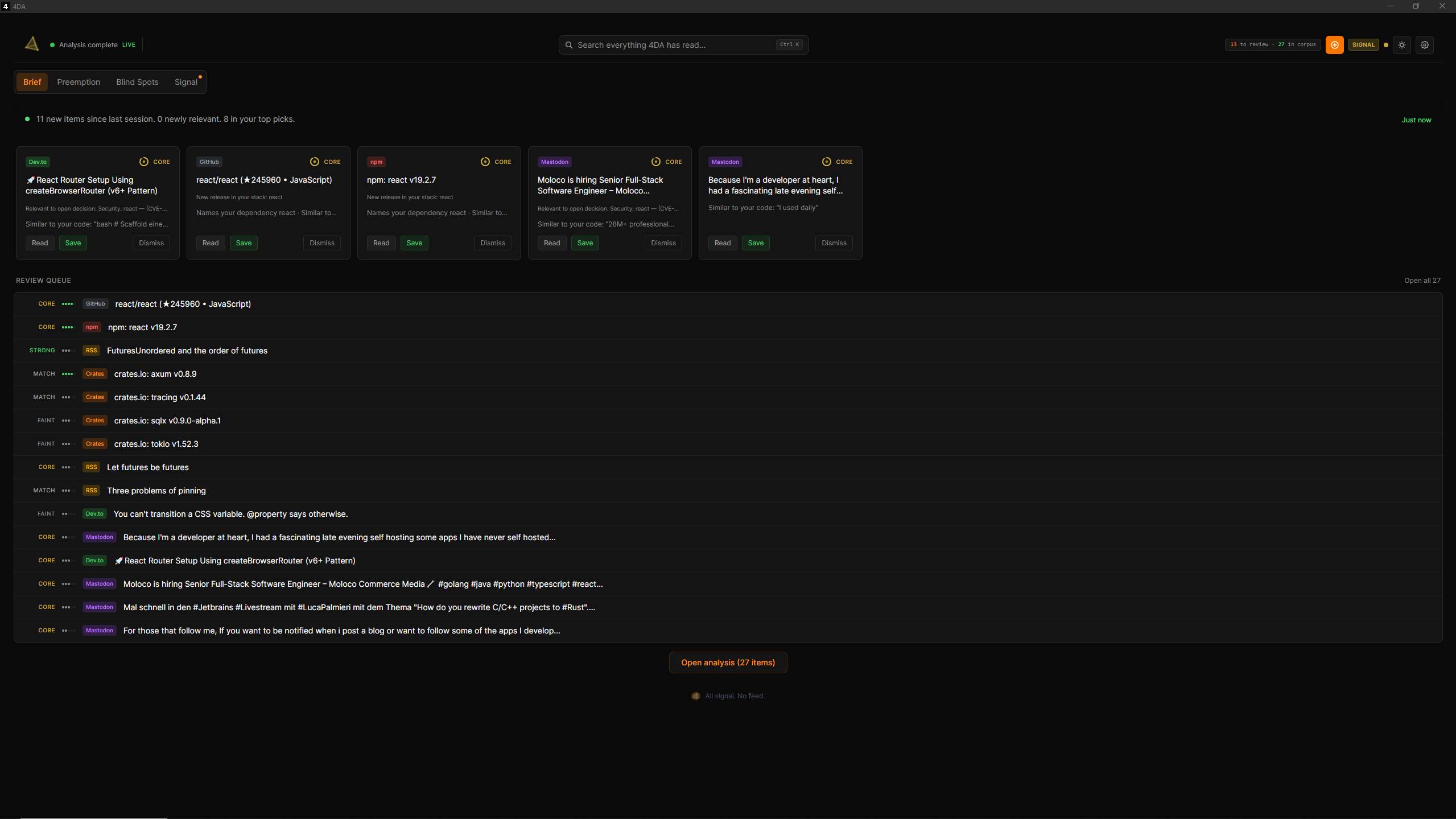
Brief — today's top picks and live signal stream scored against your stack
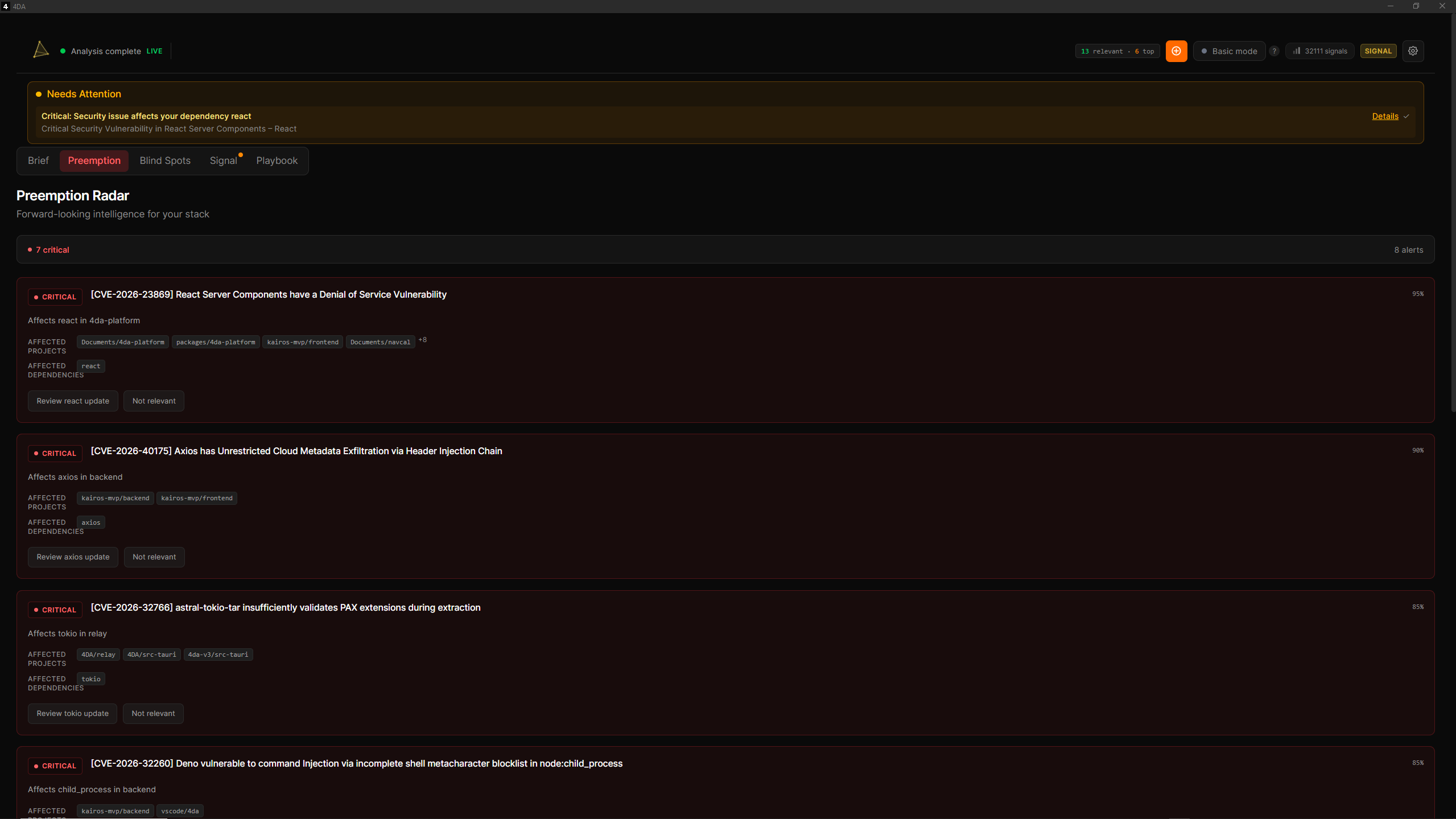
Preemption — forward-looking intelligence: CVEs, breaking changes, dependency risks
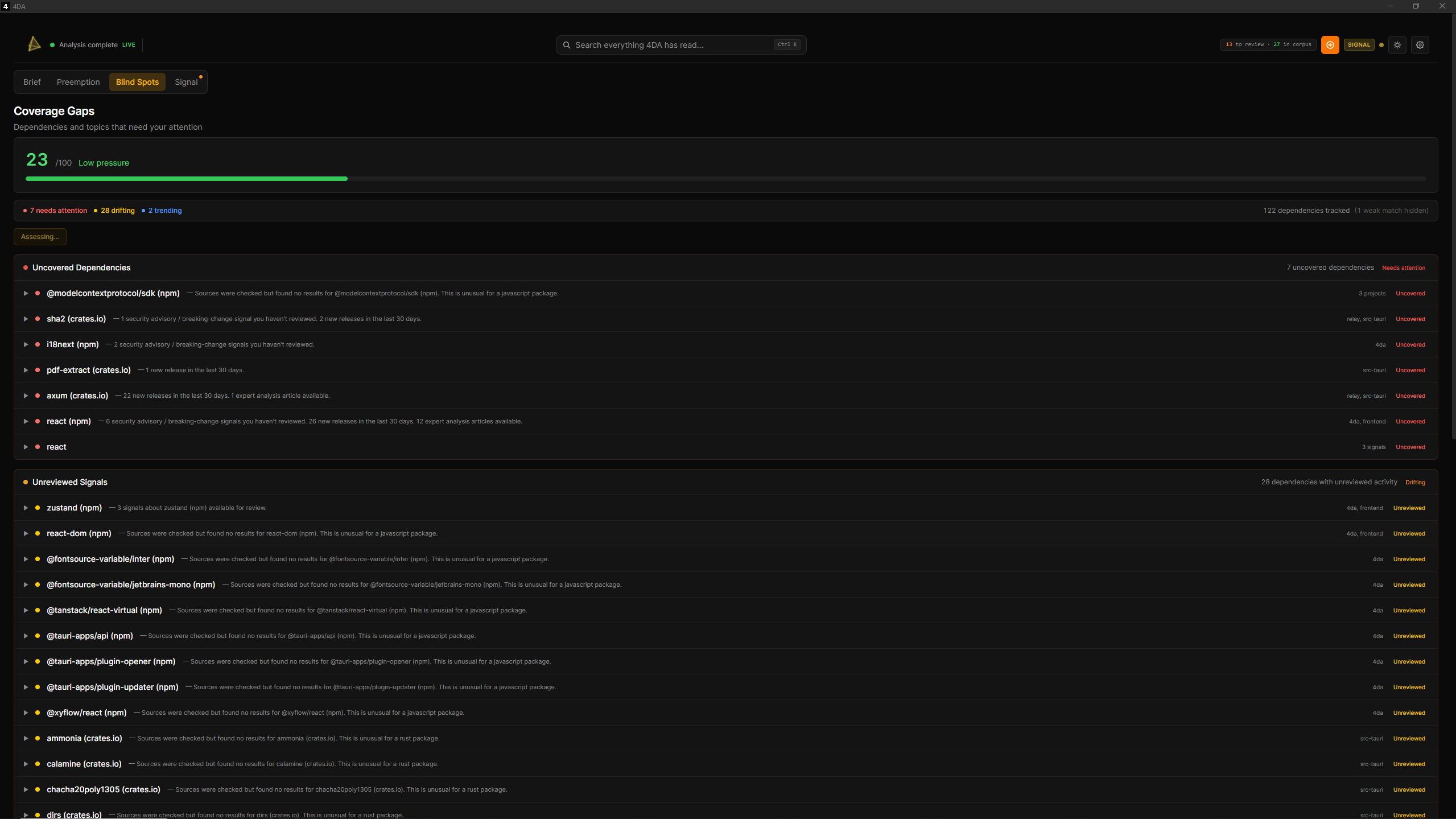
Blind Spots — coverage gaps and high-relevance items you never saw
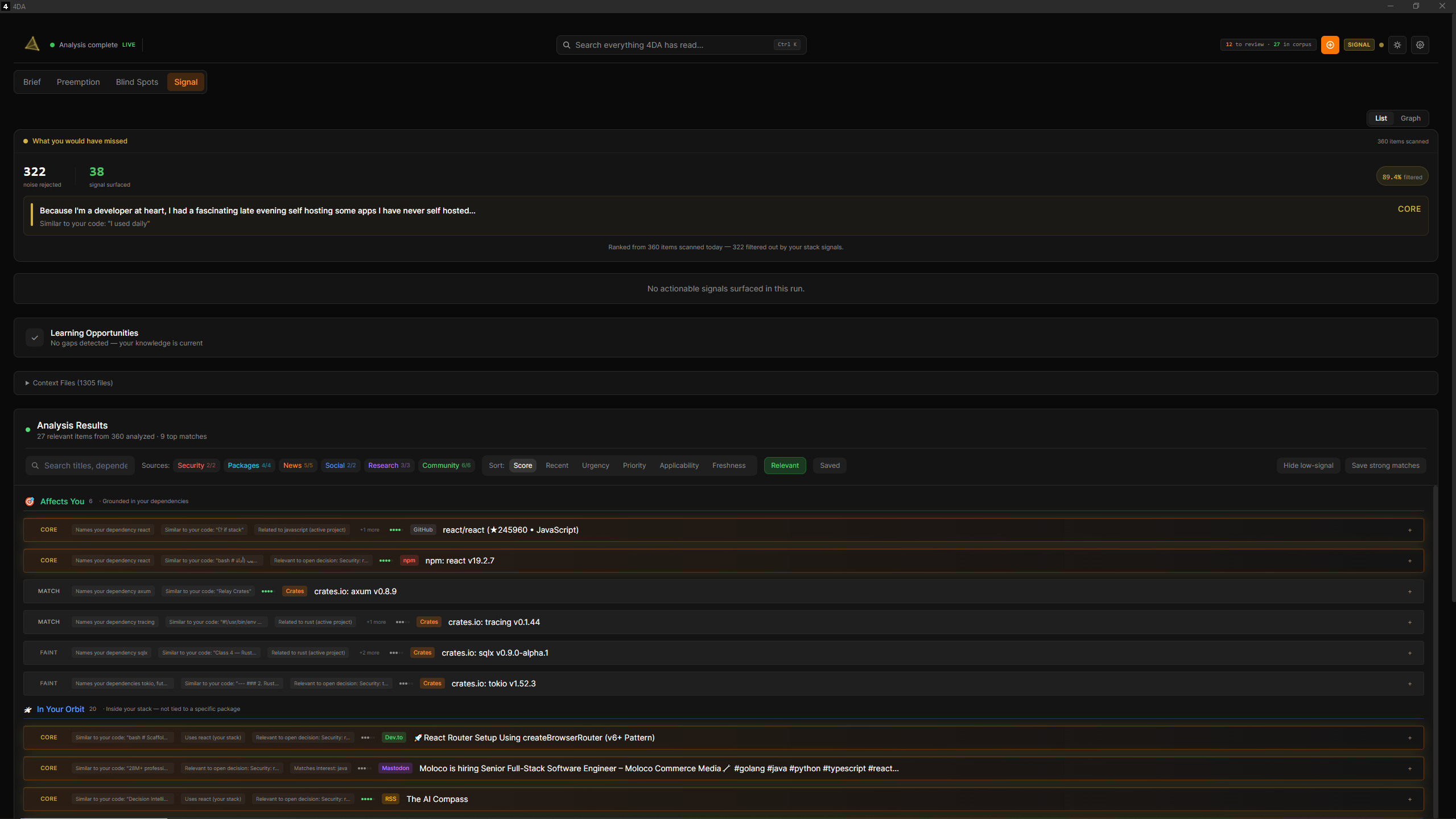
Signal — the items that earn their place, confirmed through 2+ independent axes
Development
4DA is built by a solo engineer with AI-assisted development (Claude Code), with external audits from gpt 5.4 and 5.5. The test suite (3,400+ tests across Rust and TypeScript) and CI pipeline verify correctness on every commit. The scoring algorithm is hand-designed and benchmarked against 9 developer personas with labeled test data.
pnpm tauri dev              # Dev server (localhost:4444)
cargo test                  # Rust tests (from src-tauri/)
pnpm test                   # Frontend tests
pnpm validate:all           # Full validation (lint + types + tests + build)
Benchmarks
The scoring numbers in this README are measured, not asserted — run the suite and check them yourself. The persona simulation scores a 245-item labeled corpus against 9 simulated developer personas (Rust systems, Python ML, fullstack TypeScript, DevOps/SRE, mobile, bootstrap/first-run, power user, stack switcher, niche specialist), skipping items labeled deliberately borderline, for 1,997 scored evaluations.
cd src-tauri
cargo test scoring::simulation -- --nocapture   # 9-persona simulation (the headline numbers)
cargo test scoring::benchmark -- --nocapture    # 2-profile pipeline benchmark
scoring::simulation prints a quality dashboard with the aggregate confusion matrix. On the current pipeline:
| Value | |
|---|---|
| Corpus | 245 labeled items, 9 personas, 1,997 scored evaluations (2,205 pairs less the deliberately-borderline ones) |
| Confusion matrix | TP 119 · FP 19 · TN 1,646 · FN 213 |
Rejection rate (TN+FN)/total | 93.1% |
Noise accuracy TN/(TN+FP) | 98.9% |
Precision TP/(TP+FP) | 86.2% |
Recall TP/(TP+FN) | 35.8% |
Recall is low by design: roughly 70% of the "relevant" denominator is tangential/adjacency content a precision-first brief is meant to drop. The load-bearing figure is recall on items labeled strongly relevant — security advisories and releases for declared dependencies — which is 71.3% (72/101) and is reported separately by the same suite.
What CI enforces is a floor, not the headline. The suite asserts aggregate precision >= 0.70, aggregate F1 >= 0.40, and noise rejection >= 80% for every one of the 9 personas; a regression past any of those fails the build. The percentages above are the measured values on top of those floors, so re-run the command against whatever revision you have checked out rather than trusting this table.
Source: src-tauri/src/scoring/simulation/ (corpus, persona definitions, domain embeddings, enrichment data) and src-tauri/src/scoring/benchmark.rs.
License
FSL-1.1-Apache-2.0 — source available. Free to use, inspect, and modify for any purpose except building a competing product. Every release converts to Apache 2.0 three years after publication — after that, no restrictions at all.
4DA — 4 Dimensional Autonomy
All signal. No feed.
"4DA" and the 4DA logo are trademarks of 4DA Systems Pty Ltd (ACN 696 078 841). The FSL-1.1-Apache-2.0 license does not grant rights to use these trademarks.