
AI Dimag — Verified Memory for AI Coding Agents
Your codebase remembers its decisions, conventions, and rules — and proves they're still true.










What is AI Dimag?
AI Dimag is a memory system for software engineering — not a general-purpose "AI memory" app. It gives any MCP-compatible agent (Claude, Cursor, Copilot, Windsurf…) a persistent memory of your codebase that survives across sessions — decisions, conventions, gotchas, failed approaches, guardrails, and reusable skills — stored as falsifiable claims with grounding evidence in .aidimag/ next to your code.
The subject of memory is your repository, not your preferences or chat history. Every capability — evidence, git-hook verification, guardrails, pre-commit checks, path-scoped recall, session scratchpad — exists to serve day-to-day development work.
🎯 The Difference: Claim-and-Verify, Not Store-and-Retrieve
Most memory systems store text and retrieve whatever is similar later — a stored fact is assumed true forever. That's dangerous in a codebase, where a confidently-retrieved stale fact is worse than no memory at all.
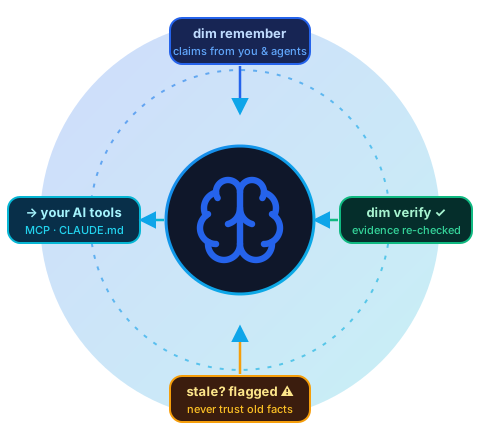
Every AI Dimag memory carries evidence (a shell check, an anchored commit, a test) that dim verify re-runs against the current repo — automatically, via git hooks, on every pull, checkout, and rebase. Beliefs that stop being true go STALE instead of silently misleading your AI.
✨ Works with Every AI Tool
- MCP tools (Claude, Cursor, etc.) get real-time memory via the MCP server
- Non-MCP tools (Copilot, Windsurf, etc.) get static context files (
.cursorrules,CLAUDE.md,AGENTS.md, etc.)
Install
npm install -g aidimag
Requires Node 22+. Ships two equivalent binaries: dim (short) and aidimag.
🚀 Quick Start
cd your-repo
dim init                    # creates .aidimag/, installs additive git hooks
dim bootstrap               # optional: LLM-survey the repo into a starter memory set
dim review                  # approve what enters memory (nothing is stored unreviewed)

dim remember "All DB access goes through src/db/store.ts" -k INVARIANT -p src/db \
  -e "STATIC_CHECK:grep -rL better-sqlite3 src --include=*.ts"
dim recall db access
dim verify                  # re-run all evidence; stale beliefs get flagged
dim brief                   # session-start briefing: in-scope memory, guardrails, gaps

# For non-MCP tools (Copilot, Cursor without MCP, etc.):
dim generate-context --format all --auto   # creates .cursorrules, CLAUDE.md, AGENTS.md, etc.
🔌 Connect to Your AI Agent (MCP)
Add to your agent config (e.g. .mcp.json for Claude Code):
{
  "mcpServers": {
    "aidimag": {
      "command": "npx",
      "args": ["-y", "aidimag", "mcp"],
      "env": { "AIDIMAG_REPO": "/path/to/your/repo" }
    }
  }
}
MCP Tools get memory_search, memory_propose, context_note (live in-chat fact capture), chat_harvest (live, tool-agnostic session harvesting with server-side secret redaction), memory_critique (a second critic grounded in verified memory), session-start briefings, session-end extraction, and more.
Non-MCP Tools: dim generate-context -f all renders verified memory into .cursorrules, CLAUDE.md, AGENTS.md, .windsurfrules, and .github/copilot-instructions.md (--auto keeps them refreshed).
Hermes Agent: dim hermes install registers aidimag as a native Hermes memory provider — one command, no pip, no venv. A single stdlib-only Python bridge delegates to the MCP server: session briefings are injected into the system prompt, recall is prefetched per turn, and session learnings become review-queue proposals (never silent writes). Then: hermes config set memory.provider aidimag.
✨ Key Features
🛡️ Human-Gated Capture
Commits, PRs, AI-chat transcripts (Claude Code, Codex, Copilot, Cursor), and pasted docs are mined into proposals. Nothing enters memory until you approve it in dim review (auto-triaged best-first, approve all --min-score 0.7 for batches).
✅ Verification Lifecycle
STATIC_CHECK / COMMIT_REF / TEST_RESULT / EXEC_TRACE / HUMAN_ATTESTED evidence. Failing evidence flips memories to STALE and auto-drafts a recovery proposal. Confidence decays without re-confirmation.
🔒 Evidence Trust Gate
Shell-command evidence that arrives via team sync is never executed until you inspect and approve it (dim verify --trust).
🔍 Hybrid Semantic Recall
FTS5 keyword + vector KNN (OpenAI, local Ollama, or AWS Bedrock; auto-detected except Bedrock, which is explicit opt-in; works keyword-only with none).
🚦 Guardrails & Skills
Behavioral rules (never / ask-first / always) and step-by-step procedures, enforced by dim check (pre-commit) and memory_critique.
👥 Team Mode, Self-Hosted
dim serve + dim sync: local-first replicas, device-code login, brain-scoped API keys, hashed credentials, cross-machine verification consensus.
📚 Knowledgebase Inbox
Drop design docs / ADRs / PDFs / DOCX into knowledge/ and they're summarized into reviewed, pinned memories.
📝 Scratchpad & Provenance Audit
dim scratch (and the scratchpad_* MCP tools) hold short-term session notes — TTL-expiring, never synced, never durable memory. dim audit lists memories resting on the weakest ground (agent-authored, evidence-free, stale, or long-unverified) so you can fix them up like a dependency audit for your repo's knowledge.
🎨 Web Dashboard & Extensions
dim ui — run checks, session briefings, bootstrap, harvest, and context generation from the browser — plus VS Code and IntelliJ extensions.
🥊 How It Compares
AI Dimag follows a claim-and-verify model; other memory systems follow store-and-retrieve. The short version:
| Conversational memory layers | Vector-store memory plugins | Hand-maintained context files | AI Dimag | |
|---|---|---|---|---|
| Built for | Chat assistants remembering users | General recall over embedded text | Static instructions for coding agents | Coding agents in a living repo |
| Unit of memory | Extracted facts / chat summaries | Embedded text chunks | Prose | Falsifiable, typed claims with evidence |
| How memory gets in | Automatic capture | Automatic embedding | Manual edits | Human-gated review queue |
| When the code changes | Nothing — stored facts stay "true" | Nothing | File silently rots | Evidence re-runs via git hooks; broken claims flip STALE |
| Trust model | Write-time label, never re-checked | Similarity ≈ trust | "It's in the file" | Verification status + decaying confidence; trust-ranked retrieval |
| Enforcement | None — injection only | None | Hope the model reads it | Guardrails + pre-commit dim check + memory_critique |
| Failure mode | Confidently recalls outdated facts | Retrieves similar, true or not | Instructions drift from reality | Says "this went STALE" instead of guessing |
Full comparison: aidimag.com/comparison
vs. named tools
How aiDimag relates to the memory tools people usually ask about. These solve a different problem (remembering users and conversations); aiDimag remembers your repository and proves its memories are still true:
| aiDimag | Mnemosyne | mem0 | Letta | Honcho | SuperMemory | Hindsight | ChromaDB | |
|---|---|---|---|---|---|---|---|---|
| Subject of memory | Your codebase | Chat/agent sessions | User & agent facts | Agent's own context | User/peer reasoning | Personal + agent | Agent memory | — (vector DB) |
| Local-first | ✅ SQLite per repo | ✅ SQLite | ⚠️ Hybrid | ❌ Docker+PG | ⚠️ PG+worker | ❌ SaaS | ✅ SQLite | ✅ Embedded |
| MCP server | ✅ Built-in | ✅ | ❌ | ❌ | ❌ | ✅ | ✅ | ❌ |
| Verifies memories against code | ✅ Evidence re-runs via git hooks | ❌ | ❌ | ❌ | ❌ | ❌ | ❌ | ❌ |
| Human-gated writes | ✅ Review queue | ❌ Auto-capture | ❌ Auto | ❌ | ❌ | ❌ | ❌ | — |
| Enforcement | ✅ Guardrails + pre-commit + critique | ❌ | ❌ | ❌ | ❌ | ❌ | ❌ | ❌ |
| Open source | ✅ MIT | ✅ MIT | ✅ Apache 2.0 | ✅ Apache 2.0 | ⚠️ AGPL | ❌ Proprietary | ✅ MIT | ✅ Apache 2.0 |
| Published benchmark | Own suite: 100% staleness detection, 0% FP | BEAM 65.2% / LongMemEval 98.9% R@All@5 (self-reported) | LoCoMo | LoCoMo 83.2% | LongMemEval 90.4% | MemoryBench 85.2% | BEAM 73.4% / LongMemEval 94.6% | — |
Chat-memory benchmarks (LoCoMo, LongMemEval, BEAM) score recall over conversation histories, so they don't apply to aiDimag — its memory subject is the repo. Instead aiDimag publishes its own reproducible suite (below), including the metric none of the chat benchmarks measure: does memory notice when the code changes?
📊 Benchmarks
Reproducible performance and quality suites live in benchmark/
(npm run bench, npm run bench:quality). Headline results (Apple M4, Node 24,
10,000-memory brain — full tables at aidimag.com/benchmarks):
| Metric | Result |
|---|---|
| FTS keyword search | 1.45ms p50 |
| Vector KNN (768-dim, sqlite-vec) | 4.15ms p50 |
| Memory writes (transactional, incl. FTS + event log) | ~5,400/s |
CLI cold start (dim --help) | ~41ms p50 |
| Staleness detection (broken claims → STALE, real git fixture) | 100% (4/4) |
| False positives (intact claims wrongly flagged) | 0% (0/4) |
| Retrieval, keyword queries (Recall@1 / MRR, FTS-only) | 1.00 / 1.00 |
| Retrieval, paraphrase queries (FTS-only; hybrid closes this gap) | 0.25 / 0.27 |
📖 Documentation
|
Getting Started |
Reference |
Guides |
Full documentation: aidimag.com
🤝 Contributing
Contributions welcome! See CONTRIBUTING.md for dev setup, project principles, and the PR checklist. All participation is governed by our Code of Conduct.
💰 License & Pricing
AI Dimag is open source under the MIT License — free for everyone, any team size, forever. Use it, fork it, embed it.
The entire local-first product is free: CLI, MCP server, verification, guardrails, skills, IDE extensions, local dashboard, and self-hosted team sync (dim serve).
Want team sync without running a server? AI Dimag Cloud is an optional managed sync subscription — that's how the project stays funded and open source. See Pricing.
Built by Anup Khanal
Website • Documentation • Cloud • npm • License