pexafy-mcp


Stock photo search for AI assistants. An MCP server that lets Claude, ChatGPT or any MCP client search a library of royalty-free images — by describing a scene in plain language, from an example image, or "more like this" — and render the results as a thumbnail grid inside the conversation.
Remote MCP, OAuth, no API key to paste, 3 tools, images rendered inline.
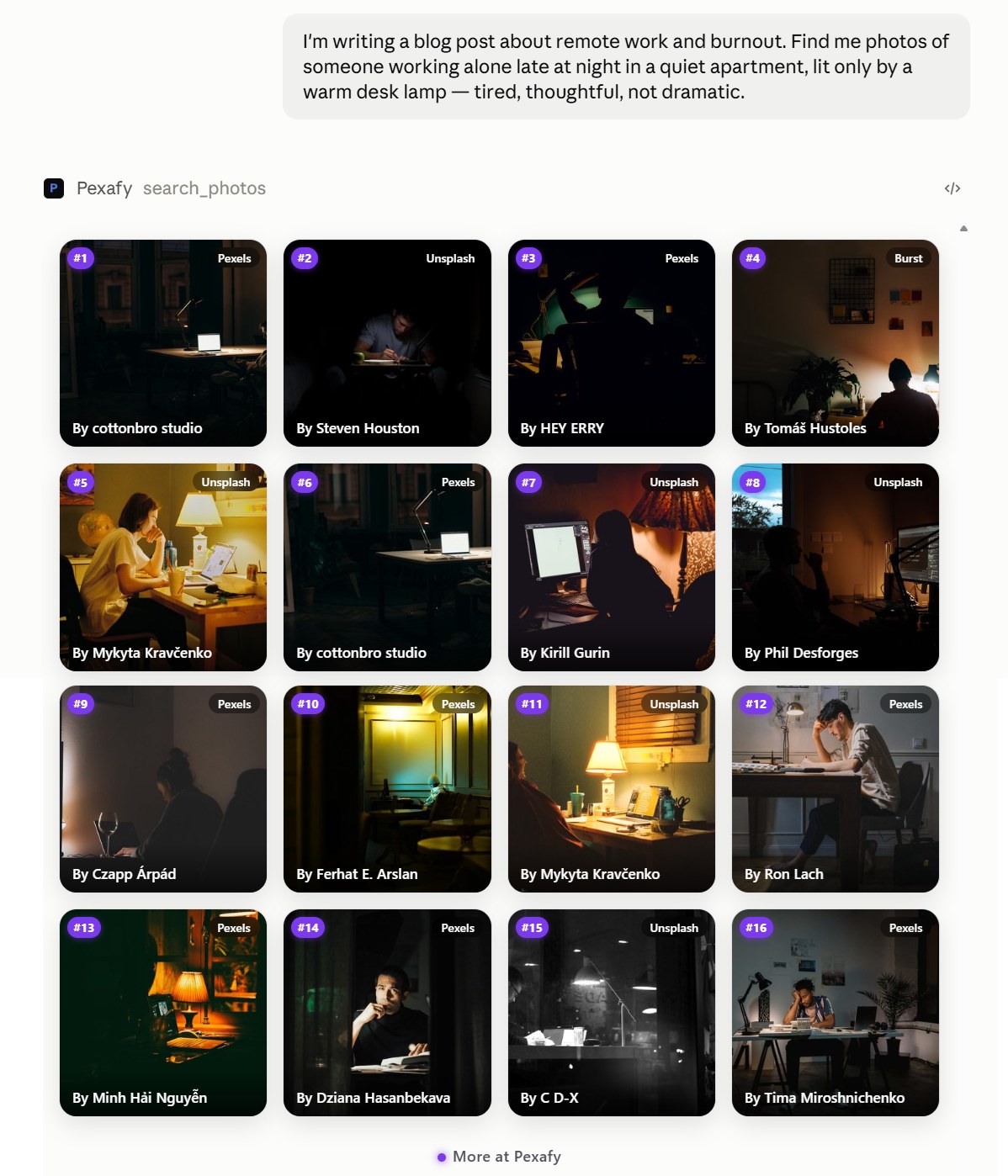
Use it (nothing to install)
A hosted server runs at:
https://mcp.pexafy.com/mcp
It speaks Streamable HTTP and authenticates with OAuth 2.1 — you sign in to Pexafy in a browser window and the connector receives its own credentials. There is no API key to generate, paste into a JSON file, or rotate later.
Claude (web and desktop)
- Open Settings → Connectors (on Team/Enterprise, an owner adds it once under Organization settings → Connectors).
- Click Add custom connector.
- Paste
https://mcp.pexafy.com/mcpand confirm. - Sign in to Pexafy in the window that opens. Done — ask Claude for a photo.
Claude Code
claude mcp add --transport http pexafy https://mcp.pexafy.com/mcp
Any other MCP client
Point it at the same URL with the streamable-http transport. Clients that don't
implement OAuth can authenticate instead with a Pexafy API key sent as
Authorization: Bearer <key> or x-api-key: <key> — get one from the
dashboard.
Liveness: GET /health (public, no auth).
What it costs
The Free plan covers 5,000 searches a month with one connector — enough for regular use, no card required. Higher tiers are on the pricing page. When you hit a limit, the assistant tells you in-chat instead of failing with an opaque error.
Tools
Three read-only tools. No write scope, no account mutation.
search_photos — semantic text search
Describe the scene in a full sentence; Pexafy is semantic, so sentences beat
keywords. All parameters are optional, but pass either q or at least one filter.
| Parameter | Type | Notes |
|---|---|---|
q | string | The scene, in natural language. Max 500 characters. |
color_name | string | One of: red, orange, yellow, green, blue, purple, pink, brown, black, white, gray, teal, beige, gold, navy. Excludes color_hex. |
color_hex | string | e.g. #1E90FF. Excludes color_name. |
color_tolerance | integer | 0 (exact) to 255 (loose). Default 20. Only with color_hex. |
orientation | string[] | landscape, portrait, square. |
source | string[] | Unsplash, Pexels, Pixabay, Kaboompics, Burst, StockSnap, Picjumbo, Skitterphoto, NegativeSpace. |
license_type | string[] | free, cc0. |
photographer | string | Exact username. |
after_date | string | YYYY-MM-DD. Published on or after. |
cursor | string | pagination.next_cursor from a previous response. |
search_photos_by_image — visual search from an example
Finds photos that look like a reference image, optionally tweaked in words ("like this, but at night").
| Parameter | Type | Notes |
|---|---|---|
image_url | string | Public http(s) URL of the reference image. |
image_file | object | Auto-filled by hosts that support uploads (e.g. ChatGPT). |
image_base64 | string | Raw base64 bytes, for programmatic clients. |
q | string | Text to combine with the image ("but with hands raised"). |
text_alpha | number | Weight of q against the image. |
orientation, source, color_name, license_type, photographer, after_date | string | Same filters as above. |
cursor | string | Pagination token. |
One of image_url, image_file or image_base64 is required. Images are fetched
server-side; max 20 MB.
get_similar_photos — more like this
| Parameter | Type | Notes |
|---|---|---|
photo_id | string | Required. A photo's UUID, taken from a previous result. |
cursor | string | Pagination token. |
What comes back
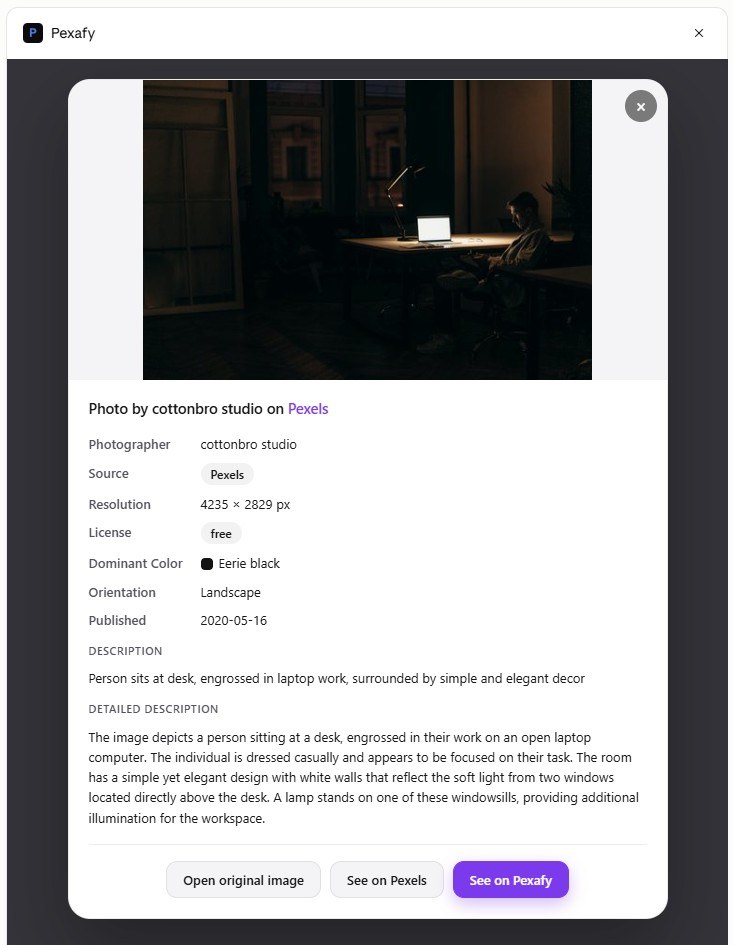
Every photo carries its id, URLs at several sizes, dimensions, dominant colour,
orientation, source, licence, photographer, and an attribution string to display
as credit — enough for the assistant to reason about the results rather than just
list them.
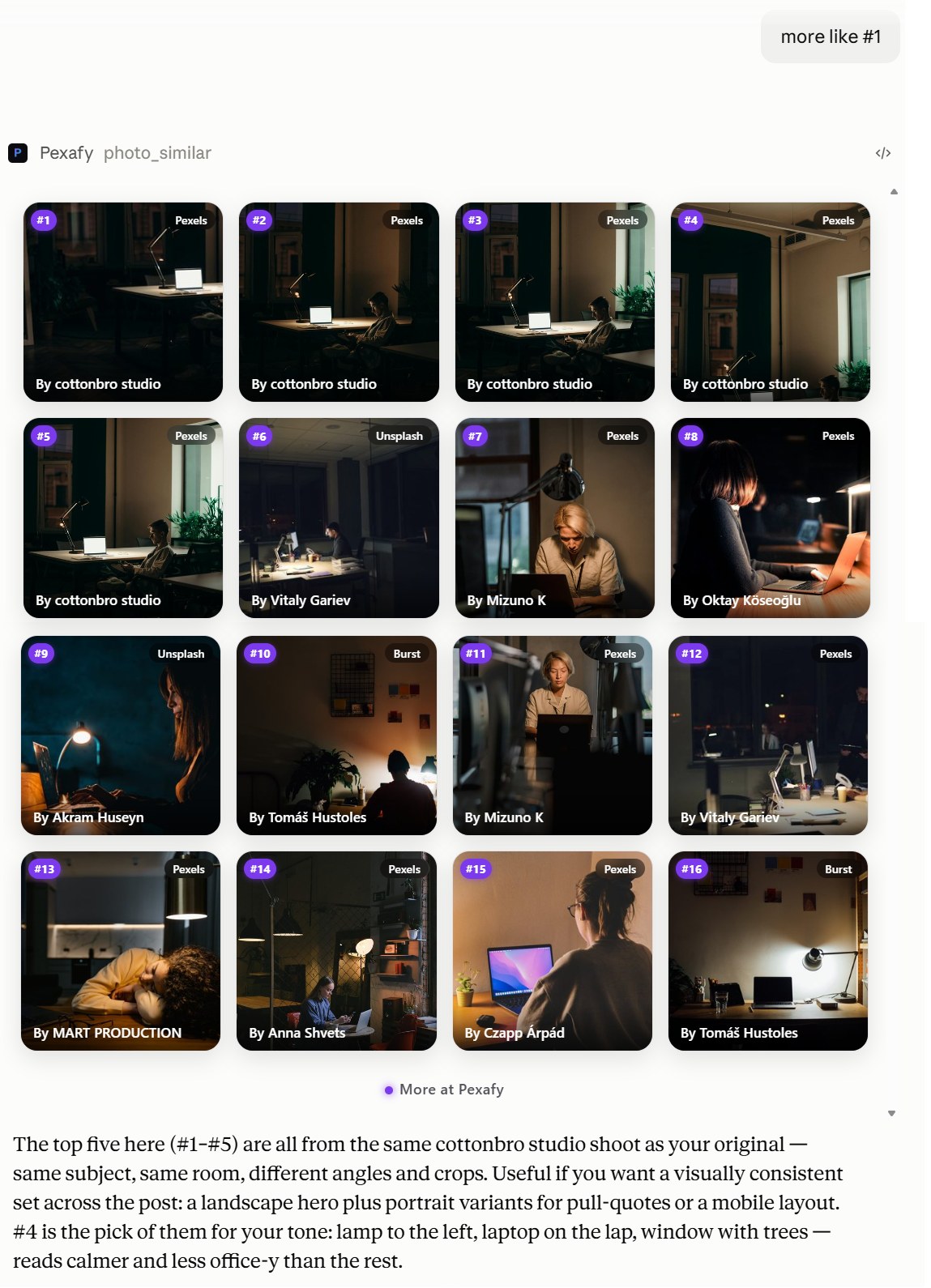
Results are numbered #1, #2, …, so you refer to a photo the way you would in
conversation. No ids to copy around:
In clients that support MCP Apps, clicking a thumbnail opens a detail panel with the full metadata — no extra call, it is all in the tool result already:
Self-host
You don't need to — the hosted server above is the intended way in. But the server is a thin, plain client of the Pexafy API, so you can run your own against your own key.
Requires Python 3.12+.
git clone https://github.com/Pexafy/pexafy-mcp.git && cd pexafy-mcp
./run.sh setup        # venv + editable install + seed .env
# edit .env — set PEXAFY_API_KEY
./run.sh dev          # stdio, for Claude Desktop / Claude Code
With the installed console script (pip install .):
pexafy-mcp                             # stdio (default)
PEXAFY_MCP_TRANSPORT=http pexafy-mcp   # remote Streamable HTTP
Claude Desktop / Claude Code, over stdio:
{
  "mcpServers": {
    "pexafy": {
      "command": "pexafy-mcp",
      "env": { "PEXAFY_API_KEY": "pexafy_api_…" }
    }
  }
}
Docker, over HTTP — see docker-compose.example.yml:
docker compose -f docker-compose.example.yml up -d
curl localhost:8765/health
The image itself defaults to stdio, the transport an MCP client uses to drive a container, so it also works directly:
docker run -i --rm pexafy-mcp
That answers initialize and tools/list with no API key and no network — the
tools come from the vendored OpenAPI snapshot. A key is only needed to run a search.
Serving over HTTP is a matter of setting the transport, which both compose files do.
Configuration
Everything is environment variables — see .env.example.
| Variable | Default | Purpose |
|---|---|---|
PEXAFY_API_BASE_URL | http://localhost:8000 | Pexafy API root |
PEXAFY_API_KEY | — | Fallback key (stdio/dev) |
PEXAFY_MCP_TRANSPORT | stdio | stdio or http |
PEXAFY_THUMB_BASE_URL / PEXAFY_THUMB_HMAC_SECRET | — | Enable the inline grid (signed thumbnails) |
PEXAFY_OAUTH_* / MCP_RESOLVE_SECRET | — | Per-user OAuth (HTTP only) |
How it works
src/pexafy_mcp/
├── server.py     # entry point: builds the server, wires hooks, custom tools, /health
├── tooling.py    # tunes the OpenAPI-derived tools for an LLM (descriptions, value sets)
├── widget.py     # MCP Apps UI resource — the inline result grid (self-contained HTML)
├── previews.py   # signs the thumbnail URLs injected into each result
├── limits.py     # turns plan-limit (429) responses into in-chat upgrade nudges
├── auth.py       # per-user auth: OAuth Resource Server or forwarded API key
└── assets/       # vendored, shipped with the package:
    ├── openapi.json          # OpenAPI snapshot the tools are generated from
    ├── facets.json           # evolving source/license value sets
    └── ext_apps_bundle.js    # @modelcontextprotocol/ext-apps SDK (inlined in the widget)
- The tools are generated from the Pexafy OpenAPI spec via
FastMCP.from_openapi(), so the API stays the single source of truth;tooling.pythen reshapes them for an LLM — narrowing the surface to the search core, dropping parameters that mislead a model, and inlining the closed value sets so no facet lookup is ever needed. build_server()assembles everything. Importing the package has no side effects and does no network I/O: it reads the vendoredassets/openapi.jsonandassets/facets.json.prepare.shregenerates those.search_photos_by_imageis hand-written: a chat assistant cannot upload a binary file to an MCP tool, so the tool takes an image URL and fetches it server-side.- The inline grid is an MCP Apps UI resource. The ext-apps client is bundled and inlined, because the host's sandboxed iframe cannot fetch external scripts at runtime.
Development
./run.sh test         # offline test suite (pytest)
./run.sh inspect      # MCP Inspector
./prepare.sh          # maintainers: regenerate the vendored assets/
Contributions welcome — see CONTRIBUTING.md.
License
MIT — see LICENSE.
The package also redistributes third-party assets (the Inter typeface, the
@modelcontextprotocol/ext-apps browser bundle and the libraries bundled into it),
each under its own licence — see THIRD_PARTY_NOTICES.md.