Put your AI agent's slow work on the back burner. Keep cooking.
Background tasks for AI agents that outlive the conversation — start a long job, close the client, and the result is still waiting when you come back.
Durable & Restart-Proof ◦ Zero Infrastructure ◦ MCP Tasks (2026-07-28) ◦ Windows & Unix
📦 PyPI • 🗂️ MCP Registry • 🐛 Issues • 📄 MIT
📢 Updates
- v1.0 — implements the official MCP Tasks extension
(SEP-2663,
io.modelcontextprotocol/tasks). A Tasks-capable client can turn astart_taskcall into a durable task and drive it withtasks/get,tasks/update, andtasks/cancel— the standard async-job protocol — while the five plain tools keep working for every other client. Built against the 2026-07-28 spec (mcp2.0). - v0.2.1 — output with non-ASCII characters (✓, emoji, any non-English text) no longer crashes tasks on Windows.
- v0.2.0 —
exit_codeis no longer reported for cancelled/timed-out tasks (it was an artifact of the kill, not a real result); new animated demo below. - v0.1.x — first release: 5 tools, task timeouts, command allow/deny policy.
Listed on the official MCP Registry as
io.github.RohitYajee8076/backburner.
backburner is an MCP server that gives any AI assistant — Claude, ChatGPT,
Gemini, GitHub Copilot, Cursor, and any other MCP client — the ability to run
long shell commands as background tasks — start a test suite, a build, a
scrape, a batch job — then keep working and check back for the results, instead
of sitting frozen until it finishes.
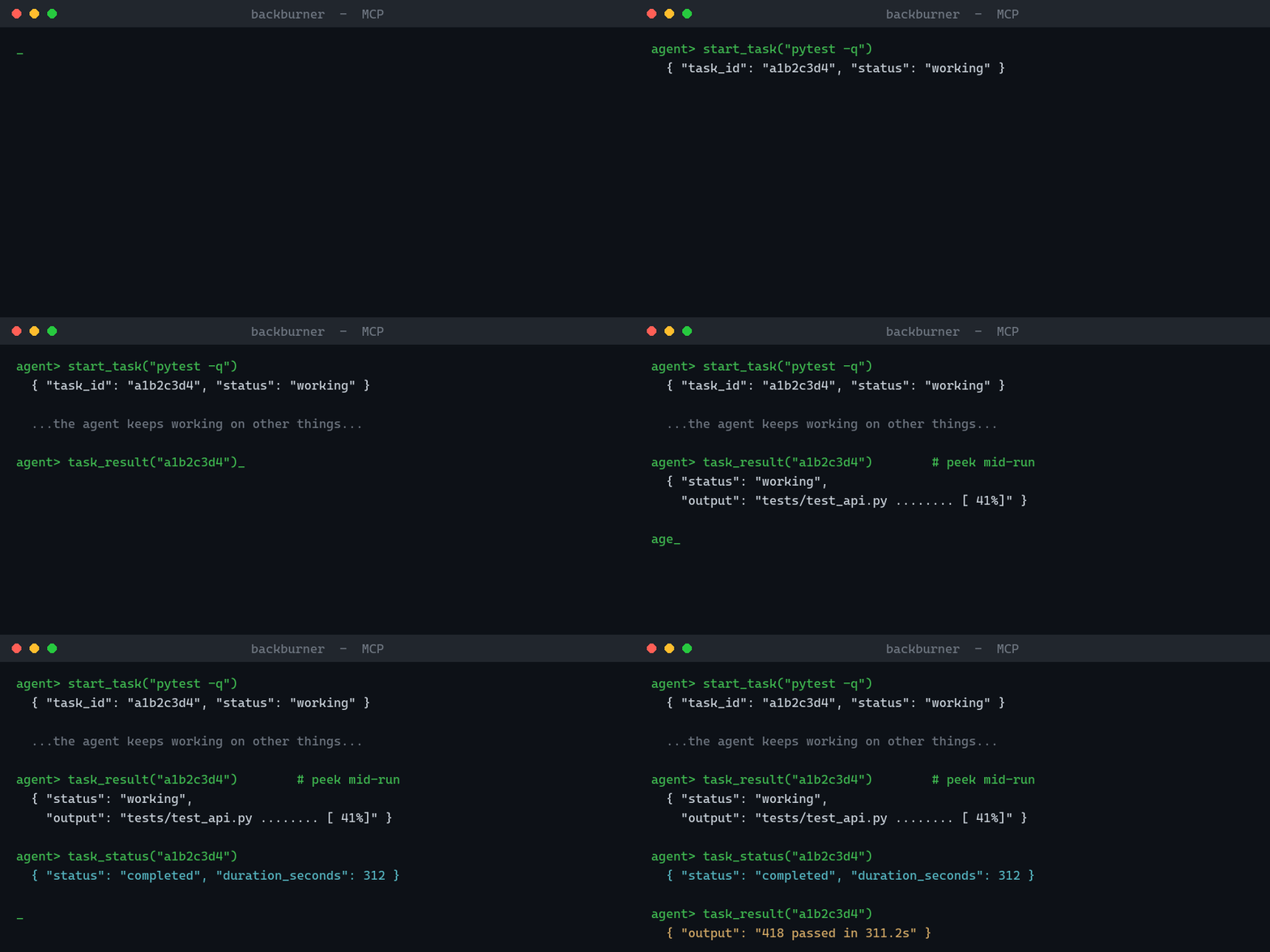
🔥 Why not just use my client's built-in background mode?
Because that lives inside the conversation — it disappears the moment the session ends. Close the chat, restart the client, reboot the laptop, and any in-session background work (and its output) is gone.
backburner keeps every task and its full output on disk (SQLite +
per-task log files under ~/.backburner/), so your work outlives the session
that started it:
- Start now, collect later — even in a different chat. A task you launch today is still listed, with its result, in a brand-new session tomorrow.
- Restart-proof. State survives the server, the client, and the machine
restarting. Finished tasks keep their output; a task cut off by a crash is
honestly marked
interrupted, never silently dropped. - No waiting, no blocking. A 10-minute tool call no longer freezes the conversation or times out and loses the work.
See it for yourself — a real two-process proof (no mock-ups):
python docs/demo_restart.py
It starts a job in one process, exits, then a separate process — which never saw the task id — finds the finished work waiting on disk.
Built on the MCP Tasks pattern, formalized in the 2026-07-28 spec release
(SEP-2663):
backburner speaks it natively (tasks/get / tasks/update / tasks/cancel)
and exposes the same engine as plain tools, so it works with every client
today.
🧰 Tools
| Tool | What it does |
|---|---|
start_task(command, cwd?, timeout_seconds?) | Run a shell command in the background, returns a task id immediately |
task_status(task_id) | working / completed / failed / cancelled / timed_out / interrupted |
task_result(task_id, tail_lines?) | Captured output — works mid-run too, so you can peek at progress |
cancel_task(task_id) | Kill the task and its whole process tree |
list_tasks(limit?) | Recent tasks, newest first |
✨ Features
-
Survives restarts — tasks are tracked in SQLite under
~/.backburner/; output is captured to per-task log files. If the server dies mid-task, orphaned tasks are honestly markedinterrupted, never silently lost. -
Real cancellation — kills the full process tree (worker processes included), on Windows and Unix.
-
Peek at live progress —
task_resulton a running task returns the output so far. -
Timeouts — pass
timeout_secondsand a runaway task is killed and honestly markedtimed_outinstead of hanging forever. -
Command policy — restrict what the AI may run with environment variables (regexes, comma-separated; deny always wins):
BACKBURNER_ALLOW="^pytest,^npm (test|run build)" # only these may run BACKBURNER_DENY="rm -rf,shutdown,format" # these never run -
Zero infrastructure — stdlib only (SQLite, subprocess, threads). No Redis, no Celery, no Docker.
-
Tested — a pytest suite covers the full job lifecycle: completion, failure, cancellation, timeouts, crash recovery, and the command policy.
🚀 Install
backburner is a standard stdio MCP server — it works with any MCP-compatible
client, including:
Claude Code · Claude Desktop · OpenAI (ChatGPT desktop / Agents SDK) · Google Gemini (Gemini CLI) · GitHub Copilot (VS Code) · Cursor · Windsurf · Cline · Zed — and any other client that speaks MCP.
First install the package:
pip install backburner-mcp
Claude Code
claude mcp add backburner -- python -m backburner.server
Everything else (Claude Desktop, Cursor, VS Code / Copilot, Windsurf, Gemini CLI, …)
Most clients use the same standard config block — add backburner to your
client's MCP config (see your client's docs for where that file lives):
{
  "mcpServers": {
    "backburner": {
      "command": "python",
      "args": ["-m", "backburner.server"]
    }
  }
}
🔒 Security note
backburner executes the shell commands the AI sends it, with your user's
permissions. That is its job — but treat it like giving your agent a
terminal. Run it only with clients whose tool-use you review/approve,
prefer permission modes that require confirmation for start_task, and
use BACKBURNER_ALLOW / BACKBURNER_DENY to scope what may run.
🗺️ Roadmap
- Task timeouts and max-runtime limits
- Allowlist/denylist for commands
- PyPI release —
pip install backburner-mcp - Listed on the official MCP Registry
- MCP Tasks extension (spec 2026-07-28, SEP-2663) — native
tasks/get/tasks/update/tasks/cancelalongside the plain tools - Task push updates (
notifications/tasks) — live status without polling - Local web dashboard — watch tasks live in the browser
- Structured progress reporting (parse % / step markers from output)
📄 License
MIT