compound-workflows
Fork of Every's compound-engineering for Claude Code. Longer sessions without context exhaustion, session recovery when things go wrong, task tracking that survives compaction, multi-model red team (PAL + Claude), fewer plan iterations, and memory that persists across sessions.
- What is Compound Engineering?
- Why Fork?
- What's Different
- Install
- Update
- Commands
- Dependencies
- Key Concept: Disk-Persisted Agents
- Roadmap
- Attribution
What is Compound Engineering?
Compound engineering is a methodology where each unit of engineering work makes subsequent units easier. You document solutions, capture decisions with their rationale, and build institutional knowledge that compounds over time.
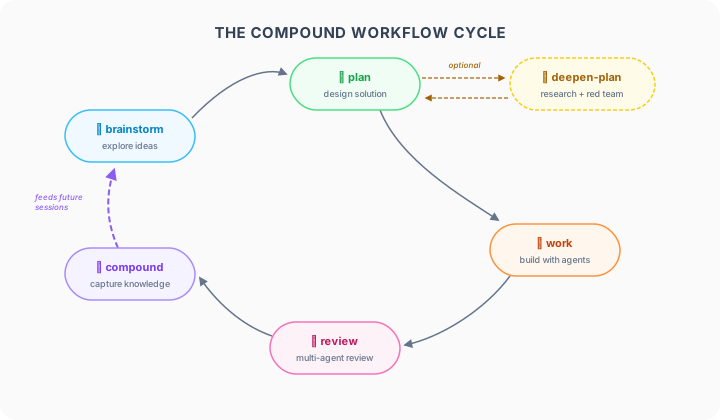
Compound workflows generalize this idea beyond software engineering to all knowledge work — an opinionated way to use Claude Code for research, planning, decision-making, and implementation. The cycle remains the same: brainstorm → plan → work → review → compound.
The plugin captures best-practice patterns and makes them shareable, while remaining configurable to individual user preferences.
Why Fork?
Ambitious tasks in Claude Code hit walls:
- Context exhaustion — Agent outputs fill up context and trigger compaction. → Agents write to disk and return summaries, so sessions last longer.
- State loss — Work progress disappears on compaction.
→
/compact-prepand/recoverhandle planned and unplanned session boundaries; beads tracking survives across compactions. - Plan iteration overhead — Plans require many rounds to reach quality. → Readiness checks and consolidation catch issues earlier, preventing the fix-introduces-new-bug cycle.
- Single-model blind spots — One model can't catch its own assumptions. → Red team challenges from multiple providers (Gemini, OpenAI, Claude) surface what a single model misses.
- Knowledge loss — Context learned in one session is gone in the next. → Tiered memory management promotes frequently-used knowledge to where it's auto-loaded.
What's Different
| compound-engineering | compound-workflows | |
|---|---|---|
| Agent outputs | In-context (fills up) | Sessions last longer — agents write to disk, not context |
| Plan quality | Unbounded iteration | Plans reach quality faster — readiness checks and auto-consolidation catch issues early |
| Red team | Single model | 3 models in parallel surface what a single model misses |
| Task tracking | TodoWrite only | Survives compaction — beads preferred, TodoWrite fallback |
| Session recovery | Manual | /do:compact-prep (proactive) + /recover (reactive) |
| Memory management | None | What you learn in one session carries to the next (in progress) |
| Process analysis | None | See where your time goes and which tasks take longer than expected |
Install
/plugin marketplace add adamfeldman/compound-workflows
/plugin install compound-workflows
Warning: Do not install alongside compound-engineering. This plugin bundles all agents and skills. Installing both will cause agent name conflicts. Run
/do:setupto detect and resolve conflicts.
Then run setup to detect your environment:
/do:setup
Update
From your terminal:
claude plugin update compound-workflows@compound-workflows-marketplace
Or use the interactive /plugin menu inside Claude Code.
Commands
| Command | Purpose |
|---|---|
/do:setup | Detect environment, configure directories, recommend enhancements |
/do:brainstorm | Explore requirements through collaborative dialogue |
/do:plan | Transform ideas into implementation plans with research agents |
/do:deepen-plan | Enhance plans with parallel multi-model research + red-team challenges |
/do:work | Execute plans autonomously with progress tracking |
/do:review | Multi-agent code review from multiple perspectives |
/do:compound | Document solved problems to build institutional knowledge |
/do:compact-prep | Save your work before compaction — checklist for memory, commits, and resume |
/do:abandon | Session-end capture without resumption |
/compound-workflows:recover | Recover context from dead/exhausted sessions via JSONL log parsing |
/compound:*aliases still work during the v3.0 transition period.
Workflow Cycle
brainstorm -> plan -> [deepen-plan] -> work -> review -> compound
Each step produces documents that feed the next. Solutions feed future brainstorms.
Session Recovery
Context exhaustion is inevitable in long sessions. Two paths:
- Proactive:
/do:compact-prepbefore/compact— saves memory, checks for uncommitted work, queues a resume task. Say "resume" after compaction. - Ending a session:
/do:abandon— captures memory, compounds learnings, commits, and pushes without queuing a resume task. - Reactive:
/compound-workflows:recoverwhen a session dies without compaction — parses the JSONL session log, cross-references git/beads/.workflows/plan state to reconstruct progress and extract what would otherwise be lost.
Dependencies
| Tool | Required? | What it enables |
|---|---|---|
beads (bd) | Recommended | Compaction-safe task tracking |
| PAL MCP | Optional | Multi-model red team — dispatches to Gemini, OpenAI, and other providers. Also supports file-aware review via Gemini CLI and Codex CLI. |
GitHub CLI (gh) | Optional | PR creation in work/review |
Without beads: TodoWrite fallback (loses state on compaction). Without PAL: Claude-only subagent fallback (single model).
Key Concept: Disk-Persisted Agents
Instead of agents returning full results into conversation context (which fills up and compacts), every agent writes findings to .workflows/ and returns only a 2-3 sentence summary.
- Context stays lean — run 15+ agents without exhaustion
- Research survives — files persist across sessions and compactions
- Traceability — see exactly what informed each decision
- Recovery — disk files + beads = full recovery after compaction
Stats & Analysis
The plugin automatically collects per-dispatch timing and token data across all
workflows. All data stays local on your machine in .workflows/stats/ — nothing
is sent externally. This enables:
- Estimation calibration — compare estimated vs actual time, segmented by type, priority, scope, and size. Discover which kinds of work consistently blow estimates and apply correction factors.
- Workflow-level timing — see how long each workflow step takes you, so you know where your time goes.
- Model routing — see which steps need the most capable model and which can run cheaper, so you spend quota where it matters.
- Velocity tracking — beads/hour trend over time, correlated with workflow maturity.
- Outcome correlation — because beads track tangible goals, time and token data connects back to actual deliverables, not just activity.
- Deep insights — mine Claude Code's session logs to understand compaction overhead, quota consumption patterns, and what's actually driving cost.
Run /compound-workflows:classify-stats to add complexity labels to collected data.
/do:analyze-stats (coming soon) will run the full analysis and present findings interactively.
Roadmap
| Priority | Feature | Description | Done | Next | Target |
|---|---|---|---|---|---|
| P1 | Quota optimization | Sonnet for research agents, relay wrappers | Released | — | v2.0 |
| P1 | Per-agent token tracking | Stats capture across all workflows | Released | — | v2.3 |
| P1 | Sonnet work subagents | Route mechanical work steps to Sonnet, save quota for judgment | Data collected | Brainstorm | — |
| P1 | Harden commands for Sonnet | Structural robustness so cheaper models follow instructions | — | Brainstorm | — |
| P2 | Workflow prompt optimization | Extend compact-prep's batch pattern to /do:work — where 43% of confirmation wait time concentrates | Phase 5 data | Brainstorm | — |
| P2 | Session analysis phase 6 | Hook audit, classification analysis, cache cost splits, effort dimension | Phase 5 done | Plan | — |
| P1 | Memory skill integration | Memory management with cleanup emphasis | Plan | Deepen | — |
| P2 | Plugin handbook | User-facing docs: getting-started, commands, config, architecture | Brainstorm | Plan | — |
| P2 | Correction-capture skill | Guide turning one-time corrections into durable rules | — | Brainstorm | — |
| P3 | Red team model selection | Configurable model routing for multi-provider challenges | Brainstorm | Plan | — |
| P3 | /do:analyze-stats | Run analysis on collected data and present findings interactively | Script built | Skill wrapper | — |
| P3 | macOS notifications | Native alerts for permission prompts and tool failures | Built | Plugin-ize | — |
| P3 | Live estimation | Workflows show estimated time remaining as they progress | Data collected | Brainstorm | — |
| — | /do:abandon | Session-end capture without resumption | Released | — | v3.1 |
Attribution
Includes agents and skills forked from Every's compound engineering plugin (MIT). The brainstorm-plan-work-review-compound cycle, agent-based review architecture, and knowledge compounding philosophy originate from that project. See NOTICE and FORK-MANIFEST.yaml for provenance.