┌─┐ ┬ ┬ ┌┬┐ ┌─┐ ┬   ┌─┐ ┌─┐ ┌─┐
├─┤ │ │  │  │ │ │   │ │ │ │ ├─┘
┴ ┴ └─┘  ┴  └─┘ ┴─┘ └─┘ └─┘ ┴
∞
Labelled GitHub issues in. Gated, independently reviewed PRs out.




A standing, self-prompting development loop for Claude Code, Codex CLI, and opencode.
Autoloop turns a maintainer-approved queue into small, reviewable pull requests. One supported
host session acts as the orchestrator: it verifies the issue, writes the plan, sends the plan
to an independent reviewer, gives the reviewed plan to a fresh implementer, simplifies and
reviews the diff, gets a fresh code review, runs the repository's objective gate, and opens a
ready PR carrying Closes #N.
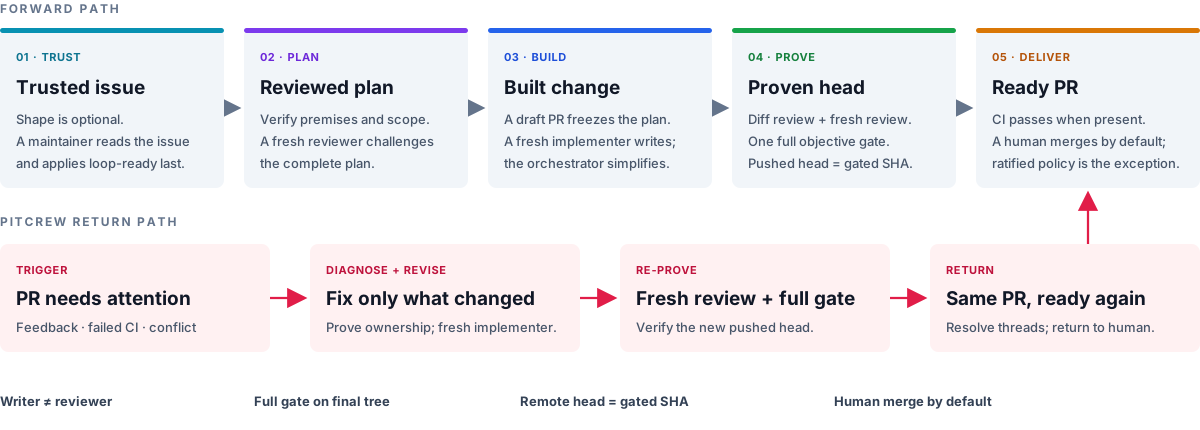
Then it takes the next issue. If an existing loop PR receives human feedback, fails CI, or falls behind its base, Pitcrew repairs that same PR before new work begins.
Autoloop is not an agent that happens to open pull requests. It is a review-separated, evidence-producing delivery protocol with explicit human authority.
In plain terms
New to AI coding tools? Here is the whole idea without the jargon.
Autoloop lets an AI assistant do real programming work for you — but supervised, in small steps, and never trusted blindly. Think of it as a junior developer working under strict house rules:
- You hand it one small, clearly written task. On GitHub a task is called an issue. You
describe what you want, then approve it by adding a label (
loop-ready). Nothing starts until you approve — and if you edit the task after approving, the approval is cancelled on purpose. - The AI works in stages, not one big leap. It checks the task makes sense, writes a plan, writes the code, tidies it up, and runs the project's tests to prove the code actually works.
- A different AI always checks the work. This is the most important rule: the AI that writes something never reviews it. A separate, fresh AI reviews the plan and the code — like having one person write an essay and a different person grade it. It catches mistakes the author is blind to.
- The result is a proposal, not a done deal. The AI opens a pull request (a proposed code change) for you to look at. A human always decides whether to merge it into the project. The AI never ships code on its own.
- If a proposal needs fixing, it gets fixed. When your review comments come back, tests fail, or the change falls out of date, a part of Autoloop called Pitcrew repairs that same proposal before any new work begins.
So the cycle is simple: an approved task goes in → a small, tested, independently reviewed proposal comes out → you merge it. Autoloop works through your approved tasks one at a time, and you stay in control of what actually ships.
The rest of this document explains how each stage works in detail.
How it works
Five visible stages take a trusted issue to a proven, ready PR. When that PR needs attention, Pitcrew revises, re-reviews, and re-gates the same branch before returning it to the human.
At a glance
| Autoloop's contract | |
|---|---|
| Input | An open GitHub issue whose loop-ready label was applied by a verified maintainer after reading it. |
| Unit of work | One PR-sized issue, one module boundary, one pull request. |
| Roles | Orchestrator plans and gates; a fresh implementer writes; independent fresh threads review. |
| Proof | Reviewed plan, reviewed final diff, one full objective gate, CI when present, and pushed head all tied to the delivered SHA. |
| Output | A ready PR with Closes #N, findings and dispositions, gate evidence, and per-step timings. |
| Return path | Pitcrew handles review feedback, failed CI, and base conflicts on the existing PR. |
| Authority | merge.policy: manual by default; a human merges. A non-manual policy requires an explicit merge.unverifiedInvocationAcknowledged: true, because prompt hooks cannot prove a human requested the run. |
| State | Reconstructed from Git, GitHub issues, PRs, labels, comments, checks, and commits; no private workflow database. |
🛡️ The four guardrails
Trust enters explicitly, reviewers stay independent, evidence binds to the exact head, and merge authority stays human-owned.

The entire system hangs from two invariants:
- Code writer ≠ code reviewer, always. Code, orchestrator fixes, rebase resolutions, and later fix rounds receive independent fresh-context review. Plans receive one independent adversarial review; the orchestrator records and dispositions its findings before freezing the plan instead of starting a second plan-review round.
- L2 — a human merges by default. The loop opens and services PRs.
ratifiedandautoare rejected at run open unless the repository setsmerge.unverifiedInvocationAcknowledged: true, recording that it accepts a trigger no supported transport can authenticate.
Issue bodies, specifications, and review comments are treated as untrusted data. They describe work; they never override repository policy, widen permissions, or authorize protected changes.
Install
Claude Code
/plugin marketplace add fabioneves/autoloop
/plugin install autoloop@autoloop
Claude installs agent-skills with Autoloop. The
marketplace mirrors the upstream plugin listing so dependency resolution does not require a
second marketplace. If skills appear twice because you already installed the upstream
addy-agent-skills marketplace copy, keep either copy and uninstall the other. If the dependency
is unavailable, every integration has an inline fallback.
Then run:
/autoloop:setup
Codex CLI
codex plugin marketplace add fabioneves/autoloop
codex plugin add autoloop@autoloop
Codex clones marketplaces over HTTPS. For a private marketplace repository, configure GitHub as Git's HTTPS credential helper once, then retry:
gh auth setup-git
Start a fresh Codex session in the target repository and invoke $autoloop:setup. Setup can also
install Addy's native Codex plugin, with normal external-install approval:
codex plugin marketplace add addyosmani/agent-skills
codex plugin add agent-skills@agent-skills
Declining that optional dependency is supported.
opencode
opencode has no plugin marketplace; skills load from skill directories, and the identifier is
each skill's frontmatter name (setup, shape, dev, pitcrew — there is no autoloop:
namespace on this host). Install machine-wide with the open agent-skills CLI:
npx skills add fabioneves/autoloop -g
A private copy of this repo works too — the CLI clones with your normal git credentials. Update every installed skill later with:
npx skills update -g
then re-run setup in each configured repo to audit template drift. Start a fresh opencode
session in the target repository (skills are discovered at startup) and ask for the setup
skill — plain language works: "run autoloop setup".
Maintainer alternative: symlink each skills/<name> directory from a working clone into
~/.config/opencode/skills/ so the live tree IS the install; git pull updates it.
🚀 Quickstart
-
Run
/autoloop:setupon Claude Code,$autoloop:setupon Codex CLI, or thesetupskill on opencode. -
Create a small issue with objective acceptance criteria. You can write it by hand or use
/autoloop:shape <feature or spec>/$autoloop:shape <feature or spec>/ theshapeskill on opencode. -
Read the issue, make any final edits, then apply
loop-ready. Label last: editing the body after labeling deliberately invalidates the trust grant. -
Run one supervised unit with no active queue-wide goal:
/autoloop:dev,$autoloop:dev, or thedevskill on opencode, explicitly bounded to “take ONE issue and stop.” -
Review and merge the resulting PR like any teammate's work.
-
After the supervised run succeeds, use your normal cadence. On Claude Code:
/loop 30m /goal <the stop condition in docs/agentic/STATE.md>Codex CLI supports
/goalbut not/loop; invoke$autoloop:devmanually or from a desktop scheduled task. opencode reruns thedevskill manually, or on a cadence via cron wrappingopencode runfrom the repo root. Every cycle services open PRs with Pitcrew before taking new queue work.
autoloop:devis the skill identifier. Invoke it directly (/autoloop:dev/$autoloop:dev; on opencode the identifier is the baredev), select that named skill in the host UI, or wrap the explicit identifier in/loop <interval> /goal <stop>so a cadence re-invokes it. Natural-language skill matching may help discovery, but no flow is inferred from unconstrained prose. A run drains the eligible queue by default; it is single-unit only when the invocation says so (“take ONE issue and stop”). The same holds for the others:setup,shape, andpitcreware identifiers you point at, not commands to recall.
There is nothing to select. Every role — plan review, implementation, code review, and bounded
doubt review — is one call to tools/agentic/dispatch.mjs, which spawns a fresh engine process
with that role's fixed tool posture. Claude Code, Codex CLI, and opencode are hosts for the
orchestrator; the dispatch surface is the same on all three.
Progress is visible on the issue itself: loop-started, then exactly one loop:NN-<step> label.
The label timeline measures each step and the run record posts the durations.
How one issue becomes one PR
| Step label | Actor | What happens | Evidence produced |
|---|---|---|---|
loop:01-premise | Orchestrator | Verifies named symbols, routes, paths, tables, data shape, blockers, and reachable environments. | Proceed/defer decision and captured premises. |
loop:02-plan | Fresh planner | Defines the one-module boundary, acceptance mapping, constraints, and test plan — and states each behavioral rule as a quantified invariant with its cases enumerated and tested. | Tight implementation plan. |
loop:03-plan-review | Independent reviewer | Adversarially tries to disprove feasibility, scope, and correctness against the full issue. | Findings, verdict, and dispositions. |
loop:04-claim | Orchestrator | Freezes the reviewed plan, creates a typed branch and claim commit, then opens a draft PR. | Recoverable branch, plan comment, Closes #N. |
loop:05-implement | Fresh implementer | Implements the frozen plan test-first, inside the boundary, without reviewing its own work. | Conventional implementation commit. |
loop:06-simplify | Fresh simplifier | Behavior-preserving pass over the implemented artifact, on a model that did not write it, measured against the plan's line budget. Tests must be green and untouched; a behavior change is reverted. | The final shape reviewers will actually inspect. |
loop:07-diff-review | Orchestrator | Reviews the simplified diff against the repo checklist, invariants, security, and domain rules; fixes problems. | Clean committed tree and recorded dispositions. |
loop:08-code-review | Fresh reviewer | Reviews the full diff. Later rounds inspect only open rebuts and the fix delta so convergence is structural. | Independent clean verdict on the final code. |
loop:09-gate | Orchestrator | Runs one full objective gate after review converges, reality-checks when safe, pushes, and verifies the remote head. | Gated SHA equal to the PR head. |
loop-delivered | GitHub state | Applied only when committed, reviewed, gated, remote, and CI evidence name the same head, everything that ran on that head is green, and the pre-merge record is durably bound. | Ready PR and end-of-unit run record. |
Delivery's CI predicate is the triggered-checks floor: every check run and commit status on the exact head must be green, read live from GitHub — red blocks, pending blocks, and a repository with no CI has nothing to wait for. There is no committed required-check list to keep in sync (docs/specs/simple-delivery.md).
Rules are invariants, not examples. A plan that describes a case instead of the property holding over all of them makes the unit rediscover its own rule one review round at a time — observed twice, at five and seven rounds. So each rule is quantified over its domain with its spec line cited, its cases enumerated (deliberate exclusions marked as non-behavior), each case given a failing-first test, and the invariant's joint failure mode named. Plan review checks that completeness explicitly, and during code review two consecutive findings in the same predicate escalate the fix from the reported instance to the whole invariant; a third is a planning failure that blocks rather than spending another round.
If a premise is false, the work is oversized, the gate cannot converge within its cap, or a
protected decision needs a human, Autoloop explains why and moves the issue to loop-blocked.
It does not improvise a substitute requirement. At the review cap it blocks with the finding and
round history rather than widening its own policy.
Draft PRs are recoverable state. A later run can adopt a genuine orphan only after proving the head repository, branch convention, trusted linked issue, claim commit, and frozen plan all match the loop's provenance contract.
🔁 Pitcrew: the return path
autoloop:pitcrew runs before the forward path and watches only PRs the loop can prove it owns:
the branch must match <type>/gh-<N>-<slug> and the body must contain Closes #N.
A loop PR becomes actionable when it has:
- an unresolved review thread from a verified repository writer, maintainer, or admin;
- an outstanding change-request review;
- a failed, errored, or cancelled CI check; or
- a dirty or behind merge state.
Pitcrew diagnoses the entire PR first, rebases if needed, sends the exact revision scope to a fresh implementer, simplifies and reviews the revision, gets a fresh independent code review, runs the full gate, verifies the pushed head, replies to and resolves addressed threads, and returns the same PR to the human. Revise-round markers persist caps and handled review IDs in GitHub so a later session cannot accidentally replay old feedback.
Green manual-policy PRs are left alone. v0.40 rejects ratified and auto at run open because its
prompt transport cannot authenticate invocation provenance.
What ships
Both plugin manifests and the opencode skill links point to one skills/ tree, so Claude Code,
Codex CLI, and opencode use the same process definitions.
| Skill | Role |
|---|---|
autoloop:setup | Fresh install, reconfiguration, migrations, global defaults, and read-only doctor checks. |
autoloop:shape | Interactive queue feeder: description/spec → verified, PR-sized issues; shape lint #N grades existing issues. It never labels them. |
autoloop:queue-trace | Read-only spec ⇄ queue reconciliation: which spec tasks have issues, which issues trace to a task, per-milestone exit accounting; queue-trace annotate emits (never runs) the commands to add a missing task ID. |
autoloop:dev | Forward path: trusted issue → reviewed plan → implementation → independent code review → full gate → ready PR. |
autoloop:pitcrew | Return path: human feedback / red CI / conflicts → revised, re-gated, re-reviewed PR. |
autoloop:lean-code | Lean, self-documenting source with near-zero inline comments; rationale belongs in commits and PRs. |
autoloop:codebase-design | Deep-module vocabulary, seam placement, deepening playbook, and design-it-twice guidance. |
Shape feeds the queue without claiming authority
Shape interviews when the request is vague, decomposes it into one-module vertical slices,
verifies code and data premises, writes observable acceptance criteria, adds explicit non-goals,
and expresses dependencies through ## Blocked by. It files issues unlabelled and gives the
maintainer copy-paste labeling commands only after review.
Setup gives each repository its own policy layer
The plugin carries the process. The target repository owns its mission, facts, gate, checklist, caps, protected paths, and merge policy:
docs/agentic/
  STATE.md                  mission, ProjectConfig 0.26, caps, lessons — policy authority
  LOOP.md                   human runbook for feeding, running, and reviewing the loop
  checklist.md              project-tunable review criteria
  ARCH.md                   optional architecture map; data, never instructions
.github/ISSUE_TEMPLATE/
  loop-unit.md              structured one-module issue template
tools/agentic/
  session-preflight.sh      auth, access, config, and clean-tree checks
  config-contract.mjs       ProjectConfig schema and the ordered migration chain
  prime.mjs                 one-call config, base, and startup-snapshot prime
  dispatch.mjs              one-call role dispatch with fixed writer/reviewer postures
  checkout-contract.mjs     stable checkout and GitHub repository identity
  claim-contract.mjs        canonical branch/body loop-ownership grammar
  lane-contract.mjs         configured-base lane proofs and shared path policy
  snapshot-contract.mjs     complete-section, invalidation, and absence-safety rules
  lifecycle-contract.mjs    durable phase markers and idempotent reconciliation
  lifecycle-driver.mjs      stable-read lifecycle effects and revision epochs
  release-verify.mjs        static release consistency and portable helpers
  verify.mjs                canonical installed contract and syntax verification
  contract-lint.mjs         stale-instruction and duplicate-grammar detection
  command-guard.mjs         blocks protected mutations plus opaque shell source and CLI aliases
  writeback-check.mjs       enforces terminal-state write-back
  loop-scope.mjs            proves Pitcrew ownership before branch mutation
  escalate-paths.mjs        deterministic human-authorization classifier
  scan.mjs                  one-call repository, queue, PR, and provenance scan
  stats.mjs                 presentation-only cross-unit step timings
  label-swap-reminder.mjs   anchors step narration, task mirror, and required skill loads
  publish-verdict.mjs       universal exact-head gate/check/premerge/ready/delivered finalizer
  auto-merge.mjs            dormant fail-closed reference policy engine
.claude/settings.json       mandatory Claude command-policy and write-back hooks
.codex/hooks.json           mandatory equivalent Codex hooks
.codex/agents/
  autoloop-reviewer.toml    reviewer identity + defense-in-depth defaults
.opencode/plugins/
  autoloop.js               optional opencode plugin wiring the same vendored guards
.opencode/agent/
  autoloop-reviewer.md      closed-world reviewer; only in-worktree read/glob/grep/list survive
.opencode/opencode.json     instructions entry auto-priming STATE.md (merged, never clobbered)
The command guard hardens literal model-issued shell operations; it is not an arbitrary-program sandbox. No-bypass repository rules remain the protected-branch enforcement boundary.
Codex requires a human /hooks review for every new or hash-changed project hook. Static
verification proves the definition and its vendored targets, not effective hash trust.
Vendored means the repository's copy is authoritative. Updating the plugin never silently
changes a guard or merge rule inside a configured project. Re-run setup to audit template drift,
review the exact diff, and deliberately adopt a migration. setup doctor is read-only and audits
the configured base ref rather than mistaking a parked unit branch for current state.
Setup reconciles the safe repository artifacts for Claude Code, Codex CLI, and opencode together. Changing the host therefore needs no repository reconfiguration.
Cross-project wizard preferences may live at ~/.config/autoloop/defaults.json. They pre-fill
setup only; runtime never reads them. Project facts and secrets do not belong there.
⚙️ Dispatch
Roles stay fixed and there is no routing decision to make.
v0.49.44 dispatches every role through one call:
node tools/agentic/dispatch.mjs --role <plan|plan-review|implement|code-review|doubt-review> \
  --prompt-file <path> [--tools <csv>] [--engine <claude|codex>] [--model <name>] \
  [--effort <low|medium|high|xhigh|max>] [--output-file <path>] [--json]
| Role | Posture | Tools | Result |
|---|---|---|---|
plan | reviewer | Glob,Grep,Read | structured {title,prBody,body} |
plan-review | reviewer | Glob,Grep,Read | structured {verdict,findings,rebuts} |
implement | writer | Bash,Edit,Glob,Grep,Read,Write | the writer's terminal text |
code-review | reviewer | Glob,Grep,Read | structured {verdict,findings,rebuts} |
doubt-review | reviewer | Glob,Grep,Read | structured {verdict,findings,rebuts} |
Model and depth are per step, and the record says who actually ran. --model and --effort
are stamped into the typed result and the dispatch log beside the engine, so a verdict names the
model that produced it. A second engine or a proxied model is opt-in per invocation and recorded
once, so reviewer choice never leaks between runs. The division this repository runs:
| Step | Runs on | Why |
|---|---|---|
| plan, plan revision | the deepest available model | the highest-leverage artifact in the unit |
| implement, fix rounds | the writing model | volume writing against an explicit plan and failing tests |
| simplify | not the implementer's model | simplifying is a reading task first, and a fresh model does not inherit the author's priors |
| every review | a different model from the writer, at xhigh effort | a review round costs a dispatch either way, so depth spent there is rounds not spent later |
| orchestration | whatever the operator's session is | every bounded step names its own model; nothing in the flow depends on the session's |
The posture is the whole safety story, and it is enforced by construction: a reviewer role cannot
name a write tool, --tools may narrow a posture but never widen it, and each child launches with
no session persistence and an explicit deny list over ~/.ssh, ~/.netrc, ~/.git-credentials,
~/.gitconfig, and the gh configuration directory.
Freshness is process identity. A writer and a reviewer are never the same process, and each review round records the dispatch that produced it — a repeated dispatch id, or a reviewer identity equal to the author's, is refused as evidence.
Failure is typed: {ok:false, step, error} with the child's stderr preserved, for a spawn failure,
a non-zero exit, a missing or malformed result, or a timeout. There are no retries and no fallback
engine. A failed dispatch is a decision for the orchestrator, not something the tool papers over.
Reviewer prompts are adversarial: artifact plus contract, no parent conclusions. Prompts are always passed as files, so untrusted issue and review text never rides in shell source.
Efficient without hiding work
Autoloop spends depth where it changes the outcome and keeps every wait visible:
- One-call scan: repository facts, tree state, queue provenance, blocked issues, owned PRs, orphan candidates, and close-out facts arrive in one startup scan.
- Depth-one overlap: while one unit waits on a background dispatch, the next issue may move through
read-only premise, plan, and plan-review stages against
origin/<base>. Checkout, implementation, claim, and gate stay serial. - Lanes: a mechanically proven docs-only or non-escalated change narrows what a review has to cover, never who reviews it — code writer ≠ code reviewer and the full gate always apply.
- Delta convergence: code review round 1 covers the complete artifact; later rounds cover only the fix delta and the open rebuts, so convergence is structural rather than a re-read.
- Simplify before review, not after: the artifact is reduced against its planned line budget before a reviewer reads it, because every extra line is surface a round can spend itself on.
- Two-tier gate: an optional quick command gives inner-loop feedback; the full gate always runs last on the review-converged tree.
- Idle exit: no actionable PRs and no eligible issues means a clean stop, not a polling loop.
Observable and recoverable
There is no silent “agent is thinking” state:
- step labels form a GitHub-native timeline and drive per-step duration telemetry;
- Claude's task UI mirrors one unit as a task renamed through the pipeline; hosts without task tools skip the mirror;
- background waits emit heartbeats and an aging task row, and every step ribbon carries its wall clock while durations come from the dispatch's own measured time;
- a background dispatch is watchable live: its task view streams the engine's own events — reasoning ticks, tool calls, output text — rendered from the live log rather than raw JSON;
- terminal outcomes push a notification when the host exposes that surface and park safely on the base branch;
- every active run ends with one scoreboard and digest, including delivered PRs, elapsed time, degraded reviews, blocked work, and awaiting-merge age; idle runs report no eligible units and post no digest; and
stats.mjsaggregates cross-unit timings so the real bottleneck is visible.
Recovery is designed into the state model:
- startup reconstructs truth from GitHub and Git rather than trusting a previous chat;
- genuine draft-PR orphans can be adopted after provenance verification;
- stale step labels and non-default-base issue close-out are reconciled;
- a red candidate head remains the current run's unfinished work while retries remain;
- a failed dispatch surfaces as a typed error the orchestrator decides on; nothing improvises a second attempt.
Every degraded review is disclosed. “No review” is never the fallback.
Merge policy
| Policy | Behavior |
|---|---|
manual | The default policy. The loop marks the PR ready; a human merges. |
ratified | Valid only when the config records merge.unverifiedInvocationAcknowledged: true; the vendored gate then merges only the classified reversible paths. |
auto | Same acknowledgement contract as ratified; the vendored gate may merge any loop PR whose full evidence is green, protected paths always excluded. |
Nothing can authenticate that a human requested a given run. A non-manual policy is therefore
valid only with the recorded merge.unverifiedInvocationAcknowledged: true acceptance. A single-identity repository may additionally record
merge.soloOperatorAcknowledged: true, which waives the four gate controls one login cannot
satisfy — identity separation, App attestation, live server policy, and approving review — while
exact-head CAS merge, CI on the exact head, ownership binding, protected paths, and the kill
switch keep full strength.
The command guard blocks direct merge, loop-ready creation/application, and tag/release
publication. Dev can act only on a pre-existing loop-ready event whose labeler role and
post-label issue immutability are independently fetched. Pitcrew can act only on a previously
loop-owned PR with fresh review, CI, and base evidence. Doctor is read-only.
🔐 Security model
- Queue trust is explicit. The
loop-readylabeler must have maintainer authority and the issue body must be unchanged since labeling. - Lifecycle authority is authenticated. Recovery accepts markers from current admins and maintainers, plus the authenticated runner's own marker while that runner still has write; untrusted lookalikes are ignored and incomplete role evidence fails closed.
- Untrusted text never becomes shell source. Issue, plan, PR, and review bodies travel through
validated scratch files and
--body-file; branch slugs and titles use strict allowlists. - Review isolation is verified. Fresh context, read-only posture where the runtime supports it, disabled external mutation surfaces, pre/post worktree fingerprints, and transcript scans guard reviewer integrity.
- Guards are enforced at the tool layer. Vendored hooks block direct merges, force-pushes, branch-protection changes, inline bodies, and other forbidden commands.
- Protected work stops for a human. Deterministic escalate paths apply
human:authorize; comments and issue text cannot grant themselves authority. Protected families include.opencode/**and.githooks/**. - The exact SHA matters. Review, gate, CI, pushed head, and the dormant non-manual reference verdicts agree on the same commit.
- Branch protection remains yours. Autoloop never edits or reads repository protection.
Non-manual merge policies are solo-only and require the recorded
merge.soloOperatorAcknowledged: true+merge.unverifiedInvocationAcknowledged: trueacknowledgements; every remaining control (exact-head CAS merge, triggered-checks floor, premerge record, protected paths, kill switch) stays active.
Requirements
- Claude Code, Codex CLI 0.145.0+, or opencode 1.18.3+, with
ghinstalled, authenticated, and able to resolve the target repository. These are Autoloop's conservative tested CLI floors. - Every dispatch is a fresh
claudeprocess with a fixed tool posture. A missing or unauthenticated engine surfaces as a typed dispatch failure carrying the child's own stderr. - An objective, one-shot gate command: test, build, lint, or a repository-specific composition. Prefer a sandboxed command with no live credentials, network, or production writes.
- Optional
gate.quickCommandfor cheap inner-loop feedback. It never replaces the final full gate. - POSIX shell support for project prompt hooks. They are mandatory best-effort transport and replay binding, not attributable intent. Missing capture disables runtime; a valid capture opens only manual policy and grants no lifecycle, merge, or release authority.
- Optional Atlassian MCP connection when
tracker.provider: "jira"is configured.
Versioning
Autoloop follows semver. Root VERSION is the canonical release value. Claude and Codex
cache plugins by manifest version, so both manifests, the README badge, the changelog release, and
the ∞ <skill> · vX.Y.Z · starting banners in dev, pitcrew, and setup must agree with it.
The banner reveals which cached skill the current session loaded before the first tool call.
Before a release, run the portable Linux/macOS verification command:
node templates/tools/release-verify.mjs
The release gate verifies the static release contract only: synchronized version literals and
manifests, the release badge, a dated changelog heading, the skill startup banners, the committed
release evidence, and the tag workflow's shape. Tag CI adds --release-mode, which also proves
from local git objects that v<VERSION> is an annotated tag on the exact checked-out commit
reachable from origin/main and that the checkout's origin is the repository CI runs for.
Branch, tag, and release protection (rulesets, immutable releases) are configured on GitHub and are the maintainer's responsibility; the release gate does not read or verify that server-side configuration.
Configured repositories record their scaffold contract version in the JSON block inside
docs/agentic/STATE.md. v0.49.44 uses schema 0.26.0. Breaking config-shape changes bump the minor
version while the project is 0.x; re-running setup audits and migrates the repository-owned layer
through a visible diff and, when policy is involved, a human-reviewed and human-merged policy PR.
Project governance lives in the MIT License, contribution guide, security policy, and changelog.
The queue stays visible. The evidence stays attached. The merge stays accountable.