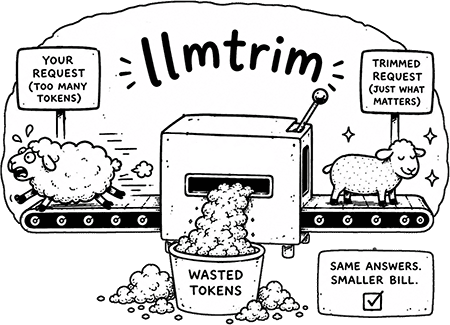
llmtrim
Local proxy that compresses LLM API traffic so you pay less. Same answers, smaller bill.
−31% input · −74% output · −66% round-trip cost · 112 live A/B cases · ~5 ms/call · no model to load
Using Claude Code? One install also gets you a live status line,
a cold-cache guard, cheaper /compact,
and /sub to serve it through CLIProxyAPI.
Proxy · CLI · MCP · library (Python · Ruby · Swift · Kotlin · JS/WASM)







What it does • Install • Day to day • In action • Works with • Claude Code • Numbers • Config • CLI & library
What it does
You run Claude Code, Codex, Cursor, or your own app. Every turn, the tool sends a large request: system prompt, tools, history, raw command output. You pay for every token of that, including the parts that do not help the model.
A 200-line build log with two errors. Tool schemas resent on every call. JSON with hundreds of near-identical rows. That bulk is still billed.
llmtrim sits on your machine as a local proxy, trims the waste, and forwards a smaller request. The reply is unchanged. You keep the same tools and answers; you spend less.
  before:  your tool ───── full request ─────▶  OpenAI / Anthropic / …
                    ◀──────── reply ──────────

  after:   your tool ──▶ llmtrim ──smaller──▶  OpenAI / Anthropic / …
                            (on your machine)
                    ◀──────── reply ──────────  (same answer)
Compression cannot raise your bill or break a request; worst case is zero savings. Everything runs locally, nothing is sent to us. In action →
For Claude Code the same install goes further: a status line with live trim % and rate limits, a guard that warns before an expired prompt cache re-bills your whole context, /compact on a cheaper model, and /sub to route sessions through another subscription. Details →
Get started
npm install -g @llmtrim/cli@latest && llmtrim setup
# open a new terminal, then keep working
llmtrim status
That's it. setup starts a local proxy, wires your shell, and enables recoverable tool-output shaping. When Claude Code is present, it also turns on the status line, cold-cache guard, /sub, and cheaper /compact. You do not run a separate install for each of those.
| You want | Run |
|---|---|
| First install | llmtrim setup |
| New version | llmtrim update (then llmtrim ensure after npm/brew/cargo) |
| Something broken | llmtrim ensure · llmtrim doctor --fix · or f in status |
Any tool that honors
HTTPS_PROXYworks (Claude Code, Codex, Cursor, Aider, your SDK). GitHub Copilot does not (certificate pinning). Full list →
Other installers (Homebrew, curl, Scoop, Cargo, Docker)
# Linux / macOS
curl -fsSL https://raw.githubusercontent.com/fkiene/llmtrim/main/install.sh | sh

# Windows (PowerShell)
irm https://raw.githubusercontent.com/fkiene/llmtrim/main/install.ps1 | iex

# Package managers
brew install fkiene/tap/llmtrim
cargo binstall llmtrim
scoop install llmtrim
docker run -d -p 43117:43117 -v llmtrim-state:/data ghcr.io/fkiene/llmtrim
Full options: INSTALL.md.
Desktop tray (menu bar / system tray)
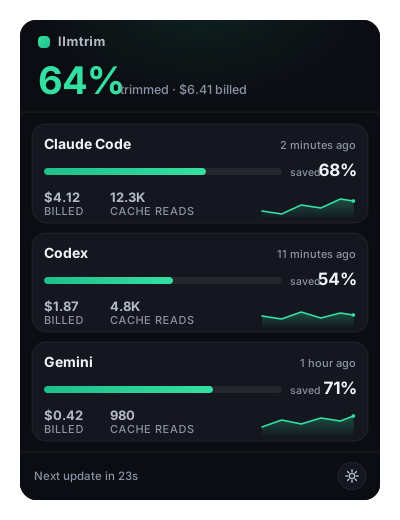
Menu-bar / system-tray popover with the same savings numbers. Bundled in Homebrew, Scoop, and npm; setup can enable open-at-login. Open with llmtrim tray. On Linux desktops, interactive ensure can fetch the tray binary from the latest release (needs libwebkit2gtk-4.1 and libayatana-appindicator3).
Is this safe?
Same technique as mitmproxy, scoped to LLM API hosts only. setup changes three things; llmtrim uninstall reverses all three:
- Private CA in
~/.llmtrim/(name-constrained; cannot intercept your bank or email) - Shell env:
HTTPS_PROXY+ CA trust - Login service: daemon at login
No API keys stored (your tool's auth is forwarded). Prompts never touch disk; only anonymous token counts. Recoverable tool results stay in bounded daemon RAM for five hours by default and disappear on restart. Full threat model: SECURITY.md.
llmtrim ca
openssl x509 -in ~/.llmtrim/ca.pem -noout -text | grep -A3 "Name Constraints"
Day to day
llmtrim status     # savings + health  (aliases: monitor, gain)
llmtrim update     # new release, restart daemon, refresh integrations
llmtrim ensure     # match the recommended install state on this machine
| Situation | Command |
|---|---|
| Watch savings | llmtrim status |
After npm / brew / cargo upgrade | llmtrim ensure (or f in status) |
| Diagnose | llmtrim doctor · repair with doctor --fix |
| Pause / resume proxy | llmtrim stop · llmtrim start |
| Force one session through llmtrim | llmtrim wrap claude |
| Remove everything | llmtrim uninstall |
After setup, update, or ensure, owned Claude Code pieces (status line, guard, /sub, compact defaults) stay in sync with the binary. You should not need statusline install or similar after an upgrade.
Time series: llmtrim status --daily · --weekly · --monthly · --json · --csv.
In action
An agent ran a build. The tool returned 58 lines; two were errors. All 58 would have been billed.
4,662 chars → 978 (−79%). Errors stay verbatim. Repeated INFO lines fold into a template plus the values (lossless when the range is regular).
# before (noise + signal)
[2026-06-13T10:02:00Z] INFO  compiling module core::worker::task_0 (incremental)
… 28 more near-identical INFO lines …
[2026-06-13T10:02:31Z] ERROR src/worker/pool.rs:214: mismatched types: expected `usize`, found `i64`
… 25 more INFO lines …
[2026-06-13T10:03:01Z] ERROR src/net/conn.rs:88: cannot borrow `buf` as mutable more than once
[2026-06-13T10:03:02Z] INFO  build failed, 2 errors

# after (errors verbatim; INFO folded losslessly)
[{}] INFO compiling module core::worker::task_{} (incremental) [×30: (10:02:00Z..10:02:29Z step 1s; 0..29)]
[2026-06-13T10:02:31Z] ERROR src/worker/pool.rs:214: mismatched types: expected `usize`, found `i64`
[{}] INFO compiling module core::net::conn_{} (incremental) [×25: 10:02:32Z..10:02:56Z; 0..24]
[2026-06-13T10:03:01Z] ERROR src/net/conn.rs:88: cannot borrow `buf` as mutable more than once
[2026-06-13T10:03:02Z] INFO  build failed, 2 errors
Try it on a request body of your own:
echo '{"model":"gpt-4o","messages":[...]}' | llmtrim compress --provider openai
Log folding is one stage. Others kick in on different waste:
| Waste | What happens |
|---|---|
| Build logs, diffs, grep dumps | Keep errors / changes / matches; fold the rest |
| Long pasted context | Keep chunks relevant to the question |
| Source code | Keep useful bodies; rest → signatures |
| Tool schemas every turn | Trim + keep the cache prefix stable |
| Huge JSON arrays | Compact table (TOON) or sample |
| Verbose model replies | Ask for terser output where safe |
[!IMPORTANT] Compression cannot raise your bill or break a request. Each stage is re-measured with the provider's real tokenizer and undone if it does not save tokens. If the provider rejects the compressed body, the original is resent. Worst case is zero savings.
Existing prompt-cache prefixes (cache_control) are left alone. On shell-capable agent turns, a newly arriving tool result may be shaped once before its first cache write; the exact raw result remains recoverable with the emitted llmtrim recall r_… command.
All 10 compressors
Stages run in savings order. Nothing under a cache_control marker is rewritten.
| Stage | What it does | When it runs |
|---|---|---|
| tool-output | Lossless template fold first, then window logs · diffs · grep · dumps down to errors / changes / matches; shell-capable agents can restore omitted first-arrival results with llmtrim recall | tool results |
| cache discipline | Mark + stabilize the invariant prefix (sort tools/schema · OpenAI prompt_cache_key) so it stays cached | tools |
| lexical retrieval | BM25+ ranking with RM3 feedback · TextTiling topic cuts · budgeted non-redundant selection; question protected | long context |
| skeletonization | tree-sitter keeps relevant function bodies, drops the rest to signatures (14 languages) | code |
| serialize + hygiene | Minify JSON, encode record arrays to TOON or CSV, Unicode-normalize | always · lossless |
| json sample | Down-sample huge record arrays: first/last + outliers + a query-biased diverse sample | big JSON |
| dedup | Collapse duplicate + near-duplicate lines (prose only) | always |
| output control | Terse instruction · Chain-of-Draft · token budget · native JSON schema · anti-overthink directive (quantized reasoning) · agent-loop frugality directive | auto |
| tool layer | Static tool selection + description trimming | tools |
| multimodal | Downscale images to the provider's resolution cap | images |
Default auto enables each stage only where it pays. safe is lossless-only. Config →
Claude Code
When ~/.claude exists, setup, update, and ensure wire these. No separate install commands.
| Feature | What you get |
|---|---|
| Status line | Model, context gauge, trim %, rate limits, cache warm/cold |
| Guard | Blocks one turn if a cold-cache resume would rewrite a huge context (and bill for it) |
/compact models | Prefer Haiku → Sonnet before your selected model, but only when the prompt cache is cold |
/sub | Per-window: /sub on [optional:codex|kimi|grok] · /sub off · /sub status |
◆ Opus→gpt-5.6-terra ▓▓▓▓▓░░░ 142k ✂ 6.8% ◔ 3h·24% · 4d·12% ♻ 63% cached
Status line details
Claude Code custom status line. The arrow is the backend that answered the last turn (not merely what is configured). In sub fallback mode it stays off while Anthropic serves and shows up when a chain provider does.
✂: trim for this session (✂ –until something is saved)◔: rate-limit windows (time left · % used) — Claude.ai when Anthropic is serving; under/subthe active plan's windows (Codex today: weekly always, 5h when the plan reports one). Kimi/Grok fill in when their usage APIs are wired- Context gauge: fill of the serving model's real window (green under 40%, orange 40-65%, red above)
♻: prompt-cache reuse; becomes♻ cache coldafter the cache TTL
Owned settings rewrite themselves when the binary path or payload changes. To opt out, leave your own status line in place, or uninstall ours (llmtrim statusline uninstall).
Cold-cache guard
Resuming a large session after the prompt-cache TTL rewrites the whole context at cache-write rates (often a few dollars) with no warning at the prompt.
Guard is a free UserPromptSubmit hook. It blocks one turn, prints idle time, context size, estimated cost, and the draft you typed (Claude Code clears the input box and would otherwise drop it), then lets a resend through. If you type something else next, the blocked text is also reinjected as model context. /compact pays that cold write too, because it has to read the full context to summarize. Local-only slash commands that never hit the model (today: /sub) pass through without acking the gap, so the next real prompt still warns.
Opt out: llmtrim guard uninstall. ensure remembers that choice.
Idle 6h 19m, 347k tokens of context. The prompt cache has expired, so the next turn
rewrites the whole context (about $3.47 before any work happens).
Cheaper `/compact`
llmtrim compact models haiku sonnet   # setup already sets this by default
llmtrim compact status
llmtrim compact off
[compact]
models = ["haiku", "sonnet"]
Candidates run in order when they fit the compressed request. Claude's selected model is always the last fallback (do not put it in the list). Empty models = [] records opt-out.
The redirect only fires once the prompt cache has gone cold. /compact re-sends the conversation Claude Code has been caching against your selected model, so while that cache is warm a cache-read there costs less than a cold read on a smaller model, and the compact stays home. After the cache expires the cheaper model wins, so that is when the redirect takes over.
Subscription reroute (`sub`) (opt-in; may conflict with provider ToS)
Send Claude Code through CLIProxyAPI instead of Anthropic, or as a fallback hop when the current path fails. Login is CLIProxyAPI's TUI; decide for yourself whether that fits the provider ToS.
llmtrim sub on                  # install + start CLIProxyAPI, enable redirect
llmtrim sub on grok             # write opus/sonnet/haiku/fable → that CLI's models
llmtrim sub auth                # CLIProxyAPI TUI — sign in
llmtrim sub models              # official + live sidecar models
llmtrim sub map on opus grok-4.6
llmtrim sub chain anthropic,codex
llmtrim sub mode fallback       # try hops in order when the current one fails
llmtrim sub status
llmtrim sub off
Interactive: llmtrim status → tab 4 Sub — Off / Always / Fallback, then e to edit the
input→output map (type to search CLIProxyAPI's catalog;
s save, a add, d delete). [ ] rotate the fallback first hop.
llmtrim update also updates CLIProxyAPI when you use it. Point LLMTRIM_CLIPROXY_URL at an
existing instance to skip the managed sidecar.
Route only a delegated Claude Code subagent while leaving the parent window unchanged:
llmtrim agents install # also installed/refreshed by setup, update, and ensure
Then ask naturally: Implement it using a Grok subagent, use Terra, or review this with GPT Terra.
Provider-only agents preserve the child request's Claude tier through the configured mapping; an
explicit model agent pins that provider model. Request-local agents override the window /sub and
global policy only for their own requests. llmtrim agents uninstall removes only llmtrim-owned
agent files and records an opt-out so ensure leaves them removed.
This window only (installed with ensure; includes subagents; survives /clear):
/sub on [optional:cli-or-model]  # gemini, codex, claude, grok, kimi, vertex, qwen, copilot, or a model id
/sub off
/sub status
Sidecar: ~/.llmtrim/cliproxy/ (binary + config). Auth: ~/.cli-proxy-api when present, else
~/.llmtrim/cliproxy/auth. Env: LLMTRIM_SUB, LLMTRIM_SUB_MODE, LLMTRIM_CLIPROXY_URL,
LLMTRIM_CLIPROXY_KEY.
Anthropic /login vs claude.ai connectors: with global sub in always mode, by
default llmtrim writes a dummy ANTHROPIC_AUTH_TOKEN into ~/.claude/settings.json (same
idea as claude-code-proxy's
ANTHROPIC_AUTH_TOKEN=unused) so Claude Code does not need a live Anthropic OAuth session.
The MITM strips that dummy token and sends /v1/messages to CLIProxyAPI; non-messages
Anthropic probes are answered locally so they never return 401 Invalid bearer token.
Claude Code treats any API-key auth as overriding claude.ai login, so claude.ai connectors
are disabled while the dummy token is set. That is expected. To keep connectors (and accept
Anthropic /login when the session expires):
llmtrim sub anthropic-login keep   # connectors OK; Anthropic login required
llmtrim sub anthropic-login skip   # default: no Anthropic /login; connectors off
Restart Claude Code after sub on / sub off / sub mode / sub anthropic-login for the
settings change to take effect. Fallback whose first hop is "what's in use" still needs a real
Anthropic login.
Use it as a CLI, MCP, or library
Same engine, no proxy required. No extra model calls; compress runs in-process.
| Language | Install |
|---|---|
| Rust | cargo add llmtrim-core |
| Python | pip install llmtrim |
| Ruby | gem install llmtrim |
| Kotlin | implementation("io.github.fkiene:llmtrim:0.13.2") |
| Swift | SwiftPM fkiene/llmtrim-swift ≥ 0.1.8 |
| JS / TS | @llmtrim/js (WASM) |
CLI pipe
echo '{"model":"gpt-4o","messages":[...]}' | llmtrim compress --provider openai > out.json
echo '{"model":"gpt-4o","messages":[...]}' | llmtrim send --provider openai
Rust · Python · JS
use llmtrim_core::{compress, ir::ProviderKind};
let out = compress(request_json, Some(ProviderKind::OpenAi))?;
import llmtrim
out = llmtrim.compress(request_json, llmtrim.Provider.OPEN_AI, "aggressive")
import { compress } from "@llmtrim/js";
const out = compress(requestJson, "openai", "aggressive");
Bindings and WASM notes: crates/llmtrim-uniffi · crates/llmtrim-wasm.
MCP server
llmtrim mcp install          # Claude Code
llmtrim mcp install --print  # paste into any client
{
  "mcpServers": {
    "llmtrim": { "command": "llmtrim", "args": ["mcp"] }
  }
}
Tools: llmtrim_compress, llmtrim_compress_text, llmtrim_stats (same ledger as status).
Works with
Any tool that honors HTTPS_PROXY and an env-provided CA:
| Tool | Works | Notes |
|---|---|---|
| Claude Code | ✅ | Prompt-cache discount stays intact |
| Codex CLI | ✅ | |
| Gemini CLI | ✅ | |
| Cursor (IDE), Cline, Roo, Kilo Code | ✅ | VS Code extensions; set NODE_EXTRA_CA_CERTS for the Node host process |
| Goose, OpenCode, Crush, Mux, Forge, OpenClaw, Pi/OMP | ✅ | CLI agents on standard provider hosts |
| Qwen Code, Grok CLI, Kimi Code, Mistral Vibe | ✅ | Provider hosts ship in the llm_providers registry, intercepted out of the box |
Aider, any other HTTPS_PROXY-aware CLI | ✅ | |
| Hermes, Droid (BYOK mode) | ✅ | Interceptable only when a direct provider key is configured; see guide for Hermes |
| Your own app / SDK | ✅ | Or call the CLI / library directly |
| GitHub Copilot | ❌ | Certificate pinning blocks interception |
| Warp, Devin | ❌ | Provider call is server-side; a local proxy never sees it |
| Cursor Agent, Kiro | ❌ | Routes through a vendor gateway, not a standard provider host |
No proxy: any MCP client can call llmtrim as tools (llmtrim mcp install), or use the CLI / library.
Providers come from the llm_providers registry (OpenAI, Anthropic, Google, DeepSeek, Mistral, xAI, Moonshot, Zhipu, Qwen, OpenRouter, …) and update with it. Non-LLM connections pass through untouched.
Configuration
Default is fine for most traffic. auto inspects each request and picks compressors by shape (tools → agent, code → code, long Q&A → rag, else aggressive).
Override with LLMTRIM_PRESET=<name> or preset = "<name>" in $XDG_CONFIG_HOME/llmtrim/config.toml:
| preset | When to use |
|---|---|
auto (default) | Let llmtrim choose per request |
safe | Lossless input only |
aggressive | Max squeeze, quality-gated |
Advanced presets
auto composes these per request shape, so most users never set them directly. Pick one when you know your traffic and want to skip shape detection:
| preset | for |
|---|---|
agent | tool-calling loops: prunes the tool block first-turn-only so the prompt cache stays warm |
code | coding turns: skeletonize and minify code, compress pasted logs and diffs |
rag | long context with a question: sentence-level retrieval |
cache | a fixed prefix reused across many calls |
reasoning | math and step-by-step workloads |
frugal | isolates the agent-loop frugality directive alone, for clean benchmarking |
Per-flag overrides (power users)
Every stage is individually tunable via config flags; preset wins over individual flags. The full table is long; see the field list in config.rs or run llmtrim compress --help. The most useful knobs:
| field | default | meaning |
|---|---|---|
toolout | on in agent/aggressive | tool-output compression (logs / diffs / grep / dumps) |
retrieve | false | lexical retrieval for long context (lossy) |
skeletonize | false | drop non-relevant function bodies to signatures |
serialize | true | TOON / CSV encoding of record arrays |
json_crush | on in agent/aggressive | sample huge record arrays |
output_control | false | terse-output instruction + cap |
output_anti_overthink | on in aggressive/rag/code/agent | commit-to-answer directive for quantized reasoning traffic |
output_frugal_tools | on in agent | steers agent loops toward fewer tool-call turns (batch, don't repeat) |
cache | false | cache_control breakpoints (lossless) |
dedup | true | collapse duplicate lines (lossless) |
quality_gate | true | revert any lossy cut whose query-relevant coverage drops too far |
Env: LLMTRIM_PRESET (preset), LLMTRIM_CONFIG (config-file path).
Runtime settings (env or config file)
These knobs are orthogonal to compression. Each resolves env-first, then from the config file, so set whichever fits. The env var wins when both are present.
| env var | config key | meaning |
|---|---|---|
LLMTRIM_EXTRA_HOSTS | extra_hosts | extra exact LLM-API hosts to intercept (comma-separated env / array in file), e.g. a self-hosted OpenAI-compatible endpoint |
LLMTRIM_EXCLUDE_PROVIDERS | exclude_providers | wire shapes to skip compressing: openai / anthropic / google (e.g. anthropic to leave Claude Code untouched); coarse, covers every host of that shape |
LLMTRIM_EXCLUDE_HOSTS | exclude_hosts | exact hostnames to skip compressing (e.g. openrouter.ai); precise, leaves other hosts of the same shape compressed |
LLMTRIM_UPSTREAM_PROXY | upstream_proxy | route egress through another proxy (see below) |
LLMTRIM_DB_PATH | db_path | ledger location |
LLMTRIM_CAPTURE_DIR | capture_dir | before/after QA capture directory |
LLMTRIM_CAPTURE_MAX_MB | capture_max_mb | capture corpus size ceiling (0 disables) |
LLMTRIM_FIRST_ARRIVAL_RECALL | first_arrival_recall | recoverable first-arrival tool-output shaping (default true; set false for normalization-only cache writes) |
LLMTRIM_FIRST_ARRIVAL_RECALL_TTL_SECS | first_arrival_recall_ttl_secs | in-memory raw-result lifetime (default 18,000 seconds / five hours) |
LLMTRIM_BIND | bind | listen IP (default loopback; 0.0.0.0 for containers) |
LLMTRIM_BREAKDOWN_WINDOW | breakdown_window | context-window override for the cost breakdown |
LLMTRIM_RETENTION_DAYS | retention_days | ledger age-retention in days |
LLMTRIM_NO_UPDATE_CHECK | no_update_check | disable the passive update check |
extra_hosts entries must be exact hostnames (llm.acme.com, never a bare acme.com): each one widens the name-constrained MITM CA, which regenerates automatically on the next launch to cover them.
Claude Code options (compact models, subscription reroute) are under Claude Code.
Upstream proxy (corporate egress or chaining local tools)
export LLMTRIM_UPSTREAM_PROXY=http://host:port
# or with auth: http://user:pass@host:port  (redacted in logs)
Outbound calls use CONNECT + verifying TLS; the upstream only sees the encrypted stream.
Looping to llmtrim's own listen address is rejected. Put the variable in the daemon's
launch environment (launchd / systemd), not only your interactive shell. Profile secrets
sit in plaintext.
Companion tools on another port (e.g. headroom) are fine.
The numbers
Every case is sent twice, once original and once compressed, then both answers are scored and billed at real rates. Cost and quality are measured together, not estimated, across 112 cases:

| original | compressed | saved | |
|---|---|---|---|
| input tokens | 71,031 | 49,062 | −31% |
| output tokens | 25,843 | 6,628 | −74% |
| round-trip cost | $0.0365 | $0.0126 | −66% |
| answer quality | 78.9% | 82.2% | no measured degradation |
The token cuts are model-independent (−31% input, −74% output). The dollar saving tracks the model's output-to-input price ratio: −66% here, projecting to −57% at GPT-4o rates and −59% at Claude Sonnet rates. The proxy compresses only the new-content surface and never rewrites the cache-controlled prefix, so your prompt-cache discount survives.
Accuracy preserved on standard benchmarks
The same A/B on the standard academic suites, at a conservative shape-matched preset (qwen3-next-80b, paired 95% CI). Quality is the score on the original request vs the compressed one. GSM8K comes from the frontier above (n=12); the other three are the named benchmarks readers compare against (n=20 each):
| benchmark | task | scorer | input saved | quality (orig → comp) | retention |
|---|---|---|---|---|---|
| GSM8K | grade-school math | numeric-exact | −47%¹ | 100% → 92% | −8pp |
| TruthfulQA (MC1) | factual truthfulness | choice-exact | 0% | 75% → 75% | +0.0±0.0pp |
| SQuAD v2 | extractive QA | token-F1 / EM | 11% | 84% → 84% | −0.0±15.2pp |
| BFCL (live_multiple) | function calling | tool-call match | 33% | 95% → 95% | +0.0±15.2pp |
Three rows compress with no quality loss; GSM8K is the one dip:
- BFCL drops the tool schemas the query doesn't need (a menu of 2 to 37 candidates per call).
- SQuAD v2 still answers its unanswerable questions correctly.
- TruthfulQA holds factual accuracy exactly: its ~75-token prompts are almost all answer text, so the safe preset finds nothing to cut.
- GSM8K trades −8pp of accuracy for −71% cost, so measure per workload before enabling its reasoning preset. ¹Its input goes negative because that preset injects a Chain-of-Draft instruction whose payoff is output-side (see the frontier table).
Evidence and a one-line reproduce (named-benchmark snapshot):
make -C crates/llmtrim-cli/bench data
(cd crates/llmtrim-cli && cargo run -q --features live -- bench quality \
   --corpus bench/data/squad2.jsonl --preset rag \
   --model qwen/qwen3-next-80b-a3b-instruct --route "" --n 20)
Methodology, per-corpus frontier, and confidence intervals: crates/llmtrim-cli/bench/README.md. Reproduce it:
make -C crates/llmtrim-cli/bench data   # pull real corpora (gsm8k, humaneval, dolly, hotpotqa, …)
(cd crates/llmtrim-cli && cargo run -q --features live -- bench suite)  # live A/B across all corpora (needs OPENROUTER_API_KEY)
(cd crates/llmtrim-cli/bench/scripts && PYTHONPATH=. python3 -m benchkit.tools.chart)  # regenerate the chart + table
How it compares
Each tool compresses one slice of the request. llmtrim compresses input and output, leaves the cached prefix untouched to keep the prompt cache stable, and scores on whether the answer survives the cut, not on tokens removed. Both axes below use the o200k_base encoder and reproduce from this repo.
| llmtrim | Headroom | RTK | caveman | |
|---|---|---|---|---|
| Compresses | input · output | input | tool/CLI output | model output |
| Skips no-op transforms | ✅ | ❌ | ❌ | n/a |
| One static binary | ✅ | Python + models | ✅ | ✅ |
Input
Input reduction (deterministic) next to answer quality from a live A/B. Quality is the drop vs llmtrim at each tool's compared setting (✅ held, a statistical tie; ❌ significantly lower), so a big reduction with a ❌ means the tool bought tokens by losing answers:
| Tool | Reduction | Quality vs llmtrim | Overhead |
|---|---|---|---|
llmtrim auto | 25% | ✅ ref | ~5 ms |
llmtrim aggressive | 28% | ✅ ref | ~5 ms |
| Headroom (ML on) | 24% | ✅ tie | ~0.9 s |
| leanctx / LLMLingua-2 | 52-81% | ❌ 18% lower | ~6 s |
| entroly | 80-89% | ❌ 42% lower | <1 ms |
Overhead is the median per-call compress time (Python wall-clock, not like-for-like CPU): Headroom and leanctx run ML on CPU here (faster on a GPU) and pay a one-time model load on top (~3 s and ~4 s); llmtrim is Rust and entroly is lexical, so neither does.
autois the quality-gated default;aggressiveaccepts lossy cuts where the gate holds.- Headroom drops to 0% with its ML disabled (its routers no-op on prose).
- leanctx and entroly are lossy with no quality gate; entroly has no low-reduction mode.
Headroom ties at matched reduction (24-25%, n=30, not significant) but its longer answers hit the model's output-token limit and get truncated 12 times to llmtrim's 2, the output inflation behind its higher cost. leanctx (measured at 26%) and entroly (at 69%, its mildest) score significantly lower than llmtrim (n=20), and fall further at their headline reductions (vs-leanctx, vs-entroly).
Output
Output reduction by asking for terser responses, on a paid live call over 9 coding prompts:
| output cut | overhead / request | |
|---|---|---|
| caveman | 80% | 949 tokens |
llmtrim output_terse | 69% | 19 tokens |
The cost is the 949-token system prompt caveman resends on every request (right column); llmtrim's is 19 for nearly the same cut. Both still net-save here, so caveman's deeper cut comes out ahead only when the output it removes is worth more than the 949 tokens it adds back (vs-caveman artifact).
The tools stack: RTK shrinks CLI output, then llmtrim compresses the tool schemas on top. Full head-to-heads: crates/llmtrim-cli/bench/README.md.
Known limits
These are surfaced by the same A/B that proves the savings:
- Anthropic / Gemini token counts are approximate. There's no public exact tokenizer, so a BPE proxy is used and flagged in
status. OpenAI is exact. - Output savings aren't measured live. The proxy compresses input; an output saving needs the A/B counterfactual, which only the offline benchmark runs.
status"saved" is input-side. - The default is quality-gated, not lossless. Lossy stages run only where the eval shows quality holds. Want a byte-faithful round-trip? Use the
safepreset. - "Lossless" is input-side, not response restoration. A lossless stage preserves the information the model reads (a folded log run, a TOON-encoded array, an abbreviation legend the model decodes in-prompt), and the token gate reverts any input cut that doesn't pay off. The engine does not transform the model's response back to an original form.
Acknowledgments
Every compressor is a deterministic implementation of published research: the ideas are theirs, the engineering and the token gate are ours.
Papers + crates behind each stage
Retrieval & context: BM25 (Robertson & Zaragoza 2009, bm25); BM25+ (Lv & Zhai, CIKM 2011); RM3 (Lavrenko & Croft, SIGIR 2001); TextTiling (Hearst, CL 1997); TextRank (Mihalcea & Tarau, EMNLP 2004); MMR (Carbonell & Goldstein, SIGIR 1998); Submodular objective (Lin & Bilmes, ACL 2011); modified-greedy knapsack maximizer (Tang et al., SIGMETRICS 2021, arXiv:2008.05391); DPP diverse sampling (Chen et al., NeurIPS 2018); Lost in the Middle (arXiv:2307.03172); DSLR (arXiv:2407.03627).
Code: RepoCoder (arXiv:2303.12570); Hierarchical Context Pruning (arXiv:2406.18294); The Hidden Cost of Readability (arXiv:2508.13666); Minification token accounting (arXiv:2606.01326).
Tool output: Drain (He et al., ICWS 2017); Brain (Yu et al., IEEE TSC 2023); LogLSHD (arXiv:2504.02172).
Dedup & abbreviation: SimHash (Charikar, STOC 2002, gaoya); CompactPrompt (arXiv:2510.18043); Maximal repeats (arXiv:1304.0528) + Re-Pair (Larsson & Moffat, DCC 1999).
Output control: Chain-of-Draft (arXiv:2502.18600); TALE (arXiv:2412.18547).
Serialization: TOON (Token-Oriented Object Notation), Johann Schopplich.
Built on tiktoken-rs, tree-sitter, image, whatlang, hudsucker, rusqlite, and more.
Found a problem?
llmtrim doctor          # diagnose
llmtrim doctor --fix     # diagnose + apply repairs
llmtrim ensure          # same repair path
Each failing check names its fix. If a request was mangled, set LLMTRIM_CAPTURE_DIR and
open an issue with the before/after pair.
If llmtrim saved you money, a ⭐ helps others find it.
Star History
Licensed under MPL-2.0. Use llmtrim freely in your stack, including commercially, with no source-disclosure obligation for your own code; the file-level copyleft applies only to modifications you make to llmtrim's own source files. Contributions via DCO sign-off.