Flow-Next





Agents generate. flow-next proves.
Implementation got cheap. Reviewing it, verifying it, and keeping a codebase coherent did not.
Flow-Next is the workflow layer that carries the weight: durable specs, re-anchored workers, adversarial cross-model review, and a receipt behind every claim of done. Everything lives in your repo, and uninstall is rm -rf .flow/.
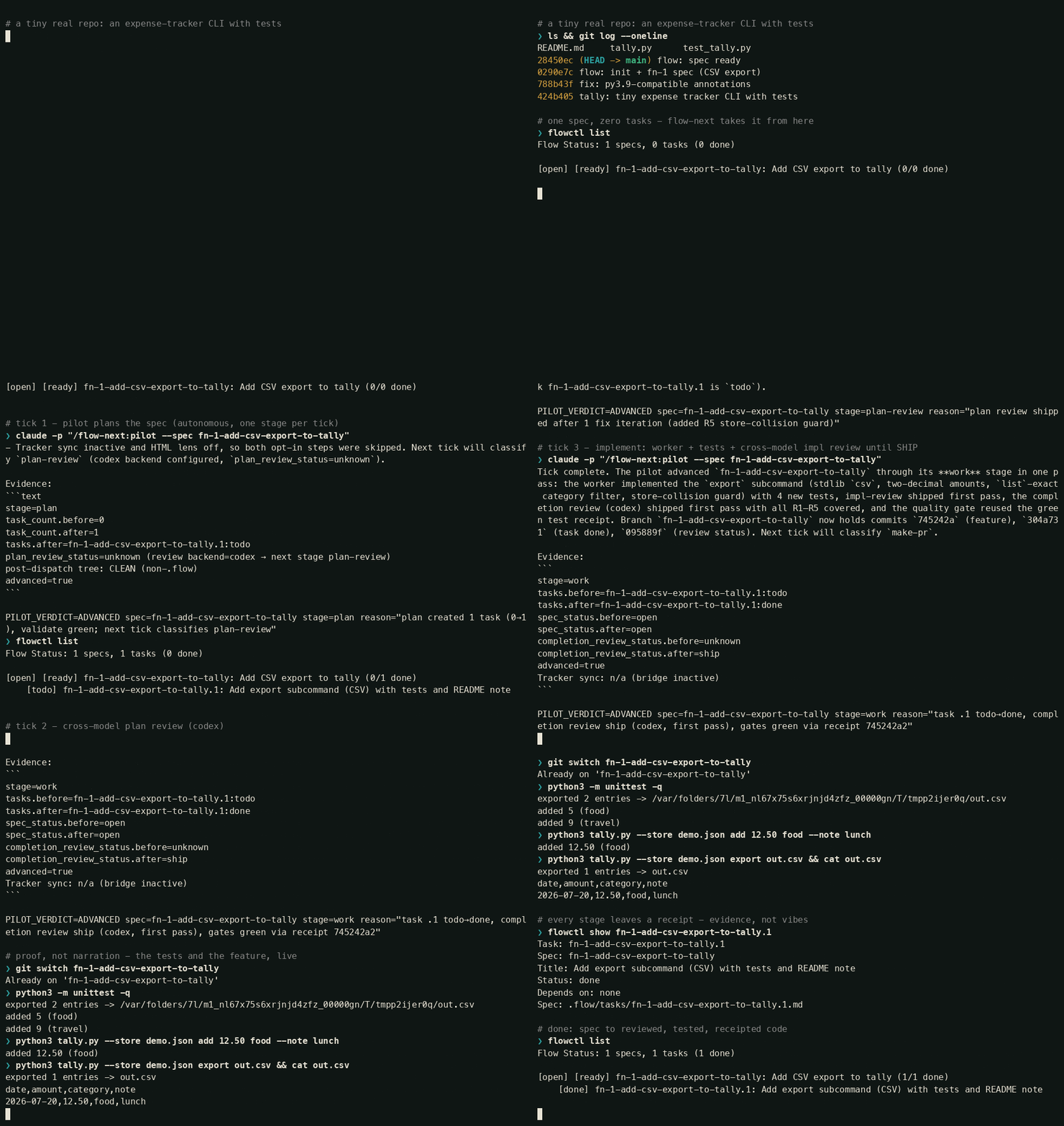
A real recorded run: plan, then cross-model plan review (catches a missing guard, fix, SHIP), then implement plus tests, then impl review SHIP, ending on the receipt. Nothing staged; every frame is live output.
The recording drives each tick with claude -p "..." (Claude Code's non-interactive / headless mode) so the whole run captures unattended. In normal use you type the prompt or the /flow-next:... command in your interactive session: same pipeline, same gates.
📖 Doc index · 👥 Teams guide · 💬 Discord · Full documentation site: flow-next.dev
Why this exists
Agentic engineering compresses implementation from weeks to hours, and it quietly removes every safety valve pre-agentic Agile relied on. The standups, the hallway clarification, the mid-flight course correction that used to finish a vague ticket over a two-week cycle: gone. When an agent can ship the task in one sitting, a rough ticket plus a chat scrollback is the whole work surface.
That work surface fails predictably. Agents drift mid-task, forget requirements, overfit to recent context, and hand reviewers 10K-line diffs with no focus signal. The bottleneck did not disappear; it moved upstream, to requirements, review, and verification. The spec has to carry the weight.
That failure surface is measured rather than asserted. SlopCodeBench (Orlanski et al., Mar 2026) chains an agent across 93 checkpoints of extending its own prior code, under specs that fix only external behavior:
- No model finished a problem. Across 11 models, not one solved a single problem end to end.
- The pass rate collapses as the work goes on. The best strict pass rate was 17.2%, down to 0.5% by the final checkpoint.
- Quality erodes with every iteration. Code quality degraded in 80-90% of trajectories, diverging further from maintained human repositories at each step.
- The cheapest fix was tested and ruled out. Quality-aware prompts lowered initial verbosity by about a third, changed the rate of decay not at all, left every pass-rate subtype statistically unchanged, and cost up to 48% more.
Better instructions do not survive iteration. What the paper's authors name as untested is enforcing structural discipline across checkpoints through tooling, and that is the bet this repo makes.
Flow-Next puts the discipline in the operating model. It turns rough intent into durable specs, specs into context-sized task graphs, task graphs into re-anchored worker runs, and implementation into reviewed PRs with receipts. From the conversation you already had to a merged pull request, it defines six named handover objects, each reviewable on its own, verified by a different model, and frozen at handover. The artifact chain is the conversation that would otherwise be missing.
What you get
Flow-Next is an AI agent orchestration plugin: agent-native skills layered on a bundled pure-stdlib Python CLI (flowctl). The host agent is the intelligence; flowctl is the deterministic plumbing. One arc, from the conversation you already had to a merged pull request: decide what to build, build it, prove it. Every skill runs from plain language, and the slash commands are the precise form of the same thing. No external services, no SaaS, no global config.
Ship more without lowering the bar. A different model reviews every plan and every implementation, the loop iterates until SHIP, and a task cannot be marked done without evidence JSON.
Reviews stop being where work waits. The pull request arrives explaining itself: which acceptance criterion each change satisfies, which decisions still need a human, what deliberately did not change.
Your team's context stops living in three people's heads. Specs, decisions, glossary, and memory are files in your repository that the next run reads. A teammate joining on Monday reads the same thing the agent does.
Climb to autonomy without a leap of faith. One dial from a supervised pair to a loop draining the backlog overnight. The gates do not change as you climb.
Spend the expensive model where it earns its keep. Route any model to any role, by parameter or by sentence. Cost and quality become steering decisions you make per task.
Your process outlives your agent.
The same specs, gates, receipts, and task state across harnesses. Everything sits in your repository under .flow/, in git and code-reviewable, and uninstall is rm -rf .flow/.
The vocabulary underneath: seven tenets
| Tenet | What it means |
|---|---|
| Spec-driven | Intent survives the chat. The unit of work is the spec, never the ticket, the transcript, or the PR title. One durable document at .flow/specs/<id>.md, evolving through layers. |
| Context-fit planning | Right-sized task slices. Specs decompose into dependency-ordered tasks, each sized to one fresh ~100k-token context window. |
| Re-anchored work | Fresh context per task. Every worker subagent re-reads the spec, the task, and git state before touching code: no token bleed, no stale assumptions. |
| Adversarial gates | Fix until SHIP. A different model (RepoPrompt / Codex / Copilot / Cursor) reviews every plan and every implementation. Different models make different mistakes, and the disagreement surface is where the gaps live. |
| Receipts | "Done" means there is proof. Commits, tests, review verdicts, and evidence recorded per task, never narration. |
| Multi-harness | One workflow everywhere. First-class on Claude Code, OpenAI Codex, Factory Droid, Cursor, and xAI Grok Build. Community port for OpenCode. |
| Self-improving | Compounds as you work. Memory, glossary, decision records, and strategy grow as side-effects of the workflow you already run, with no manual "refresh" ceremony, ever. |
Where it already runs
Flow-Next's ways of working are coached and run in enterprise engineering organisations worldwide, from CAD and construction software to proptech and education, across modern monorepos, hundred-repo microservice estates, and 30-year-old legacy stacks, on GitHub Enterprise, GitLab, and Jira. A 2-3 hour structured discovery interview reliably produces 8-11 implementation-ready specs with numbered acceptance criteria, boundaries, and task breakdowns; the edge cases surface in the interview instead of the sprint. Receipts, evidence JSON, and review gates are the audit trail enterprise adoption asks for: approval checkpoints and traceability are built in.
Adoption is not uniformly euphoric, and pretending otherwise would cost this page its credibility. The consistent pattern: product and delivery roles feel relief early, with specs they can read, evidence they can audit, and progress they can see. Senior developers feel friction early, because the pipeline formalizes judgment they already exercise implicitly, and the ceremony reads as overhead until the first review gate catches something they would have missed. The friction fades with the first caught regression; the relief does not.
The open-source record is linkable, so it speaks in its own words: an outside contributor shipping a correct flowctl patch in PR #95, a feature in awesome-claude-code-workflows for plan-first workflows, Ralph autonomous mode, and receipt-based gating (#96), and a 3-OS test matrix on every push, because the field runs all three.
"I am enjoying your version of all these cool new plugins. So far yours has worked the best." @patrickmichalina
"really enjoying this project, thanks for making it and making it public" @possibilities, external contributor
"it’s been really useful in my workflow." @raydocs
Quick start
Install
| Claude Code | OpenAI Codex | Factory Droid |
|
|
|
Why a script for Codex? Codex's plugin protocol only registers skills from plugin.json, not custom .toml agents or hooks. install-codex.sh merges the bundled agents and hooks into the active Codex home's config.toml (~/.codex by default). It is idempotent, so re-running it is safe. To install into another Codex home, run CODEX_HOME="$HOME/.codex-work" ./scripts/install-codex.sh once for that home (any path works; quote it if it contains spaces). Full platform matrix + community ports in docs/platforms.md.
Grok Build (xAI)? It picks up the Claude Code install automatically - skills, commands, and multi-agent flows verified. Details + caveats in docs/platforms.md.
The 5-command happy path
/flow-next:capture                   # 1. Synthesize conversation → .flow/specs/<id>.md
/flow-next:plan <spec-id>            # 2. Break the spec into dependency-ordered tasks
/flow-next:work <spec-id>            # 3. Execute tasks in fresh-context worker subagents
/flow-next:make-pr <spec-id>         # 4. Render a cognitive-aid PR body (9 input streams)
/flow-next:resolve-pr <PR#>          # 5. Fetch review threads → triage → resolve
That's the inner loop. Branch in (/flow-next:prospect for ranked candidates, /flow-next:chart when one oversized idea is still unclear - optional pre-capture discovery, never mandatory - /flow-next:guide when you're unsure which path is smallest, /flow-next:interview for structured discovery on an existing spec), branch out (/flow-next:pilot + /flow-next:land for the autonomous assembly line, /flow-next:audit for memory garbage collection).
You do not have to run all of it. The base loop is spec → plan → work; every other subsystem is a layer with a stated cost, a trigger, and a manual invocation. Running lean prices each one and frames the two ways to run: human-driven (you are present, so you can be the reviewer, the tracker, the QA — run lean) and autonomous (nobody is watching, so those layers are what replace you — run gated). Neither is the real mode.
After every update
Nothing to do. Nothing is copied into your repo: flowctl resolves from the plugin install on every host, the agent guide is pulled live via flowctl usage, and the spec template resolves from the bundled copy. Plugin updates land silently. Re-run /flow-next:setup only when setup tells you the docs-snippet schema bumped, or to change configuration. If a repo still carries .flow/bin/ from an older install, delete it — setup offers to, and nothing reads it. Details: platforms.md.
The pipeline is a menu, not a rail
The 5-command path is the opinionated default: rails for your first week, with everything else still available. Every stage is a composable primitive. Skip stages, reorder them, chain them in one sentence, prompt into any of them, and whichever subset you run, the same execution, evidence, and review contracts hold. (Directly answers #28 and #91.)
You never have to type a slash command or a --flag. Plain language is a first-class entry point: every skill runs from it, and every argument has a plain-language equivalent, so "implement fn-12 on a new branch and review it with codex" is /flow-next:work fn-12 --branch=new --review=codex. The explicit forms below are the precise, copy-pasteable version. The skills also compose past the pipeline: research a competitor's pricing, then "capture a spec for it"; run a load test, then "spec the fixes the numbers point to". The exploration is the input, the spec is the durable output.
Prototype first when the question needs it. Capture's input can be a conversation, a half-formed briefing package, a business-language BRD, an eval result, or a working prototype. Some questions ("how should this look?", "does this state model survive the awkward cases?") cannot be settled in prose, so build the thing badly on purpose and then "capture a spec from this prototype, ignore the code quality, I want the intent and the requirements it demonstrates." What happens to that code is a separate call made at plan time against your architecture and standards. The general move is to let something real answer the question and then capture the answer: probe a performance complaint, reproduce a bug report as the failing test that becomes R1, run an eval for a model choice, bake off candidate approaches as one task each. See Prototype-Driven Specs and the cookbook.
Capture is the intake valve; interview is the sharpening tool. Don't "interview me on this ticket" - capture the ticket first (capture also proposes whether it's one spec or several, and tags every line [user], [paraphrase], or [inferred]), then point the interview at what's actually soft. This also dissolves the "how big should a spec be?" debate: capture the entire epic and let the proposal scope it into dependency-sorted specs, then sharpen each one. The tags make it targetable: "do a business interview on this spec covering everything that was inferred" burns down exactly the lines the agent guessed, and "in-depth technical interview on R9" pressure-tests one requirement instead of re-litigating the whole spec. Capture marks the guesses; interview burns them down.
Skip stages       Tiny fix? plan + work, nothing else: /flow-next:plan "rename the config key" → /flow-next:work fn-N
One-shot chain    "Plan fn-12, run plan-review until SHIP, work every task, then make-pr." One sentence, full pipeline.
Prompt into steps "/flow-next:work fn-12 - keep the UI tasks yourself; send the API plumbing to a codex bridge"
Reorder / re-run  Interview again after planning; /flow-next:sync re-aligns tasks after implementation drift.
Parallelize       /flow-next:plan reports execution waves. /flow-next:work inspects the ready frontier, dispatches
                  a safe subset in isolated workspaces when useful, joins it, then continues; otherwise it serializes.
Route models      flowctl config set review.backend codex · per-task review: pins · a codex exec bridge for implementation.
Skills are prompts executed by the host agent. If the variation you want is not already a parameter, describe it and the host builds the arrangement on the spot (orchestration guide). Use the smallest sufficient workflow — pick stages by risk and unknowns, never by size; pipeline variations walks five worked routes from full epic down to docs chore. Full recipe catalog: flow-next.dev/cookbook.
How the flow works
flowchart LR
    Idea([Idea]) --> P[/flow-next:prospect/]
    Idea --> Ch[/flow-next:chart/]
    Idea --> C[/flow-next:capture/]
    P --> Ch
    P --> C
    Ch -->|briefing| C
    P -.->|direct via promote| L[/flow-next:plan/]
    C --> L
    C --> I[/flow-next:interview/]
    I --> L
    L --> W[/flow-next:work/]
    W --> R[/flow-next:impl-review/]
    R -->|SHIP| Q[/flow-next:qa/]
    R -->|NEEDS_WORK| W
    Q -->|YES| Done([Ship])
    Q -->|NO| W

    Done -.maintenance.-> A[/flow-next:audit/]
    A -.-> M[(.flow/memory/)]
/flow-next:chartis an optional pre-capture discovery route for one oversized or unclear idea - not a mandatory stage and never a pilot stage. Skip it when intent and boundaries are already stateable (signal absent); if you skip despite residual risk, the evidence/consent/review contracts still apply later. Unsure which path fits?/flow-next:guiderecommends the smallest sufficient route.
/flow-next:qais an opt-in live-app QA stage (after work, before make-pr): it drives the deployed app like a real user and only runs when there's a live deploy + a driver; with neither it surfaces the limitation rather than blocking. It augments, never replaces CI/staging/manual QA: the cheap first live pass that catches obvious runtime breakage before a human opens the PR. Run it by hand, or wire it into the autonomous loop as the optionalpipeline.qapilot stage (flowctl config set pipeline.qa on, default off):plan → plan-review → work → qa → make-pr.
The loop is spec-driven. Each step below maps to one skill; click through to flow-next.dev for the full page.
1. Capture, prospect, or chart (optional discovery)
Either synthesize an existing conversation into a structured spec, generate ranked candidate ideas grounded in the repo, or - when one idea is too big and still unclear - run optional /flow-next:chart decision-map discovery and hand the briefing to capture. Specs land in .flow/specs/<id>.md. Capture source-tags every acceptance criterion as [user] / [paraphrase] / [inferred] and runs a mandatory read-back, so you see exactly how much of the spec the agent invented before anything is written. Chart D-ID/evidence provenance is structural and distinct from those criterion author tags.
/flow-next:capture                    # from a conversation or chart briefing
/flow-next:prospect <focus-hint>      # ranked candidates (concept, path, constraint, volume)
/flow-next:chart "multi-tenant migration"  # optional: one oversized idea, one decision at a time
/flow-next:guide "we have a half-formed platform idea"  # smallest-sufficient router
→ flow-next.dev/skills/capture · flow-next.dev/skills/prospect
2. Interview to refine
Deep Q&A pass over a spec or task: lead-with-recommendation, confidence tiers, codebase-first investigation. Use it to flesh out an ambiguous spec before breaking it down. --scope=business|technical|both symmetrically narrows the pass, so the same skill serves the PO filling the business layer and the tech lead filling the technical layer, on the same spec file.
/flow-next:interview <spec-id>
3. Plan into dependency-ordered tasks
Research the codebase via parallel scouts, then write the spec + tasks together. Tasks fn-N.M declare blockers, inherit context from the parent spec, and declare which acceptance criteria they satisfy (satisfies: [R1, R3]). This skill does not write code, only the plan.
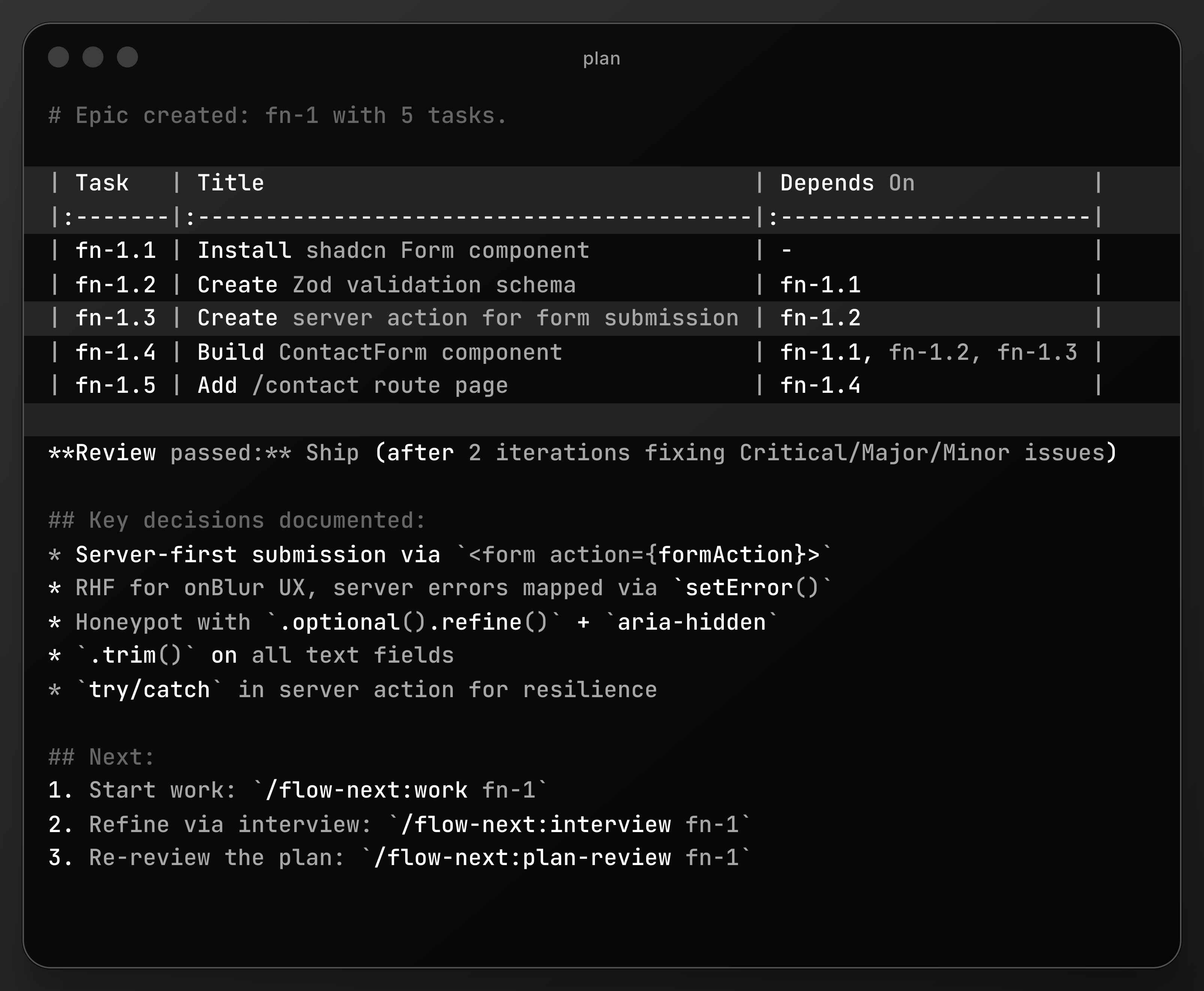
A real /flow-next:plan result: dependency-ordered tasks, cross-model review iterated to SHIP, key decisions documented.
/flow-next:plan <spec-id> # or <free-form text>
4. Work through the tasks
Execute tasks systematically: each runs in a fresh-context worker subagent, re-anchors against the spec before starting, then implements + commits + records evidence. Cross-model review gates (impl-review, plan-review) wrap the loop and iterate until SHIP.
/flow-next:work <spec-id> # or <task-id>
5. Open the PR with a cognitive-aid body
Don't ask a human to skim a 10K-line diff. /flow-next:make-pr renders a PR body from nine flow-next input streams (spec R-IDs, per-task evidence, memory hits, glossary changes, strategy alignment, deferred review findings, the diff itself), with an R-ID coverage table mapping every acceptance criterion to its satisfying task and evidence commit, and a "where to look" list that tells the reviewer which lines matter. A real one, from PR #215:
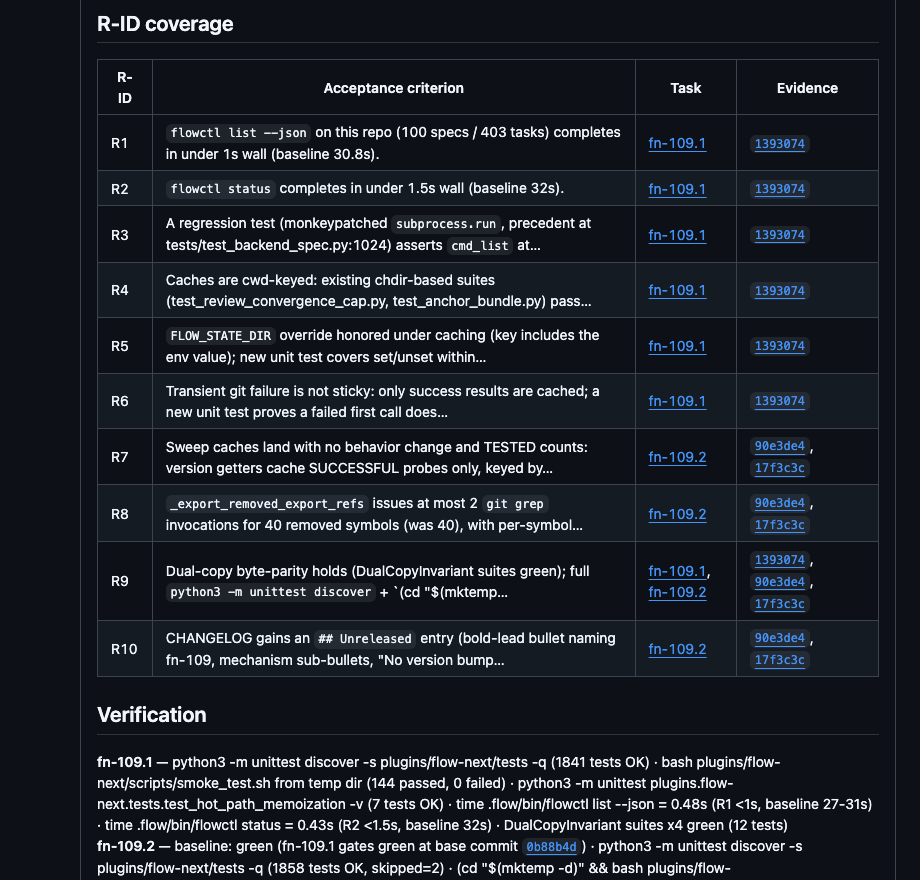
/flow-next:make-pr <spec-id> # auto-detects from current branch
Make PR also preserves one versioned, intent-ordered change walkthrough whose
identity, provenance, logical groups, file membership, deliberate non-changes,
and verification render from the same object. See the
pr-cognitive-aid consumer contract.
With HTML artifact mode on (flowctl config set artifacts.html.enabled true),
make-pr also commits a self-contained pr.html review instrument and links it
from the PR body. Same switch gives capture/plan a spec visualizer. Opt-in; see
docs/html-artifacts.md.
6. Resolve PR review feedback
Fetch unresolved threads + top-level comments + review-submission bodies, cluster them, dispatch per-thread resolver agents (parallel on Claude Code, serial elsewhere), validate, commit, then reply + resolve via GraphQL.
/flow-next:resolve-pr <PR#>
Going autonomous
Three loops, one quality bar. Multi-model review at every handover, don't-thrash reflexes (two-strike unready, auto-block, bounded CI fix budgets), and evidence over narration hold across all three. That's the differentiator from "ralph-wiggum"-style loops that run open-loop without gates.
The default path is the pilot + land pipeline, in-session, host-driven, zero scaffold:
flowctl spec ready fn-12          # bless work (or move its issue on the tracker board)
/loop 10m /flow-next:pilot        # build loop: ready spec → plan → reviews → work → draft PR
/loop 30m /flow-next:land         # ship loop: draft PR → CI green → reviews converged → merged → released
Run both concurrently (two instances, separate clones) and you have the full assembly line: board → pilot → draft PR → land → released. The ready flag (or your tracker's board state) is the consent boundary: humans bless specs, loops drain them. 📖 Going autonomous
Ralph is the hardened harness for fully planned specs (it never plans): an external shell loop drives a fresh session per iteration, so failed attempts die with the session instead of polluting the next one, under hook-enforced guardrails with receipts on disk. Ralph is deprecated — a script calling /flow-next:pilot and /flow-next:land on a loop or a cron does the same job without the scaffold and the guard hooks. Nothing is removed and existing installs keep working; new setups should use pilot + land. (Why.)
/flow-next:ralph-init           # One-time setup
scripts/ralph/ralph.sh          # Run from terminal
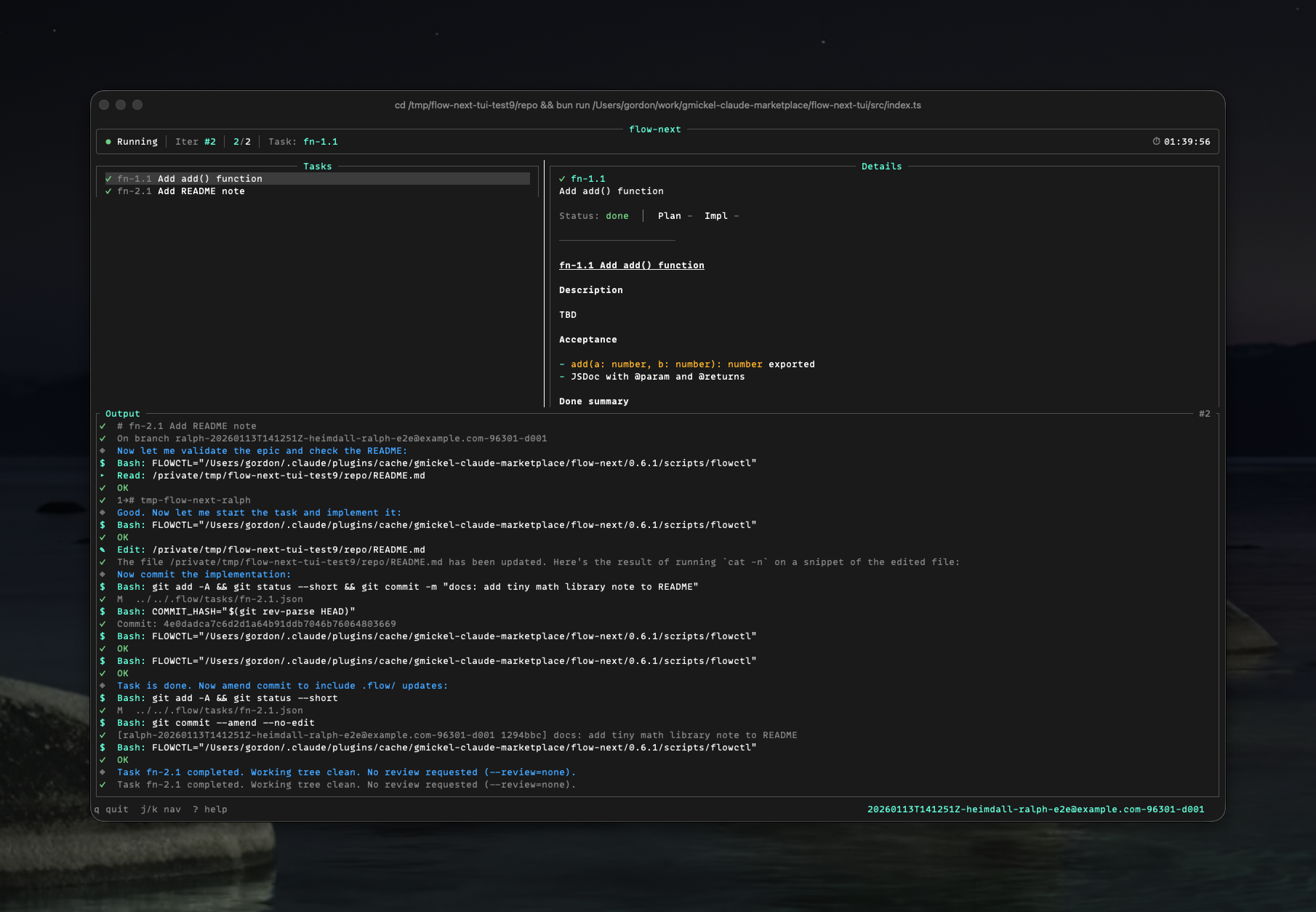
Ralph mode at night, PRs in the morning. The TUI tracks task progress, streaming logs, and run state.
Ralph deep dive · Ralph TUI (bun add -g @gmickel/flow-next-tui)
Why it works
| Problem | Solution |
|---|---|
| Context drift | Re-anchoring before every task: re-reads specs + git state |
| Context window limits | Fresh context per task: worker subagent starts clean |
| Single-model blind spots | Cross-model reviews: RepoPrompt, Codex, Copilot, or Cursor as second opinion |
| Forgotten requirements | R-IDs frozen at handover: numbered once, never renumbered; traced spec → task → commit → PR coverage table |
| "It worked on my machine" | Evidence recording: commits, tests, PRs tracked per task |
| Infinite retry loops | Auto-block stuck tasks: fails after N attempts, moves on |
| Duplicate implementations | Pre-implementation search: worker checks for similar code before writing new |
| Hallucinated specs from "I think we discussed…" | Source-tagged capture: every acceptance criterion marked [user] / [paraphrase] / [inferred], mandatory read-back loop |
| Stale project memory polluting future work | /flow-next:audit + categorized memory schema: agent reviews each entry, flags stale (never deletes) |
| 10K-line diffs with no focus signal | PR-as-cognitive-aid: R-ID coverage, critical changes, decisions, where-to-look |
| GitHub PR review threads piling up | /flow-next:resolve-pr: fetch → triage → dispatch resolver agents → reply → resolve via GraphQL |
| One model doing everything | Orchestration & model routing: four named tiers (reviewer / implementer / fast scout / thinking scout) you fill in once in your own CLAUDE.md, a reach page per harness, per-task reviewer routing, promptable overrides (docs) |
What Flow-Next is not
Scope honesty, because the architecture depends on it:
- Not a hosted dashboard or SaaS tier. Everything is in the repo; a hosted layer would break the uninstall promise.
- Not a Jira/Linear replacement for human-only teams. Flow-Next is for agentic-engineering teams. If your team lives in a tracker,
/flow-next:tracker-syncprojects specs to it: projection, not coordination. The spec stays the source of truth; the tracker never drives flow state or spawns agents. (Contrast OpenAI Symphony, where the tracker is the control plane. Flow-Next is "Symphony, but with real specs, re-anchoring, and receipts.") - Not split-file specs. One durable spec document evolving through layers, versus Kiro-style
requirements.md/design.md/tasks.mdfragmentation. - Not a replacement for human judgment. Humans own product decisions, risk tolerance, merge decisions, and production responsibility. Flow-Next makes those decisions easier to verify because the evidence is structured.
- Not waterfall. Waterfall means irreversible phases, a plan frozen at minimum knowledge, and handovers that discard what the next phase learns. Flow-Next has none of them: stages are re-enterable (re-interview after planning exposes a hole, re-plan after a task proves the approach wrong), the spec is captured at the moment of most knowledge because exploration comes first, and evidence is written back into the spec as work proceeds. It does ask for more thought earlier than a loose ticket does; it does not ask for more commitment earlier. The spec is a ratchet, not a gate. Full argument: Prototype-Driven Specs.
Commands
The 25 command-backed skills are invocable as /flow-next:<name> or in plain language; the 5 phrase-triggered skills answer to plain language (and to their full skill name, below). The inner loop is capture → plan → work → make-pr → resolve-pr. Upstream of it sit strategy, prospect, optional chart (pre-capture decision map for oversized unclear ideas), guide (smallest-sufficient router), and interview; around it, the review gates (plan-review, impl-review, spec-completion-review, qa); after it, the loops (pilot, land, ralph-init) and the maintenance skills (audit, sync, memory-migrate). visual sits beside all of them: point it at a spec, a task, a diff, or the conversation and it restates the thing as a compact markdown digest — task tree, file-layout diff, R-ID coverage — for when the text is too dense to review by reading (plain-language triggers on description-matching hosts; explicit-only on Codex — see docs/platforms.md). setup, prime, tracker-sync, and map handle the project itself.
Phrase-triggered skills (no dedicated slash command, just ask): flow-next-deps ("what's blocking what?", dependency graph + execution order), flow-next-drive (drive a running app like a real user; powers /flow-next:qa), flow-next-export-context (export RepoPrompt context for external-LLM review), flow-next-worktree-kit (worktree create/list/switch/cleanup + .env copying), and base flow-next ("show me my tasks", "what's ready?"). On hosts that surface skills as commands (Claude Code does), each is also invocable by its full skill name, e.g. /flow-next:flow-next-worktree-kit.
Full catalog of all 30 skills (25 slash-command, 5 phrase-triggered), with triggers, one-liners, and every flag: docs/skills.md. Full CLI reference (every command, every default): docs/flowctl.md. Steering all of it, from model routing to review backends, bridged implementation, and loop chaining: docs/orchestration.md.
Adopting in a team
Flow-Next is a methodology with a tool attached. The teams guide maps the AI-native SDLC onto concrete commands: the six handover objects, Spec-as-PR (review the 50-line spec before the 500-line implementation exists), parallel work from one spec, the symmetric interview (PO and tech lead run the same skill on the same file), and a week-1 → month-1 → quarter-1 adoption ladder.
Teams that live in Linear, GitHub Issues, GitLab, or Jira keep their board: the tracker bridge projects every spec to an issue, two-way. On Linear, make-pr output is also Linear Diffs-ready, so you review the PR inside the issue. → docs/teams.md · docs/tracker-sync.md
Rolling it out to everyone? On Claude Code you can skip the per-developer install: deploy the marketplace + plugin org-wide via a managed-settings.json (MDM/GPO, using extraKnownMarketplaces + enabledPlugins), or commit a .claude/settings.json to a repo for prompt-on-trust install. Each repo still needs /flow-next:setup. → Install: team / org-wide deployment
Where to look
The repo holds the offline-resilient reference. flow-next.dev holds the narrative, browseable guide. Pick by audience.
| Looking for… | Repo file | Website |
|---|---|---|
| 5-minute pitch + install | README.md (this page) | flow-next.dev |
| Skills catalog: all 30 skills, triggers, one-liners | docs/skills.md | n/a |
| Adopting in a team, handover objects, Spec-as-PR, adoption ladder | docs/teams.md | Teams guide |
Full flowctl CLI reference: every command, every flag | docs/flowctl.md | n/a |
| Which layers to run at all: human-driven vs autonomous profiles, every optional layer priced | docs/running-lean.md | n/a |
| Ralph autonomous mode internals (deprecated): hooks, receipts, DCG | docs/ralph.md | n/a |
| Optional HTML render lenses: spec visualizer + PR review instrument | docs/html-artifacts.md | n/a |
Live-app QA: /flow-next:qa, spec-derived scenarios, P0/P1/P2 findings, qa_verdict receipt | skills/flow-next-qa/SKILL.md | n/a |
.flow/ directory layout, spec-first task model, ID format | docs/architecture.md | n/a |
| Spec template: R-ID rules, confidence anchors, receipt schema | docs/spec-template.md · canonical scaffold at templates/spec.md | n/a |
| Structured review findings: versioned receipt schema, lineage/currentness, anchors, bounds, consumer fallback | docs/review-findings.md | Receipts |
| Memory schema: bug / knowledge tracks, frontmatter, audit lifecycle | docs/memory-schema.md | n/a |
| Self-improving loops: memory, glossary, decisions, strategy | docs/self-improving.md | n/a |
Tracker-sync bridge: projection model, hybrid ids, deterministic flowctl tracker transport, /flow-next:tracker-sync vs /flow-next:sync | docs/tracker-sync.md | n/a |
Project glossary feature: GLOSSARY.md shape, flowctl glossary verbs, R17 forbidden-vocabulary guard | docs/glossary.md · this repo's own: GLOSSARY.md | n/a |
Project strategy: STRATEGY.md shape, downstream skill grounding | docs/strategy.md · STRATEGY.md | n/a |
| Cross-platform install matrix + Codex / Droid / OpenCode notes | docs/platforms.md | n/a |
scripts/sync-codex.sh pipeline, plain-text transform, validation guards | docs/sync-codex.md | n/a |
| Troubleshooting: stuck tasks, Ralph debug, receipt validation, uninstall | docs/troubleshooting.md | n/a |
| Contributing: local dev, adding skills, releasing | CONTRIBUTING.md | n/a |
| Repo strategic intent + active tracks | STRATEGY.md | n/a |
| Vocabulary dictionary (terms + banned synonyms) | GLOSSARY.md | n/a |
| Visual overview, diagrams, methodology | n/a | flow-next.dev |
Doc index with one-line descriptions: plugins/flow-next/docs/README.md.
Requirements
- Python 3.11+ (or the
pylauncher on Windows): the bundledflowctlCLI is pure-stdlib. Launchers skip broken aliases and working interpreters below the supported floor before loading flowctl. jqandgh: required for the review subsystem and PR plumbing.bun(optional): only needed for the Ralph TUI.
Platforms
First-class on Claude Code, OpenAI Codex, Factory Droid, Cursor, and xAI Grok Build. Community port for OpenCode.
| Platform | Status |
|---|---|
| Claude Code | First-class (canonical surface) |
| OpenAI Codex (CLI + Desktop) | First-class (mirror at plugins/flow-next/codex/, regenerated by scripts/sync-codex.sh) |
| Factory Droid | First-class (regex-OR matchers handle Execute ↔ Bash) |
| Cursor | First-class. Recommended: team-marketplace repo import (admin imports this GitHub repo via the Cursor GitHub App; Default Off/On/Required; auto-refresh on push). Fallback: local plugin (./scripts/install-cursor.sh / install-cursor.ps1). Skills, commands, multi-agent, native asks, slash autocomplete verified; Ralph intentionally not built for Cursor (details) |
| Grok Build (xAI) | First-class via Claude Code compatibility: skills, /flow-next:* commands, hooks, and multi-agent flows (verified). Type /flow-next: to open the command autocomplete; /flow-next- filters the separate hyphen-named skill surface. Ralph intentionally not built (details) |
| OpenCode | Community port: flow-next-opencode |
Detailed install + cross-platform patterns in docs/platforms.md, the canonical home for the tiering sentence above.
Upgrading from 0.x? The 1.0 release renamed the
epicsurface tospec; the legacy aliases and automated migration commands were removed in 3.0. Update the plugin, then follow the manual three-step pre-1.0 layout port in troubleshooting.
Ecosystem
| Project | Platform |
|---|---|
| flow-next-opencode | OpenCode |
| FlowFactory | Factory.ai Droid |
| Ralph TUI | Cross-platform TUI for Ralph runs |
Contributing
Bug reports and PRs welcome: start at CONTRIBUTING.md (local dev, adding skills, the docs-only rule) and SECURITY.md for private disclosure. Questions and show-and-tell: GitHub Discussions. Or come say hi on Discord.
Every PR runs the same gate: the full test suite on a 3-OS matrix (Ubuntu / macOS / Windows) plus an offline docs-linkcheck - green CI is the merge floor.
Also check out
GNO: local hybrid search for your notes, docs, and code. Long-term memory over your files via MCP.
bun install -g @gmickel/gno && gno mcp install --target claude-code
License
MIT. See LICENSE.


