xupersplit
Split shared expenses without the fuss. Create a split, share the link, and let everyone add what they paid — balances and who-owes-whom are worked out automatically, with one-tap payments straight from the balance view.
split.xuper.fun · English · Svenska



Next.js 16 · Supabase · Tailwind v4 · wagmi/viem

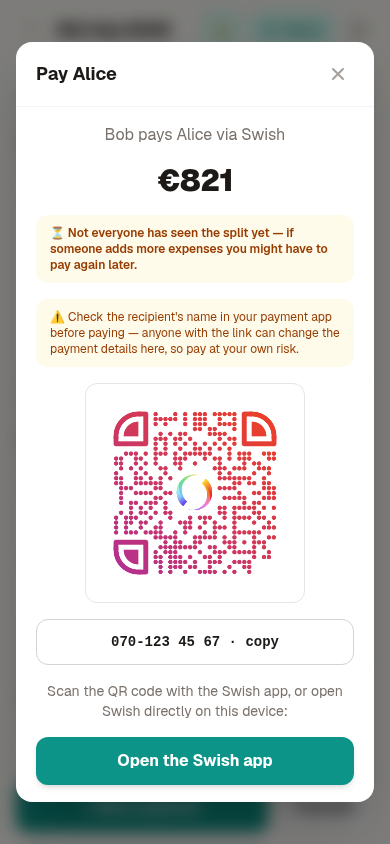
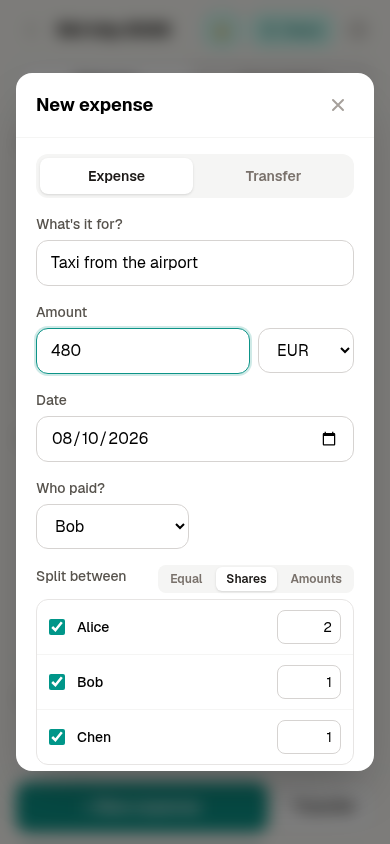
Create a split and see who owes whom · a Swish QR with the amount already in it · splitting by shares
Works with AI agents. xupersplit is an MCP server too — point your assistant at one URL and it can create the split, add what everyone paid and tell you who owes whom. No account, no API key, nothing to install.
claude mcp add --transport http xupersplit https://split.xuper.fun/api/mcp
What it is
A clean, accountless expense splitter. The secret link is the key — anyone with it can add expenses and settle up; no login required. Optional email sign-in just makes your splits follow you across devices. Built as a one-prompt project and grown from there.
Features
- No account needed. The unguessable split link (122 bits of entropy) is the capability. Sign-in is optional.
- Flexible splitting — equal, weighted shares, or exact amounts, with cent rounding via the largest-remainder method.
- Smart settlements — the minimum set of "A pays B" transfers, with partial payments ("pay all or part") and strike-through once settled.
- Don't settle too early — see who has opened the split and who's marked themselves done; the pay dialog warns if someone hasn't weighed in yet.
- Secure splits (optional, when signed in) — bind participants to their accounts: you can only edit your own payment details and enter your own expenses. The creator picks who must log in, who can view, and how people join.
- Multi-currency — enter expenses in any currency with the rate locked at save (Kittysplit-style); set a main currency per split. Includes sats — run a whole split in bitcoin if you like.
- Eight payment methods, several with genuine one-tap prefill — see below.
- MCP server — AI agents can run a whole split over Model Context Protocol, with no account and no API key.
- Six languages — English, Svenska, Norsk, Dansk, Suomi, Íslenska (auto-detected, switchable).
- Privacy by design — payment details can be wiped once everyone is square, inactive splits are purged after 6 months, IP hashes deleted within a day, CSV/JSON export, full GDPR policy.
- Dark / light / system theme, cookie-less analytics, discreet cookie notice.
Payments
xupersplit stores each recipient's payment handle(s) and, wherever a payment network exposes an open, agreement-free interface, turns the balance row into a real one-tap payment — prefilled with the exact amount. No money ever passes through xupersplit; it only builds the link/invoice/transaction the payer approves in their own app.
| Method | Experience | How |
|---|---|---|
| Swish 🇸🇪 | QR + app deep link, amount prefilled | Public app.swish.nu link + QR endpoint — no merchant contract |
| Lightning ⚡ | QR + lightning: link, exact amount baked in | LNURL-pay (LUD-16): a lightning address → BOLT11 invoice |
| Ethereum / USDC Ξ | One-tap prefilled USDC transfer | WalletConnect (Reown AppKit) — connect, pick chain, approve |
| Solana / USDC ◎ | One-tap prefilled USDC SPL transfer | WalletConnect (Reown AppKit) — Phantom/Solflare, recipient ATA auto-created |
| Ethereum / Solana address | Address QR + copy, ENS resolved | 0x… / name.eth / base58 — for any wallet |
| Revolut | Clickable revolut.me profile link | Opens the recipient's profile to pay |
| Vipps · MobilePay · IBAN | Stored handle + copy button | No open P2P API — the payer finishes in their own app |
Why the difference? Swish exposes a genuinely open prefilled deep link and QR endpoint; Lightning's LNURL and EVM/Solana over WalletConnect are open protocols. Vipps and MobilePay (now Vipps MobilePay) only offer amount-prefilled flows through their merchant APIs — a business agreement that routes money to a company, not person-to-person — so for those xupersplit does the honest thing and shows the handle with a copy button. If they ever ship an open P2P deep link, wiring it in is a small change. PRs welcome. 🤞
Crypto is irreversible. Crypto methods show extra warnings, and any method warns (with a date) if the recipient's details were ever changed from what was first entered — anyone with the link can edit them.
MCP server
xupersplit speaks Model Context Protocol, so an AI assistant can create a split, add what everyone paid and report who owes whom — then hand you the link to share. Accountless like the rest of the app: no sign-up, no API key.
claude mcp add --transport http xupersplit https://split.xuper.fun/api/mcp
Or point any MCP client at https://split.xuper.fun/api/mcp (Streamable HTTP;
stdio-only clients can bridge via npx mcp-remote). Self-hosted instances get
the same endpoint at their own /api/mcp.
It also works as a custom connector in Claude and ChatGPT on the web — paste the endpoint, no authentication. ChatGPT needs developer mode switched on first, or the option to add one isn't there at all. Step-by-step at /mcp.
Eleven tools cover the whole lifecycle — create_split, get_split,
add_expense, record_payment, update_entry, delete_entry,
add_participant, rename_participant, remove_participant,
set_payment_methods, update_split. People are referred to by name and
amounts are plain decimals, so an agent never handles uuids or cents.
The server is a thin layer over the same RPCs and money.ts helpers the web app
uses, and it only ever holds the anonymous role — which is what keeps secure
splits (they need a signed-in auth.uid()) unreachable over MCP. Full details
at /mcp.
Architecture
- No service-role key in the app. All data access goes through
security definerPostgres RPCs (split_data,save_entry,set_payment_methods, …) where the secret split key in the URL is the capability. RLS is deny-all on every table and direct grants are revoked — the client only ever holds the public publishable key. Schema and every change live insupabase/migrations/. - Next.js App Router + server actions; the client is plain React, no state library. Tailwind v4 with CSS-variable theming.
- Thin, keyless API routes proxy the open payment networks, all
same-origin-locked:
/api/swish-qr,/api/ln-invoice(LNURL-pay),/api/ens(viem),/api/fx(fiat + BTC, with provider fallback). - WalletConnect is fully gated on a project id — absent, the EVM dialog cleanly falls back to QR + copy.
- Privacy & abuse controls — settle-time payment wipe (opt-out), 6-month purge of inactive splits, per-IP-hash + global create rate limits, and a daily job that flags split-key enumeration attempts.
Tech stack
Next.js 16 · React 19 · TypeScript · Tailwind CSS v4 · Supabase (Postgres, Auth) · wagmi + viem + @solana/web3.js + Reown AppKit · Playwright · Vercel
Run it locally
npm install
cp .env.example .env.local   # add your own Supabase URL + anon key
npm run dev
.env.local:
NEXT_PUBLIC_SUPABASE_URL=https://<your-project>.supabase.co
NEXT_PUBLIC_SUPABASE_ANON_KEY=<your publishable key>
# Optional — enables the WalletConnect USDC flow (free id from cloud.reown.com)
NEXT_PUBLIC_REOWN_PROJECT_ID=<your reown project id>
Deploy your own
Self-hostable on the free tiers of Supabase + Vercel.
- Supabase — create a project (EU regions keep data in Europe), then apply
the schema with
supabase link --project-ref <ref> && supabase db push(runs every migration insupabase/migrations/). Grab the Project URL and publishable (anon) key. For optional email sign-in, configure SMTP and the…/auth/confirmredirect. - Vercel — import the repo, add
NEXT_PUBLIC_SUPABASE_URLandNEXT_PUBLIC_SUPABASE_ANON_KEY(both safe to expose; security relies on RLS- RPCs). Add
NEXT_PUBLIC_REOWN_PROJECT_IDtoo if you want WalletConnect. Deploy.
- RPCs). Add
- Custom domain (optional) — add it in Vercel, point a DNS-only CNAME
to
cname.vercel-dns.com, and add the domain's…/auth/confirmto the Supabase redirect allowlist if using email sign-in.
Full self-host with Docker
Prefer to own the whole stack? selfhost/ brings up the app and
its own backend — Postgres, auth (GoTrue), the REST/RPC layer (PostgREST) and
a local mailbox — with no external services. The app itself acts as the gateway,
so the browser only ever talks to one origin.
cd selfhost
cp .env.example .env       # ⚠️ change the secrets — see the notes in the file
docker compose up -d --build
- App: http://localhost:3000. Sign in with email + password (works instantly, no SMTP needed) — or use the magic code, which lands in Mailpit at http://localhost:8025.
- HTTPS is one flag away: point a domain at the host, set
DOMAIN+ACME_EMAILandSITE_URL=https://…in.env, thendocker compose --profile tls up -d --build— Caddy fetches and renews a Let's Encrypt certificate automatically. Behind NAT or want a wildcard cert? SetCF_API_TOKEN(a scoped Cloudflare token) and Caddy uses the DNS-01 challenge instead — no port 80 exposure needed. - The migrations in
supabase/migrations/are applied automatically on first start. .env.exampleships with public demo JWT keys so it runs out of the box. For anything internet-facing, changeJWT_SECRET+ the passwords and regenerateANON_KEY/SERVICE_ROLE_KEY(any JWT tool works — sign{"role":"anon",...}/{"role":"service_role",...}with the new secret).- Set
APP_PORT/MAILPIT_PORTin.envto change host ports;REOWN_PROJECT_IDenables the WalletConnect pay buttons.
See selfhost/README.md for the full guide —
secret regeneration, the gateway architecture, Cloudflare DNS-01, a config
reference and troubleshooting.
Tests & CI
Playwright smoke tests (npm run test:e2e) run on every PR against a local
production build, gating merges to main; the pure split/balance/settlement
logic lives in src/lib/money.ts.
Contributing
Issues and PRs are welcome, and so is a bug report from someone who just used the site. Start with CONTRIBUTING.md.
Never post a split link. A split's URL is its password — anyone who sees it can read and edit that split, and issues are public and indexed. Describe the problem, or make a throwaway split with fake names.
- 🐛 Report a bug — or just email split@xuper.fun if a GitHub account is a hassle
- 💡 Suggest a feature
- 🔒 Report a vulnerability privately — never as a public issue; see SECURITY.md
- 🌱 good first issue — small, self-contained tasks
Most wanted right now: a real open P2P deep link for Vipps or MobilePay so the amount can be prefilled the way Swish and Lightning already do, plus additional payment rails and translation fixes across the six locales. The codebase is small and fully typed.
License
MIT — see LICENSE.
If xupersplit saved your group some bickering, you can

built with love, coffee and beer