Mushi Mushi
Your AI wrote it. Mushi tells you why it broke.
Plain-English diagnosis + a paste-ready fix, right inside Cursor and Claude Code. No log-reading. No second LLM API key for MCP.
Fastest path — drop Mushi into your AI editor:
npx mushi-mushi setup --ide cursor # or: --ide claude
Already shipping an app? One command installs the SDK + env vars + an optional test report:
npx mushi-mushi
Open source, self-hostable, MIT JS core — bring your own LLM key, no second key for MCP, no lock-in. Self-host in minutes · licensing.
What is Mushi, exactly? Read the one-page constitution: VISION.md — the single source of truth for positioning, the north-star sentence, and who this is for.




Node ≥22 · CI · SDK MIT · enterprise · Smithery
Vision · Quick start · Connect your editor · Self-host · Sentry enrichment · Packages · Docs · Live demo · Operators / platform · Roadmap
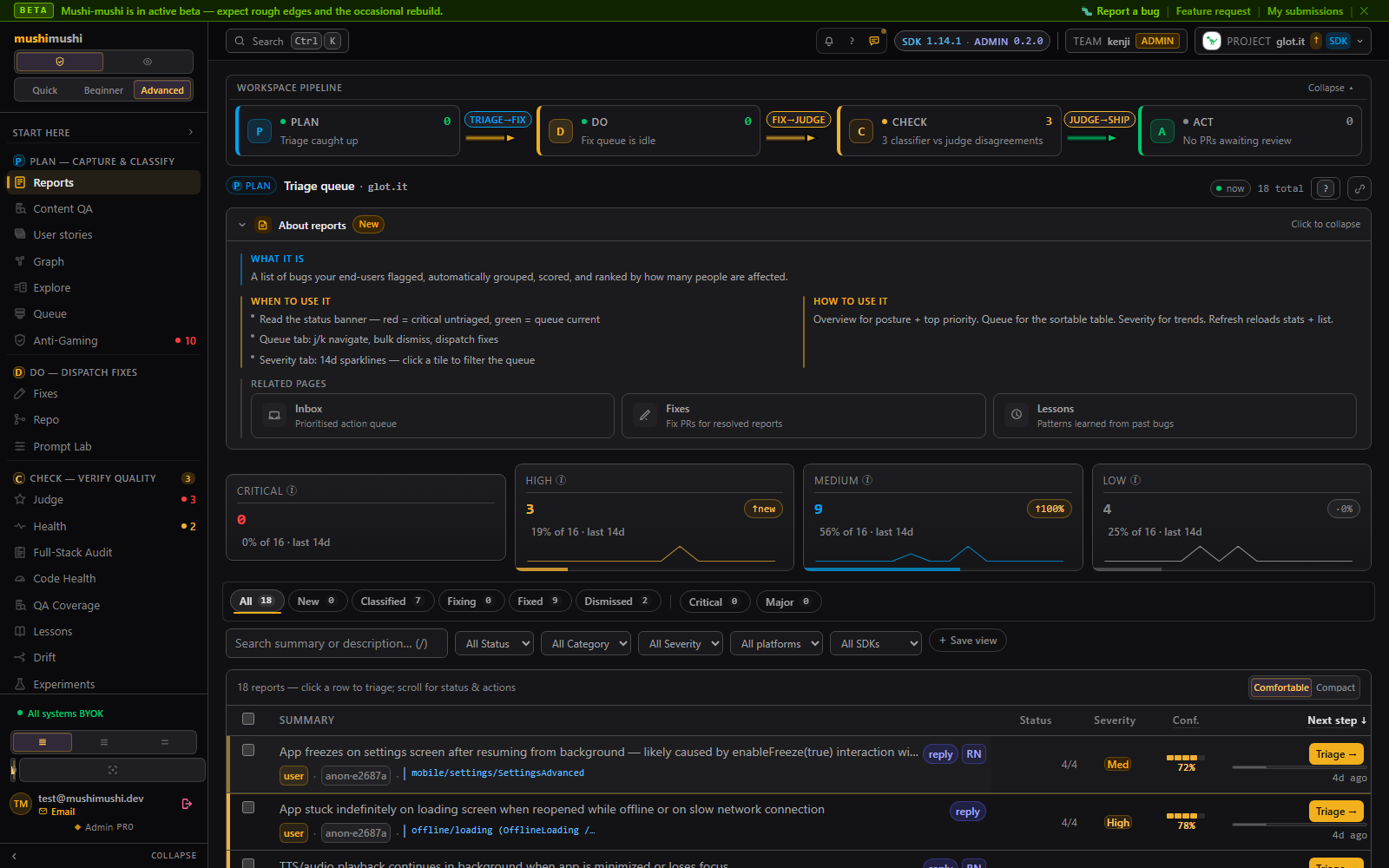
↑ the diagnosis: plain-English root cause + a paste-ready fix prompt · click to open the live demo
60-second proof
Using Cursor, Claude Code, or another AI editor? Paste this prompt and your agent does the whole setup — install, wiring, and a verified test report:
Install the Mushi skills from github.com/kensaurus/mushi-mushi (
npx skills add kensaurus/mushi-mushi), then run the mushi-setup skill to wire the Mushi SDK and MCP server into this app and send a test report to verify the connection.
Or run the wizard yourself:
npx mushi-mushi
The wizard auto-detects your framework, installs the right SDK, writes framework-prefixed env vars (e.g. VITE_MUSHI_PROJECT_ID / VITE_MUSHI_API_KEY, or NEXT_PUBLIC_MUSHI_*) to .env.local, and prints the snippet to paste. Those two vars are all the SDK needs — no Supabase, no LLM key (see examples/sdk.env.example; the root .env.example is for self-hosting the backend only). Then, the moment something breaks:
- The bug lands in your queue — screenshot, the user's note, the route, the last console + network events, device context.
- Mushi produces the diagnosis: a plain-English root cause + a fix you can paste.
- You pull it into your editor over MCP:
npx mushi-mushi setup --ide cursor # then ask Cursor: "what's broken in prod?"
No Sentry, no account, no monitoring stack required to see value. Self-host the whole thing in under five minutes, or use the free hosted tier (no card).
What this is
For the solo AI-first builder (the vibe coder): you ship fast with Cursor, Claude Code, Lovable, or Bolt, then lose afternoons when something breaks in code you didn't fully write. Mushi is the comprehension layer — plain-English diagnosis in your editor over MCP, so a bug costs five minutes instead of your afternoon. (Small teams and agencies hit the same pain.)
These are the bugs your monitoring can't see, and the ones you didn't write:
- A user added a coupon and the pay button slipped under their keyboard.
- A new signup tapped Save twice because nothing visibly happened the first time.
- A Pro customer's dashboard takes 12 seconds to load — and they've opened the competitor's tab.
- A layout that looks fine on your laptop folds in half on the one Android model used by 18% of your traffic.
What it is not
Not another dashboard you have to go read, and not an enterprise monitoring stack — standalone first, no Sentry/Datadog/Firebase required. Full positioning: VISION.md.
The diagnosis loop
When a user shakes their phone (or clicks the reporter):
- Capture — screenshot, route, user note, recent console + network events, device context.
- Classify — two-stage LLM tags severity, category, and a plain-English root-cause hint. The screenshot goes through an air-gapped vision pass that can't see the text prompt. A nightly judge scores the classifier and feeds a prompt-A/B loop.
- Connect — the report embeds into a knowledge graph (Postgres + pgvector). The same broken button reported twenty times shows up as one row, not twenty.
- Fix (optional) — Dispatch fix (or Slack / MCP / CI) runs an agent in a sandbox, runs your tests, and opens a draft PR. You review it like any other PR.
flowchart LR
    subgraph App["Your app"]
        SDK["mushi-mushi/{react, vue, svelte, angular, …}<br/>shadow-DOM widget · screenshot · console · network"]
    end
    subgraph Edge["Supabase Edge (Hono gateway + ~50 functions)"]
        API["api"]
        FF["fast-filter"]
        CR["classify-report<br/>+ vision + RAG"]
        ORCH["fix-worker"]
    end
    subgraph DB["Postgres + pgvector"]
        REP["reports"]
        KG["knowledge graph"]
        FIX["fix_attempts"]
    end
    subgraph Agents["mushi-mushi/agents"]
        SBX["sandbox: e2b / modal / cloudflare"]
        GH["GitHub PR"]
    end
    SDK -->|HTTPS| API
    API --> FF --> CR
    CR --> KG
    CR --> REP
    REP --> ORCH --> Agents
    Agents --> GH
The architecture, sequence diagram, and component-by-component spec live in apps/docs/content/concepts/architecture.mdx.
Self-host in under 5 minutes
A single Docker Compose file gets you a working stack against your own Supabase project:
cd deploy
cp .env.example .env   # ANTHROPIC_API_KEY, Supabase creds
docker compose up -d
SELF_HOSTED.md and the Self-host in minutes guide are the long-form walkthroughs. A Helm chart lives at deploy/helm/ — one helm install on any cluster.
Hosted: sign up at kensaur.us/mushi-mushi/, click Start free, no card, create a project, and copy your projectId + apiKey. The free tier covers 50 diagnoses a month (no card required).
One BYOK rule, both ways. Self-host and you bring your own Anthropic / OpenAI key — you pay the vendor at list rate, we never mark up a token. On hosted you bring no key at all: we meter by diagnosis (the plain-English root cause + fix), never by tokens, with a per-project spend cap and 50 / 80 / 100% alerts so the bill can't surprise you. Full numbers: pricing.
Internal edge functions (
fast-filter,classify-report,fix-worker,judge-batch,intelligence-report,usage-aggregator,generate-synthetic) authenticate viarequireServiceRoleAuth. Never expose them with--no-verify-jwt. Only the publicapifunction should face the internet — seepackages/server/README.md.
Sentry enrichment
Mushi works standalone. If you already run Sentry, Mushi enriches it: Sentry owns "errors your code throws"; Mushi owns the bugs that don't throw (dead buttons, 12-second screens, layouts that break on one phone) and the plain-English diagnosis + fix Sentry's $80/mo Seer tier reserves for bigger teams.
Inbound adapters forward Sentry (and Datadog, Bugsnag, Rollbar, Crashlytics, New Relic, Honeycomb, Grafana Loki, CloudWatch, Opsgenie, Firebase) alerts into Mushi for deeper fix context; outbound plugins send Mushi's verdicts back so a Sentry issue auto-resolves the moment Mushi merges its fix. The full enrichment / synthesis story lives in docs/operators/ — it's the upgrade path, never the front door.
| Mushi | Sentry | Langfuse | |
|---|---|---|---|
| Catches | Thrown errors and silent UX bugs (dead clicks, slow screens, layout breaks) | Thrown errors, performance traces | LLM call traces, prompt evals |
| Output | Plain-English root cause + paste-ready fix, in your editor | Stack trace + breadcrumbs, in a dashboard | Trace tree + scores, in a dashboard |
| Auto-fix | Optional: sandbox agent opens a draft PR | Seer add-on (paid) | Not in scope |
| Second LLM key for MCP | No — reuses your app's key | N/A | N/A |
| Setup | One command, no account required to try | SDK + DSN + dashboard | SDK + project + dashboard |
Different jobs: Sentry watches what your code throws, Langfuse watches what your LLM calls do, Mushi watches what your user experiences — including the bugs that never throw.
Framework coverage
Most developers install one SDK — npx mushi-mushi picks it for you. React/Next.js quick start:
npm install @mushi-mushi/react # also covers Next.js
import { MushiProvider } from '@mushi-mushi/react';

function App() {
  return (
    <MushiProvider config={{ projectId: 'proj_xxx', apiKey: 'mushi_xxx' }}>
      <YourApp />
    </MushiProvider>
  );
}
Other frameworks — Vue, Svelte, Angular, React Native, Vanilla JS, iOS, Android, Flutter
// Vue 3 / Nuxt
import { MushiPlugin } from '@mushi-mushi/vue';
app.use(MushiPlugin, { projectId: 'proj_xxx', apiKey: 'mushi_xxx' });

// Svelte / SvelteKit
import { initMushi } from '@mushi-mushi/svelte';
initMushi({ projectId: 'proj_xxx', apiKey: 'mushi_xxx' });

// Angular 17+
import { provideMushi } from '@mushi-mushi/angular';
bootstrapApplication(AppComponent, { providers: [provideMushi({ projectId: 'proj_xxx', apiKey: 'mushi_xxx' })] });

// React Native / Expo
import { MushiProvider } from '@mushi-mushi/react-native';

// Vanilla JS / any framework
import { Mushi } from '@mushi-mushi/web';
Mushi.init({ projectId: 'proj_xxx', apiKey: 'mushi_xxx' });
iOS (Swift PM, v0.4.0): .package(url: "https://github.com/kensaurus/mushi-mushi.git", from: "0.4.0") · Android (Gradle): dev.mushimushi:mushi-android:0.4.0 · Flutter: pub add mushi_mushi.
Want a runnable example?
examples/react-demois a minimal Vite + React app with test buttons for dead clicks, thrown errors, failed API calls, and console errors.
Full package list and maturity table: SDK reference.
Where it stops
Mushi is honest about what's still partial. Skim before you commit:
| Area | Working | Still partial |
|---|---|---|
| Classification | Haiku fast-filter, Sonnet deep + vision air-gap closed, structured outputs, prompt-cached prompts, pg_cron self-healing, Stage 2 streaming via streamObject with progressive reports.stage2_partial UI updates and OpenAI fallback | — |
| Judge / self-improve | Sonnet judge with OpenAI fallback, prompt A/B auto-promotion via judge → avg_judge_score → promoteCandidate, OpenAI fine-tune adapter end-to-end (submit JSONL → poll → predict against fine_tuned_model_id, BYOK OPENAI_API_KEY), Bedrock fine-tune adapter (SigV4-signed CreateModelCustomizationJob, requires MUSHI_BEDROCK_FINETUNE_ENABLED=1 + AWS BYOK keys) | Anthropic fine-tune API is not publicly self-service in 2026 — the adapter stub links to the access-request form. |
| Fix orchestrator | Single-repo validateResult gating, GitHub PR, MCP JSON-RPC 2.0 client, multi-repo coordinator, first-party ClaudeCodeAgent (spawns local claude CLI) and CodexAgent (OpenAI Responses API, BYOK) — both gated behind explicit env flags so shared deployments never invoke them unintentionally | — |
| Sandbox | Provider abstraction; local-noop (tests) + e2b / modal / cloudflare (prod). Production refuses local-noop unless MUSHI_ALLOW_LOCAL_SANDBOX=1. | — |
| Verify | Playwright screenshot diff + step interpreter (navigate / click / type / press / select / assertText / waitFor / observe) | — |
| Enterprise | Plugin marketplace + HMAC, audit ingest, region pinning, retention CRUD, Stripe metering, SAML SSO via Supabase Auth Admin API, OIDC SSO self-service — see the commercial boundary below for which of these are paid/Enterprise-tier | — |
| Graph backend | SQL adjacency over graph_nodes / graph_edges ships in every deployment | Apache AGE is a hosted-tier enhancement when the extension is installed. Managed Supabase stays on SQL adjacency. |
| Inventory v2 & QA-gates | Hand-written inventory.yaml, SDK-driven discovery, Claude proposer, ESLint gate rules, 5-gate composite GitHub check, synthetic monitor, expected_outcome contract end-to-end — see docs/operators/ | Inventory is gated behind Advanced mode + the inventory_v2 plan flag. |
| Self-host (Helm) | Single-pod deploy on any Kubernetes; pre-install Job applies all SQL migrations from a bundled ConfigMap. Multi-region via global.region + global.peerRegions Helm values. | Full active/active write replication is not automated yet — write routing relies on client-side region stickiness. |
Running this for a team?
The platform depth — inbound adapters, outbound plugins, A2A / AG-UI / MCP interop, the inventory.yaml QA-gate system, the synthetic monitor, SSO / audit / retention / region pinning, and open-standards plumbing — lives in docs/operators/ so the front door stays on the wedge. Start there if you're wiring Mushi into an existing stack or evaluating it as a platform.
Cursor & Claude Skills
Install Mushi skills in your Cursor or Claude Code project for one-command setup, usage, and debugging:
npx skills add kensaurus/mushi-mushi
Then: /mushi-setup (guided SDK install + MCP wiring), /mushi-debug (diagnose ingest / MCP / pipeline failures), /mushi-health (pass/fail check across CLI, API, edge functions, BYOK keys), /mushi-integration (two-way loop, fix dispatch, lessons). The admin Connect & Update page (/connect) mirrors the same flows with one-click Add to Cursor deeplinks.
Repo at a glance (run pnpm docs-stats): ~370K TS lines · 1,763 source files · 44 workspace / 36 npm packages · 55 edge functions · 336 SQL migrations · 19 pipeline agents. Full tour: docs/SCREENSHOTS.md.
Contributing
Issues and PRs welcome:
git clone https://github.com/kensaurus/mushi-mushi.git
cd mushi-mushi
pnpm install
pnpm dev
Requires Node.js ≥ 22 and pnpm ≥ 10. See individual package READMEs, docs/stats.md for canonical counts, and CONTRIBUTING.md.
License & branding
This repository is open-core — the Supabase / Grafana model. The SDK packages are MIT — use them in any product, open or closed. The server (the part you self-host or we run for you) is AGPLv3 — true OSI open source: self-host it, fork it, modify it for your own org. If you offer a modified server as a hosted service to third parties, publish your changes or see COMMERCIAL-LICENSE.md. A small Enterprise Edition boundary (packages/server/ee/) is source-available but commercial for production use — that's operator/enterprise plumbing only, never the wedge.
| Surface | License | Permitted | Notes |
|---|---|---|---|
SDK packages — core, web, react, vue, svelte, angular, react-native, capacitor, flutter, ios, android, node, cli, mcp, mcp-ci, plugin-* (13 plugins), adapters (11 sources), inventory-schema, inventory-auth-runner, eslint-plugin-mushi-mushi, brand, marketing-ui | MIT | Use, fork, sell, embed in proprietary products. | Trademarks separate — see below. |
Server packages — @mushi-mushi/server, @mushi-mushi/agents, @mushi-mushi/verify | AGPLv3 | Use, modify, self-host, fork for your own org. SaaS modifiers publish changes or commercial license. | OSI-approved copyleft. The cloud runs this exact core. |
| Enterprise features — SSO/SCIM, audit-log ingest, retention policy CRUD, region pinning, SOC2 evidence | Commercial / paid tier | Available on the Enterprise plan (hosted) or with a commercial license (self-host). | The code may be source-visible, but production use of these specific features is a paid boundary — see docs/operators/. |
| Trademarks — "Mushi Mushi", "Mushi", 虫, the bug logo | Trademark policy | Refer to the project, build add-ons, link to the repo. | Forks must rename. Hosting a service under the Mushi name requires written permission. |
| Third-party attributions | NOTICE | — | Upstream projects we depend on and their licenses. |
Security researchers: see SECURITY.md for the threat model, PII commitments, and safe-harbor terms.
Also by @kensaurus
Other free apps and tools from the same Tokyo studio:
| App | What it does | Links |
|---|---|---|
| glot.it — Learn Thai Free | 161 lessons, pitch-contour tone mirror, AI roleplay chat, offline-first. | App Store · Google Play |
| yen-yen — Expense Tracker | Kakeibo-style household ledger. No bank password, no ads, no auto-writes. | App Store · Google Play |
| The Wanting Mind — Free Book | 147,000-word interactive book — 3D knowledge graph, 12 narrators, 22 simulations. | App Store · Google Play |
| cursor-kenji | 58 Cursor AI agent skills for React / Next.js / Supabase development. | npx skills add kensaurus/cursor-kenji |