RigorPilot Skills
Research-first Agent Skills for Deep Learning Experiments.
Main idea: RigorPilot keeps AI-assisted deep learning research grounded in comparability, reproducible evidence, and auditable changes while an agent reproduces, improves, or explores a research repository.
Not just higher scores. Meaningful deep learning research progress.









⚡ At a Glance
| Focus | Summary |
|---|---|
| 🧭 Purpose | Research-first workflow skills for deep learning experiments, not a generic coding agent or score-chasing framework. |
| 🔒 Default rule | trusted by default: ambiguous requests route to reproduction, setup, run, train, analysis, or safe debugging. |
| 🧪 Exploration boundary | Explore work starts only when the researcher explicitly authorizes candidate-only exploration. |
| 📄 Flagship output | Every reproduction ends with an annotated README: your README replayed verbatim with color-coded, evidence-linked per-section results. |
| 🧠 Thinking loop | Exploration follows a greedy, evidence-anchored research cycle: observe → ground → hypothesize → design → run → fair compare → keep or roll back. |
| 🌱 Continuous learning | An immutable rigor core plus a user-owned lessons overlay that personalizes safely with use. |
| 📦 Evidence outputs | Artifacts are written to repro_outputs/, analysis_outputs/, train_outputs/, debug_outputs/, explore_outputs/, and related directories. |
| 🌐 Works across agents | Skills follow the Agent Skills open standard (Claude Code, Codex, Cursor, VS Code, Gemini CLI, …); a root AGENTS.md routes any AGENTS.md-aware agent. |
🚀 Start Fast
Most users only need one of these commands:
| Goal | Command |
|---|---|
| Install the full RigorPilot skill set | npx skills add lllllllama/rigorpilot-skills --all |
| Install the trusted reproduction entrypoint | npx skills add lllllllama/rigorpilot-skills --skill ai-research-reproduction |
| Install the explicit exploration entrypoint | npx skills add lllllllama/rigorpilot-skills --skill ai-research-explore |
Claude Code project commands:
/ai-research-reproduction/ai-research-explore/analyze-project/safe-debug
Brand and migration compatibility
The project brand is RigorPilot Skills; the recommended GitHub repository
slug is rigorpilot-skills.
- Preferred install source:
lllllllama/rigorpilot-skills - Compatibility fallback:
lllllllama/ai-paper-reproduction-skills ai-paper-reproductionmigrated toai-research-reproductionresearch-exploremigrated toai-research-explore- Existing compatible skill slugs remain supported;
rigor-*names are display modes today, not install aliases.
📄 Annotated README
After a Rigor Reproduce run, repro_outputs/ANNOTATED_README.md replays the
target repository's README verbatim — split into heading blocks, each followed
by a color-coded annotation of what the agent actually did there. One glance
shows what ran, what was skipped, and where your attention is needed; every
annotation links back to the evidence bundle
(SUMMARY.md · COMMANDS.md · LOG.md · status.json) for details.
Color legend: 🟢 executed successfully · 🔵 informational / not executed · ⚪ read only · 🟡 partial · 🔴 blocked · 🟣 decision required.
The header carries a rubric-style section-coverage scoreboard
(e.g. 🟢 1 · 🟡 2 · 🟣 1 · 🔵 1 · ⚪ 8 (13 sections)), also recorded
machine-readably as readme_section_coverage in status.json — inspired by
how replication benchmarks such as
PaperBench grade reproduction attempts
with hierarchical rubrics rather than a single pass/fail.
What it looks like — the original section stays untouched, the colored, evidence-linked verdicts sit right below it:
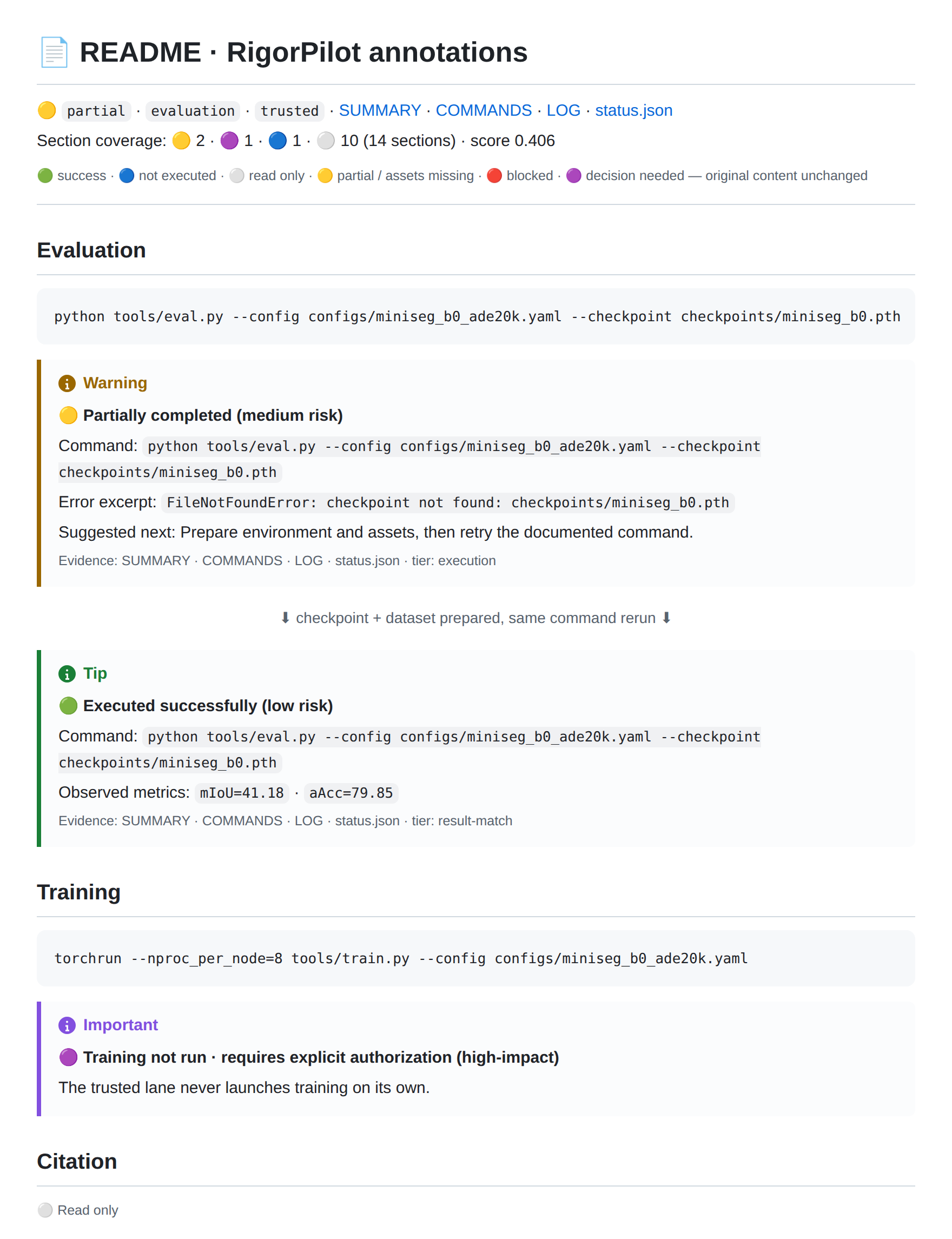
Full real example, generated by actually running ai-research-reproduction
on a realistic segmentation-repo README (badges, model zoo, installation,
data prep, evaluation, training, FAQ, citation) — two scenarios, told by the
same command before and after asset preparation:
| Scenario | What you see |
|---|---|
| First attempt → | 🟡 evaluation fails (checkpoint missing, real error excerpt) · 🟡 dataset not ready · 🟣 training awaits authorization |
| After assets are ready → | 🟢 evaluation succeeds with observed mIoU / aAcc |
The evidence links inside both files (SUMMARY, COMMANDS, LOG, status.json) resolve to the real generated bundle committed next to them.
🎯 Choose an Entry Point
| What you want to do | RigorPilot display name | Current skill slug |
|---|---|---|
| Reproduce a deep learning repository from README commands | Rigor Reproduce | ai-research-reproduction |
| Analyze repository structure, entrypoints, and risks without editing | Rigor Analyze / Audit | analyze-project |
| Prepare environment, datasets, weights, and cache assumptions | Rigor Setup | env-and-assets-bootstrap |
| Run documented inference or evaluation conservatively | Rigor Run | minimal-run-and-audit |
| Start or verify training conservatively | Rigor Train | run-train |
| Debug a failure safely, diagnose before patching | Rigor Debug / Audit | safe-debug |
Explore candidates on top of current_research | Rigor Explore | ai-research-explore |
| Implement candidate changes on an isolated branch | Rigor Improve | explore-code |
| Run small probes or short-cycle experiments | Rigor Explore / Improve | explore-run |
Bundled helper skills are usually called by orchestrators:
repo-intake-and-planpaper-context-resolver
🛣️ Lane Model
🔒 Trusted Lane
Use this lane for reproduction, setup, read-only analysis, conservative execution, training verification, and safe debugging.
- Primary entrypoint:
ai-research-reproduction - Output directories:
repro_outputs/,train_outputs/,analysis_outputs/,debug_outputs/ - Core requirement: preserve scientific meaning, minimize semantic changes, and record assumptions, blockers, and evidence.
🧪 Explore Lane
Use this lane only when the researcher explicitly authorizes candidate-only exploration.
- Primary entrypoint:
ai-research-explore - Leaf skills:
explore-code,explore-run - Output directory:
explore_outputs/ - Key anchor:
current_research
current_research should be a durable research state such as a branch, commit,
checkpoint, run record, or already-trained local model state. Explore outputs
are always candidate results. They must not claim trusted reproduction success,
complete benchmark results, or verified novelty.
🔬 Core Research Principles
- Do not chase scores blindly: score gains must have explanatory value.
- Do not claim novelty lightly: novelty needs literature, code, or experimental evidence.
- Do not break comparability silently: if evaluation conditions change, say that results are not directly comparable.
- Do not disguise engineering fixes as research contributions.
- Do not leave collaborators out of control: important changes must be auditable, reversible, and explainable.
See references/research-rigor-principles.md and references/agent-operating-principles.md.
🔁 Lifecycle View
The repository follows a shallow lifecycle-oriented routing model:
flowchart LR
    A[Understand] --> B[Reproduce]
    B --> C[Set up]
    C --> D[Run or train]
    D --> E[Debug]
    E --> F[Report]
    B -. explicit only .-> G[Explore]
    G --> H[Rank candidates]
    H --> F
The lifecycle helps the agent choose the right lane and evidence target. It does not force every repository into a fixed implementation sequence.
🧠 Research Thinking Loop
Agents implement well but often think in engineering steps. Once the
researcher freezes the evaluation contract and explicitly authorizes
exploration, ai-research-explore runs a codified greedy research cycle —
from observation to a fair keep-or-rollback decision
(full contract):
flowchart LR
    A[Observe run evidence] --> B[Ground: paper · code · prior runs · intuition]
    B --> C[Falsifiable hypothesis]
    C --> D[Single-variable design]
    D --> E[Bounded run]
    E --> F{Fair comparison vs current best}
    F -- better --> G[Keep as new candidate best]
    F -- worse or unfair --> H[Roll back, record why]
    G --> I[Ledger entry]
    H --> I
    I --> A
- Every hypothesis carries a labeled evidence anchor —
paper,code,prior-run, orintuition; unanchored ideas queue in the idea bank and never execute. - Greedy applies to selection, not honesty: a keep requires comparable evidence under the frozen contract; ties favor the simpler, cheaper change.
- Underneath: hard-gated idea ranking, atomic idea decomposition, three-layer implementation fidelity (planned / heuristic / observed), and executor-emitted file-level evidence.
- Lineage: adapts the greedy solution-space search of AIDE and the managed agentic tree search of AI-Scientist-v2, constrained by RigorPilot's comparability-first gates.
🌱 Continuous Learning
The shipped skills are an immutable universal rigor core; personalization lives in a user-owned overlay (policy):
- Failed runs — and their later fixes — are auto-recorded as one-line lessons
in
~/.rigorpilot/lessons.jsonl(opt out withRIGORPILOT_LESSONS=0). python shared/scripts/lessons_store.py summarizedistills them into~/.rigorpilot/PERSONAL_RIGOR.md, which skills consult at run start as the researcher's standing preferences and known pitfalls.- Hard rules: lessons are advisory only — they never relax rigor gates, never store secrets, never edit skill files. Delete the folder and the skills return to the universal base.
🧾 Suggested Research Evidence
| Artifact | Purpose |
|---|---|
SCIENTIFIC_CHANGELOG.md | Records what changed, why it changed, whether it affects scientific meaning, and whether it remains comparable. |
COMPARABILITY_REPORT.md | Explains whether results can still be compared to the README, paper, baseline, or SOTA reference. |
REPRODUCIBILITY_NOTES.md | Records commands, configs, seeds, checkpoints, datasets, environment assumptions, and known gaps. |
NOVELTY_CLAIM.md | States possible novelty as a hypothesis, with supporting evidence, missing evidence, limitations, and required ablations. |
ABLATION_PLAN.md | Describes which variables must be isolated to validate a candidate change. |
EXPERIMENT_LEDGER.md | Records runs, metrics, commands, artifacts, changed files, and evidence status. |
SCIENTIFIC_CHANGELOG.md, COMPARABILITY_REPORT.md, and EXPERIMENT_LEDGER.md
are already generated by standard trusted / explore writers. The remaining names
(REPRODUCIBILITY_NOTES.md, NOVELTY_CLAIM.md, ABLATION_PLAN.md) are
future-compatible evidence concepts.
📁 Output Directories
| Directory | Contents |
|---|---|
repro_outputs/ | Trusted reproduction bundle, including ANNOTATED_README.md |
train_outputs/ | Trusted training bundle |
analysis_outputs/ | Read-only analysis, research map, change map, eval contract, idea seeds, atomic idea map, implementation fidelity, and related outputs |
debug_outputs/ | Safe debug diagnosis and patch plan |
sources/ | Free-first research lookup records, repo-local extraction, and auditable index |
explore_outputs/ | Changeset, idea gate, experiment plan, manifest, ledger, candidate ranking, and related outputs |
🧩 Campaign Inputs
ai-research-explore still accepts variant_spec.json, but
research_campaign.json or research_campaign.yaml is preferred for Rigor
Explore campaigns.
Durable core fields:
current_researchtask_familydatasetbenchmarkevaluation_sourcesota_referencecompute_budget
Optional fields:
candidate_ideasvariant_specresearch_lookupidea_policyidea_generationsource_constraintsfeasibility_policy
See skills/ai-research-explore/references/research-campaign-spec.md.
🌐 Multi-Agent, Multi-Model
RigorPilot is model-agnostic by construction:
- Agent Skills standard — every skill is a spec-compliant
SKILL.md(agentskills.io), the format adopted by Claude Code, OpenAI Codex, Cursor, VS Code, Gemini CLI, and 30+ other tools.npx skills add lllllllama/rigorpilot-skillsworks for any of them. AGENTS.mdrouting — the rootAGENTS.mdgives AGENTS.md-aware agents (Codex, Cursor, Copilot, Gemini CLI, Aider, Zed, …) the lane model, entrypoint table, and hard rules without any install step.- Same contract, any model — SKILL.md instructions carry no
model-specific tool syntax; the evidence bundles (
status.json,ANNOTATED_README.md, …) are identical whichever model executes the run, so results stay comparable across GPT-, Claude-, and Gemini-based agents. - Per-skill client mirrors —
skills/*/agents/openai.yamland.claude/commands/*keep Codex- and Claude-specific entry points in sync with the canonical contract.
🛠️ Local Install
Use the Python installer only when developing locally, needing a project-scoped install, or manually targeting client directories.
python scripts/install_skills.py --client agents --target "$HOME/.agents/skills" --force
python scripts/install_skills.py --client codex --target "$HOME/.codex/skills" --force
python scripts/install_skills.py --client claude --target "$HOME/.claude/skills" --force
Project-scoped examples:
python scripts/install_skills.py --client agents --target ./.agents/skills --force
python scripts/install_skills.py --client claude --target ./.claude/skills --force
These commands are written to work in both Windows PowerShell and Linux shells.
💬 Example Prompts
Trusted reproduction
Use ai-research-reproduction on this deep learning research repo. Stay README-first, prefer documented inference or evaluation, avoid unnecessary repo changes, and write outputs to repro_outputs/.
Read-only analysis
Use analyze-project on this repo. Read the code, map the model and training entrypoints, and flag suspicious patterns without editing files.
Safe debug
Use safe-debug on this traceback. Diagnose the failure first, propose the smallest safe fix, and do not patch until I approve.
Candidate exploration
Use ai-research-explore with research_campaign.json. Treat the task family, dataset, evaluation source, and SOTA table as frozen inputs. Rank candidate ideas and write evidence outputs to analysis_outputs/ and explore_outputs/.
✅ Local Validation
Run everything (CI entrypoint):
python scripts/run_all_tests.py
Basic checks:
python scripts/validate_repo.py
python scripts/test_skill_registry.py
python scripts/test_trigger_boundaries.py
python scripts/test_operating_principles_structure.py
python scripts/test_claude_command_wrappers.py
python scripts/test_readme_selection.py
Core output and explore regressions:
python scripts/test_output_rendering.py
python scripts/test_readme_annotation.py
python scripts/test_train_output_rendering.py
python scripts/test_analysis_output_rendering.py
python scripts/test_safe_debug_output_rendering.py
python scripts/test_research_explore_dry_run.py
python scripts/test_research_explore_campaign_flow.py
python scripts/test_research_explore_artifact_consistency.py
python scripts/test_research_explore_variant_execution.py
python scripts/test_research_explore_nontraining_execution.py
python scripts/test_atomic_idea_decomposition.py
python scripts/test_idea_seed_generation.py
python scripts/test_implementation_fidelity.py
Install-related regressions:
python scripts/test_bootstrap_env.py
python scripts/test_install_targets.py
python scripts/test_setup_planning.py
🧭 Current Repo Snapshot
11skills total:9public skills and2helper skills.6trusted-lane public skills and3explore-lane public skills.4project-scoped Claude Code wrappers under.claude/commands/.48Python scripts, including45test scripts.- Documentation and command examples are kept usable from both Windows PowerShell and Linux shells.
⚠️ Current Limits
run-trainis a bounded training monitor, not a long-running training scheduler.- Trusted reproduction avoids silent semantic changes.
- Helper skills stay narrow and are not public catch-all entrypoints.
- Exploratory work must stay isolated from trusted baselines.
ai-research-exploreis the governed Rigor Explore compatible slug, not an open-ended autonomous research agent.
📚 References
- Research rigor principles
- Deep learning experiment principles
- Shared operating principles
- Skill registry
- Routing policy
- Trigger boundary policy
- Client compatibility policy
- Output contract
- Research pitfall checklist
🧱 Scope
RigorPilot Skills is a research-first skill repository for deep learning experiments. It focuses on scientific meaning, comparability, reproducibility, collaborator control, and auditable workflow boundaries. It helps agents move research forward more reliably, but it does not replace researcher judgment.