🇨🇭 Part of the Swiss Public Data MCP Portfolio
📰 amtsblatt-mcp





MCP server for amtsblattportal.ch — the Swiss official gazette portal (SHAB + 27 cantonal gazettes). Public procurement and official notices, person-data rubrics excluded by design.
Overview
The Amtsblattportal publishes roughly 2.79 million official notices: public procurement, cantonal and communal announcements, enactments, spatial planning — and also bankruptcies, debt collection, inheritance calls and civil-status records naming natural persons.
This server exposes only the first group. Rubrics carrying systematic natural-person data are not queryable, and no tool accepts a person's name, birth date or address. That is a deliberate data-protection decision, explained in Data Protection & Scope.
Anchor demo query: "Which public tenders did canton Ticino publish this month?"
Demo
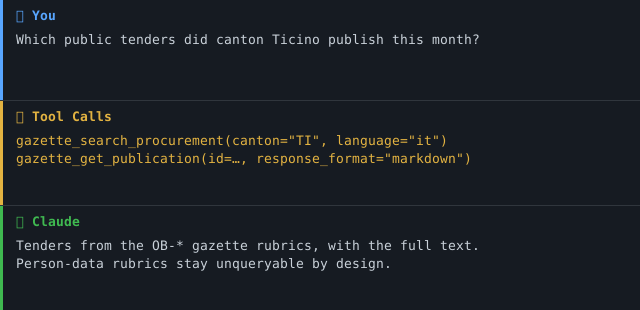 →
→ gazette_search_procurement(canton="TI", only_language=True, language="it") → gazette_get_publication(id=…)
For procurement in any other canton — including Zürich, Bern and Basel-Stadt —
use swiss-procurement-mcp;
see Boundary with swiss-procurement-mcp.
Features
- Fail-closed green allow-list — 49 released rubrics out of 152; everything else is blocked by default, including rubrics the upstream adds later
- Explanatory refusals — a blocked rubric returns why, never a silent empty result and never a workaround hint
- Procurement-aware — knows that only AR and TI still publish tenders here,
that BS wound down during 2024 and BL/VS are historical archives, that
OB-ZGwas never filled after the simap switch, and that ZH routes everything through simap.ch — so it explains instead of returning nothing. Activity is measured, not read off the rubric label - Deadline arithmetic in Europe/Zurich, the legally relevant timezone
- Honest multilingual counts — the portal publishes one record per language
with a different publication number each; identical editions are collapsed,
translated ones are reported via
language_mixrather than guessed at, andonly_language=Truegives a single-language view - Defensive XML parsing — the schema is per-sub-rubric; no rubric-specific path is hard-coded, and entity-escaped HTML bodies are unescaped and stripped
- Egress allow-list, retry with backoff, structured JSON logging
- Markdown or JSON output with per-response attribution +
provenance
Prerequisites
- Python 3.11+
- No API key. The read API of amtsblattportal.ch is freely accessible.
Installation
pip install amtsblatt-mcp
# or, without installing:
uvx amtsblatt-mcp
From source:
git clone https://github.com/malkreide/amtsblatt-mcp
cd amtsblatt-mcp
pip install -e ".[dev]"
Configuration
Claude Desktop
{
  "mcpServers": {
    "amtsblatt": {
      "command": "uvx",
      "args": ["amtsblatt-mcp"]
    }
  }
}
Cloud deployment (streamable-http)
export MCP_TRANSPORT=streamable-http
export MCP_API_KEY="$(openssl rand -hex 32)"   # mandatory — fails loud if unset
export PORT=8000
amtsblatt-mcp
The endpoint is /mcp.
Migrating from SSE. Until 0.18.0 this server spoke SSE only, on
/sse+/messages. MCP spec2026-07-28reclassifies HTTP+SSE as deprecated with a twelve-month removal window and removes protocol-level sessions, so streamable-http is now the default.MCP_TRANSPORT=ssestill works and still carries the full bearer-auth, rate-limit and CORS stack — it logs a warning at startup naming the deadline. Update the client URL when you switch: the path change is the part that breaks silently.
| Variable | Default | Purpose |
|---|---|---|
MCP_TRANSPORT | stdio | stdio, streamable-http (alias http), or the deprecated sse |
MCP_HOST | 127.0.0.1 | HTTP bind address. Defaults to loopback; set 0.0.0.0 to expose on all interfaces (the Docker image does this deliberately). |
MCP_STATELESS | (unset) | 1 runs streamable-http with no session tracking at all. Removes session hijacking and session affinity as questions rather than answering them (SEC-009, SCALE-002). Opt-in, because a stateless server cannot resume an interrupted stream or push server-initiated notifications. Ignored on sse, which has no stateless mode. |
MCP_CORS_ORIGINS | (unset) | Comma-separated origins allowed to call the endpoint from a browser. Unset means no cross-origin browser access at all — stdio and non-browser clients are unaffected. Mcp-Session-Id is exposed and accepted for the listed origins, so a browser client can hold a session. * is honoured but logs a warning and disables credentials, because browsers reject a wildcard origin together with credentials. |
MCP_API_KEY | — | Bearer token; required on every HTTP transport |
MCP_RATE_LIMIT / MCP_RATE_WINDOW | 60 / 60 | Sliding-window rate limit |
RUBRICS_TTL | 86400 | Taxonomy cache TTL (seconds) |
LOG_LEVEL | INFO | DEBUG | INFO | WARNING | ERROR. Structured JSON, one object per line, always on stderr — stdout carries the MCP protocol on a stdio transport. |
Logging
Built on structlog. Every event emitted during a
tool call carries that call's correlation_id, bound via contextvars — so a
retry or an egress denial logged deep in the HTTP path can be joined to the
request that caused it, without threading context through every signature.
| Level | Emitted when |
|---|---|
DEBUG | a tool call was entered (tool_call_started) — tells you whether a hung call ever started |
INFO | a tool call finished cleanly, with latency |
WARNING | upstream retry, egress denied, auth failure, rate limit |
ERROR | a tool call raised |
Records carry the exception type only — never its message and never an upstream response body.
{"event":"tool_call_started","tool":"gazette_search_procurement","correlation_id":"23221af26ae640c7","level":"debug","timestamp":"2026-07-27T22:20:07.494276Z"}
{"status":"ok","latency_ms":312,"event":"tool_call","tool":"gazette_search_procurement","correlation_id":"23221af26ae640c7","level":"info","timestamp":"2026-07-27T22:20:07.806Z"}
Ship these to your SIEM and alert on auth_failed, rate_limited,
egress_denied, green_gate_violation and blocked_publication_requested —
the last two mean something tried to reach a rubric this server does not serve.
Available Tools
| Tool | Signature | Notes |
|---|---|---|
gazette_search_publications | (keyword?, rubric?, sub_rubric?, canton?, date_start?, date_end?, limit=20, page=0, language='de', only_language=False) | Green rubrics enforced. Without rubric, all green rubrics are injected — a keyword-only query can never reach a blocked one. |
gazette_search_detailed | same filters + top_n=3 | Aggregated. Search and full text for the top top_n hits in one call, fetched in parallel. Same green gate on every expanded document; blocked ones are withheld and counted, never rendered. |
gazette_search_procurement | (keyword?, canton?, date_start?, date_end?, include_inactive=False, limit=20, page=0, language='de', only_language=False) | OB-* rubrics plus the gazette-native sub-rubrics AR-VS40, AR-OW40, BA-SH40. A canton with neither gets a simap.ch explainer and no HTTP call. No CPV — the source has none. |
gazette_get_publication | (id, response_format='markdown') | Full official text from XML. Re-checks the rubric after fetching; content from a blocked rubric is discarded. |
gazette_list_rubrics | (language='de', rubric_class='green', response_format='markdown') | rubric_class='all' shows the full taxonomy with traffic-light classes and reasons — listed ≠ queryable. |
gazette_source_status | (response_format='markdown') | Reachability, latency, cache age, scope metrics. |
All tools are readOnlyHint=True.
Example use cases
| Question | Tool chain |
|---|---|
| Tenders in Ticino this quarter | gazette_search_procurement(canton="TI", only_language=True, language="it") |
| Procurement simap.ch does not have | gazette_search_procurement(canton="VS") — 150 Valais awards, none on simap |
| Tenders in any other canton | → use swiss-procurement-mcp |
| What is even queryable here? | gazette_list_rubrics() |
| Why can't I search bankruptcies? | gazette_list_rubrics(rubric_class="all") |
| Zoning changes in Zurich | gazette_search_publications(rubric="RP-ZH") |
| Full text of a notice | gazette_get_publication(id="fbf0ff9e-…") |
| Everything published about one company | → use register-mcp |
Data Protection & Scope
The Amtsblattportal systematically publishes personal data of natural persons. Those publications are public — but making them systematically queryable by name through an AI agent is a repurposing the publication never intended, and a profiling instrument under the revised Swiss FADP (revDSG).
Four rules follow, and they are enforced in code, not in documentation:
- Allow-list, never block-list. Not explicitly green ⇒ not queryable. New upstream rubrics are closed by default.
- No person-based search entry in any tool signature.
- No persistence. Publications have statutory deletion periods; a cache outliving them would actively undermine them. Only the taxonomy is cached.
- Blocked ⇒ explained. Never a silent empty result, never a hint at circumvention.
What is excluded
🔴 Konkurse (KK), Schuldbetreibungen (SB), Schuldenrufe (LS, SR),
Nachlass (NA), Erbschaft/Testament/Ableben (ES, TE-*, VA-*),
Familie & Zivilstand (FZ-*, BV-*, BU-*), gerichtliche Vorladungen
(UV, GB-*, GE-*, SJ-BE), Baugesuche (BP-*), Grundbuch (GR-*),
Meldungskatalog GR (AA-GR).
🟡 Deferred: Steuerwesen, Anzeigen, Bewilligungen, Bildungs- und Kirchenwesen and the general catch-all rubrics.
The full audit trail — including three documented extensions to the source
specification — is in docs/rubric-classification.md.
The boundary with register-mcp
For publications about a specific company, use
register-mcp. It keeps full
rubric access — including a firm's own bankruptcy — but only ever keyed on a
company UID. A firm's insolvency is corporate data, not natural-person
profiling, and UID scoping makes name-based enumeration impossible.
amtsblatt-mcp has the opposite shape: broad search, narrow rubrics. It does
not expose the upstream uids parameter at all.
Boundary with swiss-procurement-mcp
simap.ch is the primary source for Swiss public procurement — all 26 cantons
plus the Confederation, with CPV and BKP codes, awards and publication history.
Use swiss-procurement-mcp
for procurement questions.
amtsblattportal.ch is the primary source for official notices — commercial register, spatial planning, enactments, cantonal and communal announcements. That is what this server is for; procurement is 6 of its 49 released rubrics.
Procurement here is largely a second publication of the same tenders, and
that is now measured rather than assumed. A publication's XML carries
<simapPublicationNumber> when it originates on simap.ch, which joins the two
corpora exactly. Over the full 2026 OB-TI corpus, 503 of 546 records (92.1%)
carry one; three of the six OB-* rubrics say as much in their own labels
(OB-BL — "über Simap importiert (I N A K T I V)").
The exception is small and sharply bounded: AR-VS40 (Valais, 150 awards),
AR-OW40 (Obwalden, 7), BA-SH40 (Schaffhausen, 2) and the Ticino sub-rubric
OB-TI65 ("Avvisi di gara non CIAP") carry no simap reference at all.
That is the one part of this portal's procurement coverage swiss-procurement-mcp
cannot reach, and gazette_search_procurement serves it for cantons VS, OW and
SH even though they have no active OB-* rubric. Numbers and method in
docs/simap-overlap.md.
The two servers stay separate on purpose: different sources, different reuse
terms, and a fail-closed rubric gate that only means something while it covers
every tool in the server. See
docs/procurement-coverage.md for the numbers.
Maturity & phase
Phase 1 — read-only. All six tools are read-only; there is no write path and none is planned. See ROADMAP.md for the phase-specific backlog, what is deliberately not planned, and what a phase transition would require.
The scope restriction that matters most here is not the phase but the green allow-list — rubrics carrying systematic natural-person data are not queryable, enforced in code and re-checked after every fetch. That does not change with phase. See Data Protection & Scope.
SDK and dependency updates arrive as Dependabot PRs, so a breaking protocol or SDK change is reviewed deliberately rather than drifting in silently.
Architecture
   Claude / MCP client
            │
      amtsblatt-mcp
            │
   ┌────────┴────────┐
   │  green gate     │  ← rubrics.py: fail-closed allow-list
   └────────┬────────┘     (checked at the tool AND at the query builder)
            │
   ┌────────┴────────┐
   │  param allow-   │  ← Silent Ignore guard
   │  list + quirks  │  ← Silent Empty guard (taxonomy validation)
   └────────┬────────┘  ← plausibility guard (corpus-size check)
            │
   ┌────────┴────────┐
   │ egress allow-   │
   │ list (httpx)    │
   └────────┬────────┘
            │
  amtsblattportal.ch/api/v1
   /publications · /publications/{id}/xml · /rubrics · /tenants
Architecture A (live-API-only). The endpoints answer stably without authentication, so no bulk dump is maintained.
Verified upstream quirks (live-checked 2026-07-20)
| Quirk | Behaviour | Defence |
|---|---|---|
| Silent Ignore | An unknown parameter name returns HTTP 200 and the full corpus. canton=ZH (singular typo) silently drops the filter. | Query params built exclusively from ALLOWED_GAZETTE_PARAMS; plausibility guard rejects results > 2 000 000. |
| Silent Empty | An unknown rubric value returns HTTP 200 with total: 0 — indistinguishable from a real no-hit. | Every code validated against the taxonomy before the call. |
| Metadata only | The list endpoint and GET /publications/{id} both return content: null. | Full text only via /publications/{id}/xml. |
| Sorting ignored | pageRequest.sortOrders is accepted with 200 but has no effect; sortOrders comes back []. | Sorted client-side. |
Missing publicationStates | Returns 401, not 400 — it does not mean credentials are required. | Always injected; the 401 message says so. |
| No page-size cap | pageRequest.size=2000 returns 2000 items. | Client-side cap of 100. |
| Inconsistent plurals | rubrics/cantons/subRubrics are plural, keyword/tenant singular. | Exact spellings encoded, not a pluralisation rule. |
Known Limitations
-
Uneven cantonal coverage. Only 16 of 29 mandates expose their own rubric taxonomy; AG, FR, GE, GL, JU, LU, NE, UR are still incomplete.
-
Deletion periods. Publications drop out of the API over time — hence pass-through only.
-
Procurement boundary. Most cantons, including Zürich, route tenders through simap.ch, outside this portal. There is no
OB-ZH, and no CPV classification exists here. What this portal has and simap does not is listed indocs/simap-overlap.md;gazette_get_publicationreportssimap_publication_numberso a mirror is distinguishable from an original. -
Procurement coverage, measured (
publicationStates=PUBLISHED, 2026-07-27, records per calendar year — reproduce withpython scripts/measure_procurement_coverage.py):Rubric 2022 2023 2024 2025 2026 Latest Status OB-TI517 491 625 607 546 2026-07-27 active OB-AR95 85 79 56 40 2026-05-22 active OB-BS1 149 1 058 319 15 2 2026-05-20 wound down during 2024 OB-VS0 1 052 1 0 0 2024-01-05 archive — simap import until end of 2023 OB-BL0 74 0 0 0 2023-03-30 archive — labelled «I N A K T I V» OB-ZG0 0 0 0 0 — never filled Only TI and AR still publish actively.
OB-BSis the instructive case: its label is a plain "Öffentliches Beschaffungswesen" with no inactive marker, so only the volume reveals the migration — which is whyactiveis measured, never read. Useinclude_inactive=Trueto reach the BS, BL and VS archives. Details indocs/procurement-coverage.md. -
No push. Polling only; no subscription or webhook mechanism.
-
Legally binding text is the signed PDF, not this API.
MCP Protocol Version
| Supported spec version | 2026-07-28 |
| Pinned in | MCP_PROTOCOL_VERSION in server.py |
| SDK | mcp[cli]>=1.28.1 |
The MCP Python SDK negotiates the protocol version in the session layer and offers no constructor parameter for it, so the version cannot be pinned by configuration. It is pinned as a declared constant and enforced by detection:
- At runtime, a mismatch logs a
protocol_version_driftevent atWARNING. The server keeps working. - In CI,
tests/test_protocol_version.pyfails.
An SDK bump should break our build, not the runtime of someone who upgraded
mcp in their own environment.
Update policy
- Dependabot opens SDK update PRs monthly (
.github/dependabot.yml). - When an update moves the protocol version, the CI test fails. The fix is
not to edit the constant blindly: read the spec changelog, verify the
server still behaves — especially the green allow-list invariants — then bump
the constant, this section and
CHANGELOG.mdin one commit. - Protocol-version bumps are called out explicitly in
CHANGELOG.md, not folded into a dependency-bump line.
Primitives: tools only
This server exposes tools and neither resources nor prompts. A decision, not an omission (ARCH-008).
Why not resources. Resources address identifiable, listable content the client can enumerate and cache. This corpus is 2.79 million publications that grows daily, and — more importantly — not all of it is servable. Rubrics carrying systematic personal data are excluded by design, and that exclusion is enforced at two points: a pre-request green gate on the filters, and a post-fetch gate on the returned document.
A resource URI would put a publication id in the client's hands as an enumerable address. Since ids are opaque, the rubric behind one cannot be known until the document is fetched — which is exactly why the post-fetch gate exists. Exposing publications as resources would mean either enumerating ids we have not gated yet, or gating at fetch time anyway, at which point the resource abstraction buys nothing and costs a second content path to keep the guarantee on. This repo has already learned that lesson once: the aggregated tool needed the gate extracted into a shared helper precisely because a second path to content is where such guarantees quietly stop holding.
One candidate was checked concretely:
| Candidate | Why it stays a tool |
|---|---|
gazette_list_rubrics | Genuinely resource-shaped — a finite, slow-changing taxonomy, already cached with a TTL. But its whole purpose is to communicate that listed ≠ queryable: it renders traffic-light classes and the reason each blocked rubric is blocked. As a resource that framing would be a document the model may or may not read; as a tool it is an answer to a question the model asked. |
Why not prompts. Question templates would duplicate guidance the tool docstrings already carry, in a second place that can drift out of sync with the allow-list. Given that the docstrings are what tell the model which rubrics are reachable, one source is safer than two.
Return shapes: rendered text, not models
Tools return str — Markdown by default, JSON via response_format='json' —
rather than Pydantic models. This is a documented deviation from SDK-002,
made deliberately rather than by neglect.
The rendered output is not a serialisation of an internal object; it is composed
for the reader. It carries the provenance line, the scope statement
(green_rubrics_only), the deduplication warning when language variants were
merged, and the explanation a blocked rubric returns instead of data. Those
are the parts that keep the model from drawing wrong conclusions, and they are
prose, not fields.
Returning a model would either drop them or smuggle them back in as string
fields, which is the same thing with more ceremony. The json format already
covers the machine-readable case for callers that want it.
What would change this: a caller that needs to compute over results rather than read them. At that point the right move is typed models on the JSON path specifically, not a wholesale change of what every tool returns.
Testing
pip install -e ".[dev]"
PYTHONPATH=src pytest tests/ -m "not live"   # 75 tests, no network
PYTHONPATH=src pytest tests/ -m live         # hits the real API
ruff check src/ tests/
The suite covers the mandatory portfolio set: green-rubric search with source URL, blocked rubric → explanation with zero HTTP calls, canton filtering, Europe/Zurich deadline arithmetic against a fixed "today", pagination across a page boundary, language deduplication, boolean normalisation, and API-unreachable handling. Fixtures are shortened real responses, consistently anonymised — no real personal data.
Project Structure
amtsblatt-mcp/
├── src/amtsblatt_mcp/
│   ├── rubrics.py       # Fail-closed green allow-list — the scope decision
│   ├── server.py        # MCPServer, 5 tools, quirk guards, XML parsing
│   ├── _log.py          # Structured JSON logging + per-tool call events
│   ├── _middleware.py   # Bearer auth + sliding-window rate limit (SSE only)
│   └── _otel.py         # Optional OpenTelemetry wiring
├── tests/
│   ├── test_allowlist.py    # Data-protection invariants (own CI job)
│   ├── test_search.py       # Search, procurement, pagination, dedup, errors
│   ├── test_publication.py  # XML parsing, deadlines, egress allow-list
│   └── fixtures.py          # Anonymised real responses
├── docs/
│   ├── rubric-classification.md   # Why each of the 152 rubrics is open/closed
│   ├── procurement-coverage.md    # Measured OB-* volume; why `active` is measured
│   └── simap-overlap.md           # Mirror vs. original, joined on simapPublicationNumber
├── scripts/
│   └── measure_procurement_coverage.py
├── Dockerfile · compose.yaml      # Hardened, non-root, read-only container
└── server.json                    # MCP registry manifest
Changelog
See CHANGELOG.md.
Contributing
See CONTRIBUTING.md. Changes to
src/amtsblatt_mcp/rubrics.py require an
explicit rationale in the PR description: releasing a rubric is a
data-protection decision, not a feature.
Security
See SECURITY.md for reporting and operator hardening notes.
License
MIT — see LICENSE. Data-source notice: NOTICE.md.
Data source: amtsblattportal.ch, operated by SECO / State Secretariat for Economic Affairs on behalf of the Swiss Confederation. Freely usable, but without warranty of completeness or accuracy. Only the signed PDF of a publication is legally binding.
Author
Hayal Oezkan · malkreide
Credits & Related Projects
Part of the Swiss Public Data MCP Portfolio:
register-mcp— Zefix commercial register with a company-UID join to the gazettes