wg-easy-mcp







A Model Context Protocol (MCP) server for administering wg-easy (WireGuard Easy) instances.
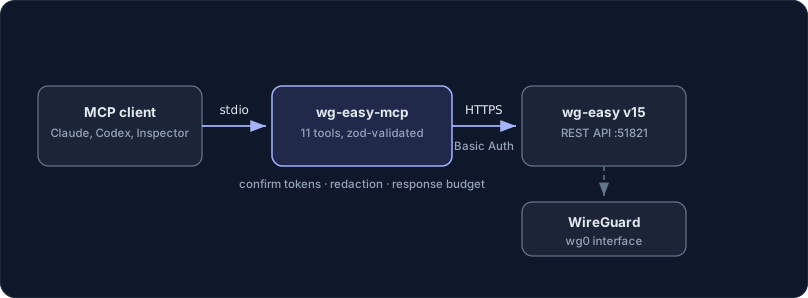
Lets MCP clients like Claude Code, Claude Desktop or Codex manage your WireGuard VPN: list, create, update, enable/disable and delete clients, fetch configuration files and QR codes, and inspect the server status — all through the wg-easy v15 REST API.
📖 Full documentation: wg-easy-mcp.ni-c.de
Requirements
- Node.js ≥ 22
- A running wg-easy v15+ instance
- 2FA (TOTP) must be disabled for the account used by this server — the wg-easy API only supports Basic Authentication and does not work with 2FA enabled
Note: The wg-easy REST API is not yet declared stable and may change between releases. This server targets wg-easy v15.
Configuration
Configuration is provided via environment variables:
| Variable | Required | Description |
|---|---|---|
WG_EASY_URL | yes | Base URL of the wg-easy web UI, e.g. https://vpn.example.com:51821 |
WG_EASY_USERNAME | yes | Username of a wg-easy admin account |
WG_EASY_PASSWORD | yes | Password of that account |
WG_EASY_INSECURE_TLS | no | Set to true to accept self-signed TLS certificates (scoped to the wg-easy connection) |
Use
https://. With a plain-httpURL the Basic Auth credentials and all WireGuard private keys travel unencrypted; the server prints a warning unless the host is local. For self-signed certificates prefer a proper internal CA overWG_EASY_INSECURE_TLS.
Without credentials the server still starts and lists its tools (so registries and inspectors can introspect it), but every tool call fails with setup instructions instead of reaching the wg-easy API.
Installation
Claude Code
claude mcp add wg-easy -s user \
  -e WG_EASY_URL=https://vpn.example.com:51821 \
  -e WG_EASY_USERNAME=admin \
  -e WG_EASY_PASSWORD=your-password \
  -- npx -y wg-easy-mcp
Claude Desktop
Add to your claude_desktop_config.json:
{
  "mcpServers": {
    "wg-easy": {
      "command": "npx",
      "args": ["-y", "wg-easy-mcp"],
      "env": {
        "WG_EASY_URL": "https://vpn.example.com:51821",
        "WG_EASY_USERNAME": "admin",
        "WG_EASY_PASSWORD": "your-password"
      }
    }
  }
}
Codex
Add to your ~/.codex/config.toml:
[mcp_servers.wg-easy]
command = "npx"
args = ["-y", "wg-easy-mcp"]
env = { WG_EASY_URL = "https://vpn.example.com:51821", WG_EASY_USERNAME = "admin", WG_EASY_PASSWORD = "your-password" }
From source
git clone https://github.com/ni-c/wg-easy-mcp.git
cd wg-easy-mcp
npm install
npm run build
# then use `node /path/to/wg-easy-mcp/dist/index.js` as the command
Docker
A multi-arch image (linux/amd64, linux/arm64) with an SBOM and build provenance is published to GitHub Container Registry:
docker run -i --rm \
  -e WG_EASY_URL=https://vpn.example.com:51821 \
  -e WG_EASY_USERNAME=admin \
  -e WG_EASY_PASSWORD=your-password \
  ghcr.io/ni-c/wg-easy-mcp:latest
The image talks MCP over stdio, so clients need docker run -i (no port is
exposed):
{
  "mcpServers": {
    "wg-easy": {
      "command": "docker",
      "args": [
        "run",
        "-i",
        "--rm",
        "-e",
        "WG_EASY_URL",
        "-e",
        "WG_EASY_USERNAME",
        "-e",
        "WG_EASY_PASSWORD",
        "ghcr.io/ni-c/wg-easy-mcp:latest"
      ],
      "env": {
        "WG_EASY_URL": "https://vpn.example.com:51821",
        "WG_EASY_USERNAME": "admin",
        "WG_EASY_PASSWORD": "your-password"
      }
    }
  }
}
Tools
| Tool | Description |
|---|---|
list_clients | List all WireGuard clients with status and traffic statistics |
get_client | Get the full details of a single client |
create_client | Create a new client (name, optional expiresAt) |
update_client | Update a client; only the provided fields are changed |
enable_client / disable_client | Enable or disable a client |
delete_client | Permanently delete a client — two-step, guarded by a confirmation token |
get_client_config | Get the client's WireGuard .conf file |
get_client_qrcode | Get the client configuration as a QR code (SVG) |
generate_one_time_link | Generate a one-time config download link (requires one-time links to be enabled in wg-easy) |
get_server_info | Release/update status, general settings and interface configuration (secrets redacted) |
Safety
delete_clientis a two-step operation: the first call returns a random confirmation token (valid for 5 minutes, bound to the client ID) and only a second call with that exact token deletes the client. Unlike a plainconfirm=trueparameter, the token cannot be guessed or pre-supplied by the model or by injected text.get_server_inforedacts secret fields (privateKey,preSharedKey,password, session/TOTP secrets) from the admin API responses.- Everything the wg-easy API returns carries an explicit untrusted-data marker and a 60 000-character budget. Client names, DNS entries and endpoints are free-form strings, so they are marked as data to report rather than instructions to follow, and a single oversized field cannot flood the model's context.
- A
WG_EASY_URLcontaining embedded credentials (user:password@host) is rejected at startup — they would otherwise be echoed in the startup log and prefixed onto every request. - Upstream error bodies are truncated and HTML error pages (reverse proxies) are dropped before being returned to the MCP client.
WG_EASY_INSECURE_TLSonly relaxes certificate validation for the wg-easy connection — it does not disable TLS verification process-wide.- Tools carry MCP annotations (
readOnlyHint,destructiveHint,idempotentHint) so hosts can apply appropriate permission policies. - Keep in mind that
get_client_configandget_client_qrcodereturn the client's private key, and agenerate_one_time_linkURL allows an unauthenticated config download — treat tool output as sensitive.
The full trust model is in SECURITY.md and, in prose, at wg-easy-mcp.ni-c.de/guide/security.
Development
npm install
npm run build     # compile TypeScript to dist/
npm test          # run the vitest test suite
npm run lint      # eslint + prettier check
npm run test:coverage
CI runs the suite on Node 22 and 24 and adds npm audit, CodeQL and a Trivy scan of the container image on both architectures. See CONTRIBUTING.md.
The documentation site lives in docs/ with its own manifest:
cd docs && npm install && npm run dev
Releasing
- Bump the version in
package.jsonand add aCHANGELOG.mdentry. - Commit, then tag and push:
git tag -a vX.Y.Z -m "vX.Y.Z" && git push origin main vX.Y.Z
The release workflow runs the test suite, publishes to npm (via trusted publishing, no token, with provenance), creates a GitHub release from the changelog entry and updates the entry in the official MCP Registry (io.github.ni-c/wg-easy-mcp, via GitHub OIDC). The container image is published to GHCR by the CI workflow on the same tag.
server.json lists both an npm and an OCI package; the registry job syncs the version into both before publishing. If it ever fails, fix main and re-run mcp-registry.yml via workflow_dispatch — re-running the tag job checks out the old tree.