ArkGate — Architecture Co-pilot for AI TypeScript
One architecture config. One check. One coach.
Your AI writes most of the code. ArkGate keeps that work inside an architecture you can trust — and makes sure a “green” check means something real.




ArkGate 4.6.2 is on npm
latest— first-contact copy (what to do in a few lines). 4.6.2 notes · 4.6.1 · 4.6.0 · Docs hub · Product voice
Choose your path
| You are… | Go here |
|---|---|
| Anyone (ship with AI, minimal jargon) | Use ArkGate |
| Developer (hosts, CI, config, brownfield) | Develop with ArkGate |
| Contributor (improve this library) | CONTRIBUTING |
Full map: docs/README.md
Start in one minute
npm install -D arkgate typescript
npx arkgate start                 # preview files + commands
npx arkgate start --apply         # compact contract + host router + CI plan
npx arkgate-check --doctor        # control plane: status light + primary next action
That is the product. Doctor is the control plane — when stuck, do primary next action #1. Doctor also shows what to improve next (architecture lenses such as separation of concerns and dependency inversion — not a score). Leftover lenses mean design work may remain even when imports are green. Details: use.md — Improvement compass.
start → doctor (+ compass) → /ark-adopt (session 0) → day-to-day /ark-place
                         ↘ /ark-explore then /ark-autopilot when leftover design remains
Teams: keep the constitution out of product PRs. Local gate
ark-check --changed --base origin/dev. Steward law PRs use --contract-session.
Aliases ark / ark-check / ark-mcp still work. npm / pnpm / yarn. No install lifecycle scripts.
What it is
A machine-readable architecture file (ark.config.json) plus enforcement:
| When | Tool |
|---|---|
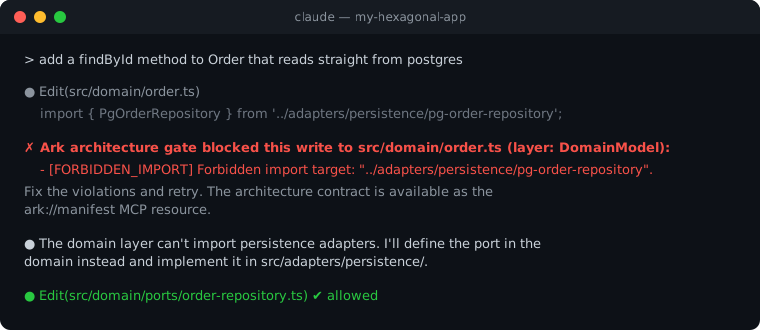
| While the AI writes | Pre-write block on supported hosts; warning only elsewhere |
| Before merge | arkgate-check as a required CI status |
Two planes (4.0)
| Plane | What it guards | Config |
|---|---|---|
| Layers (always) | Who may import whom — imports, placement, purity, isolation | ark.config.json layers + rules |
| ArkRules (opt-in; structure rules inside a layer) | Habits inside a layer — structure sensors + domain invariants as data | arkRules → arkrules/<Layer>.json |
Absence of ArkRules changes no inter-layer verdict. Label residual [Layer] vs [ArkRules].
Details: configuration · use path.
Not a web framework, ORM, or job runner. Optional experimental runtime is separate and not required for the gate.
Name note: npm package arkgate — not affiliated with the separate Archgate CLI project.
When not to adopt
ArkGate is overkill for small trees with no AI agents and no multi-layer boundaries, for
single-developer hobby CRUDs under no integration pressure, and for teams that will not maintain
ark.config.json or a required CI status running arkgate-check --strict-merge. In those
cases stay with a boundary linter alone (see Why not only ESLint / Nx / cruiser?).
Anyone path: docs/use.md — When not to adopt. Limits of a green
check: 4.3.0 — What ArkGate is / isn't.
Status lights (not settings)
| Light | Means | Your move |
|---|---|---|
| Suggest | Thin / new tree | Finish start → doctor |
| Adapt | Not fully protected | Doctor action #1 |
| Enforce | Honest edges under the contract | Keep write path + CI |
| Enforce · design-weak | Edges clean; design residual remains | Shape residual — not “done” |
Details: docs/use.md.
Host enforcement support
| Host | Local write boundary | MCP validation | CI / merge path | Repair payload |
|---|---|---|---|---|
| Claude Code | Hard block for listed ops (PreToolUse Write / Edit / MultiEdit) when installed + trusted | Advisory; the agent must call it | Required GitHub status context running arkgate-check --strict-merge (alias ark-check) | Emitted on hook deny; host must re-inject (hard path when installed + trusted) |
| Grok Build | Hard block for listed ops (PreToolUse write / search_replace (plus aliases)) when installed + trusted | Advisory; the agent must call it | Required GitHub status context running arkgate-check --strict-merge (alias ark-check) | Emitted on hook deny; host must re-inject (hard path when installed + trusted) |
| Google Antigravity | Hard block for listed ops (PreToolUse write_to_file / replace_file_content / multi_replace_file_content) when installed + trusted | Advisory; the agent must call it | Required GitHub status context running arkgate-check --strict-merge (alias ark-check) | Emitted on hook deny; host must re-inject (hard path when installed + trusted) |
| Cursor | Hard block for listed ops (preToolUse Write / StrReplace) when installed + trusted | Advisory; the agent must call it | Required GitHub status context running arkgate-check --strict-merge (alias ark-check) | Envelope may emit (--hook-repair); reinjection not guaranteed (advisory host) |
| OpenAI Codex | Advisory / best-effort at write (not equivalent to Claude/Grok/Cursor hard block) | Advisory; the agent must call it | Required GitHub status context running arkgate-check --strict-merge (alias ark-check) | Envelope may emit (--hook-repair); reinjection not guaranteed (advisory host) |
| OpenCode | Advisory / best-effort at write (MCP + optional plugin; not a hard boundary) | Advisory; the agent must call it | Required GitHub status context running arkgate-check --strict-merge (alias ark-check) | No hard-boundary payload |
Read the CI column: for every host, the repository-wide hard guarantee is a required
GitHub status context that runs the CLI — not “CI file present,” and not the CLI binary name alone.
Codex/OpenCode never get a fake hard write claim. Cursor hard write covers only listed
preToolUse ops when .cursor/hooks.json is installed and trusted — Shell/Tab/human edits still rely on CI.
This table describes the supported profile after its files are installed and the host loads/trusts them. A hard local boundary covers only the listed hook operations; alternate tools, direct filesystem writes, and human edits still rely on CI. MCP validation is advisory because the agent must call it. The CI check blocks a merge only when the repository makes that status required. Repair envelopes may be emitted without reinjection being guaranteed; silent auto-apply never happens. Run arkgate-check --doctor (or ark-check --doctor) for the evidence actually detected in the current repository.
Why the hard guarantee lives at the merge gate
The split above is a deliberate trade-off, not a gap. ArkGate validates at the earliest boundary
each host offers and enforces at the earliest boundary a repository can make non-bypassable: the
required merge status. Hard hooks (Claude Code, Grok Build, Google Antigravity) deny the listed
write operations at write time; advisory surfaces (MCP, rules, OpenCode plugins) coach the agent
while it works. But any local boundary can be routed around — another tool, a direct filesystem
write, a human edit — so the only guarantee ArkGate claims for every path is the
arkgate-check --strict-merge check, and only when the repository makes that status required.
Local checks optimize feedback speed; the merge gate owns correctness.
A useful consequence: the contract doubles as a pressure sensor. Recurring violations or baseline
exceptions concentrated on one layer edge are evidence that the current design stopped fitting the
code — a reason to reshape the contract deliberately (start with /ark-explore), never to weaken
the gate.
Setup per host: docs/ai-gates.md · Develop path: docs/develop.md
For authoritative MCP contract evidence, call ark_identity with the exact project root, then
call ark_manifest with that root plus the returned project id. A contained descendant requires
the matching id. The legacy ark://manifest resource remains compatibility-only and always
unverified/non-authoritative because standard resources/read cannot portably carry that
expectation.
Why not only ESLint / Nx / cruiser?
| ArkGate | Typical boundary linter | |
|---|---|---|
| CI import rules | ✅ | ✅ |
| Hard-block AI writes on supported hosts | ✅ | ❌ |
Project-bound contract agents can read (ark_manifest) | ✅ | ❌ |
| Placement + preflight for multi-file changes | ✅ | ❌ |
| Honest governed % + dual plan (edges vs shape) | ✅ | ❌ |
| Opt-in intra-layer ArkRules (structure + invariants) | ✅ | ❌ |
| Incomplete analysis cannot look green | ✅ | varies |
Common commands
npx arkgate start --apply
npx arkgate status --json          # session/project snapshot (identity, activation, last check)
npx arkgate-check --doctor
npx arkgate-check --plan
npx arkgate-check --coverage
npx arkgate-check --strict-merge   # CI / required status
npx arkgate-check --install-agent-gates --tools claude,cursor,codex,grok
# optional: refresh shared home skills (Claude/Grok/Codex; never downgrades)
# npx arkgate-check --install-agent-gates --skills-only --agent-homes --force
# optional: same 13 skills via Agent Skills ecosystem (no new names)
# npx skills add ./node_modules/arkgate/templates/agent-skills
More: docs/develop.md · skills install: docs/agent-guide.md · enthusiast track: docs/enthusiast/
Optional experimental runtime
Gates need no app runtime. The experimental @arkgate/runtime companion is separate and is not a production-readiness claim.
Durability stance
Default stores (InMemoryEventBuffer, InMemoryAuditStore, InMemoryReadModelStore,
InMemoryWorkflowStore) are reference in-memory only — fine for tests and demos; they
do not survive restarts and are not production durability. Implement the store interfaces
for real systems. Details: docs/production-hardening.md.
Documentation
| Audience | Link |
|---|---|
| Docs hub | docs/README.md |
| Anyone | docs/use.md |
| Developers integrating ArkGate | docs/develop.md |
| Contributors to this library | CONTRIBUTING.md |
| Host install detail | docs/ai-gates.md |
| Config · package surface · TS | configuration · package-surface · typescript-support |
| Brownfield | docs/brownfield-adoption.md |
| Security | SECURITY.md |
Current release (4.6.2 on npm latest) | docs/releases/4.6.2.md · CHANGELOG |
| Prior (4.6.1) | docs/releases/4.6.1.md |
| Prior (4.5.7) | docs/releases/4.5.7.md |
| Prior (4.5.0) | docs/releases/4.5.0.md |
| Prior (4.4.0) | docs/releases/4.4.0.md |
| Prior (4.3.0) | docs/releases/4.3.0.md |
| Prior (4.2.1) | docs/releases/4.2.1.md |
| Previous (4.2.0) | docs/releases/4.2.0.md |
| Previous (4.1.1) | docs/releases/4.1.1.md |
| Previous (4.1.0) | docs/releases/4.1.0.md |
| Previous patch (4.0.1) | docs/releases/4.0.1.md |
| Previous (4.0.0) | docs/releases/4.0.0.md |
| Previous (3.9.2) | docs/releases/3.9.2.md |
| History / maintainer evidence | docs/archive/ |
Contribute to this library
git clone https://github.com/pedroknigge/arkgate
cd arkgate && npm ci && npm run build
npm test && npm run check:architecture
Full guide: CONTRIBUTING.md · queue: ROADMAP.md
Website: arkgate.online · npm: arkgate
MCP: io.github.pedroknigge/arkgate
Node ≥ 18 · MIT
Ark doesn’t invent your product. It keeps AI-generated TypeScript inside an architecture you can trust — and tells you when it isn’t really enforcing anything yet.