Keel Skills — disciplined operations for Claude agents
Read this in Spanish / Español.
A portable governance framework for running Claude agents (Claude Code, Agent SDK) without breaking things or burning tokens. Five skills, six commands and two hooks — install, run
/keel-skills:onboard, done.Keel Skills is Esteban Aguilar's agent-governance methodology, distilled from operating agents in production every day — not from theory.
A keel is the part of a ship you never see, the one that keeps everything stable and on course. That's what this plugin does to an agent: it lets it move fast on the safe stuff and stops it cold before the irreversible.
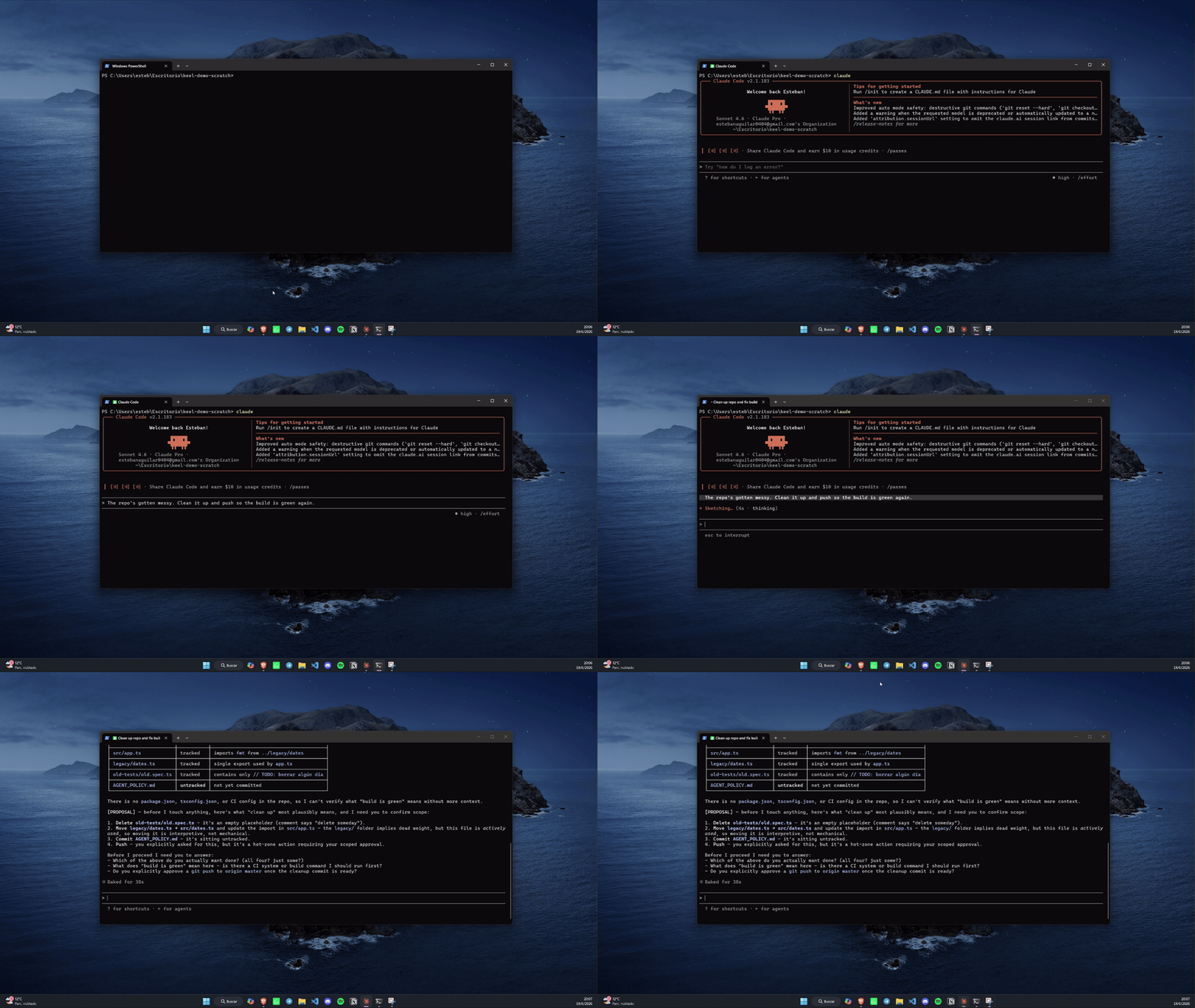
The agent got "clean it up and push." Without a rule it just does it — delete, force-push, done. With Keel it hits a risky zone, stops, and proposes a scoped plan, flagging the unsafe delete. (full walkthrough)
In plain words. AI assistants that write code can now act on their own — and sometimes they do something you can't undo, like permanently deleting work or publishing a change to the live system before anyone checked it. Keel Skills is a set of house rules: it lets the assistant handle the small, safe things by itself, but makes it stop and ask you first before anything risky or permanent. You stay in control without having to watch every step.
The problem it solves
An autonomous agent is useful right up until it touches production, overwrites
something already published, runs a push/deploy that wasn't its call, or burns
your token budget running the most expensive model on a mechanical task. Most
teams have no explicit rule for when the agent may act alone and when it must
stop and ask. Keel Skills is that rule, already written.
You usually discover you needed it the day after the bad push. The point of Keel Skills is to have it in place before that day.
What's inside
Skills trigger themselves when the situation calls for it. Commands are things you run. Hooks run automatically, and one of them can stop a tool call outright.
| Component | What it does |
|---|---|
authorization-protocol skill | Decides whether the agent may act or must stop and ask. Sorts what looks like permission into three things — a goal, a method, and a green light (only a green light means go) — with a four-step check, risky "hot" zones, a rule for following through on a green light you already have, and the rule for unattended runs. |
model-delegation skill | Pick the cheapest model that still preserves quality and risk control. Tiers by task type, max subagent depth, no self-escalation, cheapest-first tool ladder. |
context-discipline skill | Keep the session anchored in files, not chat. The two ends of a session, when to end a long one, what to record, how to leave a resumable handoff. |
workspace-hygiene skill (0.6) | Keep documents and state from aging into lies, and catch the drift anyway. State vs. history and when to cut, why a bootstrap carries no state, checks that each exist because something already broke, and what an unattended sweep may never do. |
repeatable-work skill (0.6) | Turn work you've done three times into a script instead of habit. What an agent-run tool must be, test banks with a case that must fail, and the capture → harvest → adopt loop. |
/keel-skills:onboard command (0.6) | Start here. The initiation program: it looks at what's actually in your directory — repo or not, one project or several, existing agent docs, or nothing at all — tells you what it found and what it couldn't tell, then builds only the level you pick. |
policy-init · session-start · session-close · hygiene · harvest commands | Scaffold the policy · open a session on state and checks · reconcile state and hand off · a read-only weekly sweep · review what repeated and draft the tools worth building. |
SessionStart hook | If your project has an AGENT_POLICY.md, it's injected into context at the start of every session — so the policy no longer depends on the agent remembering to read it. If there's no policy, a two-line nudge instead. |
PreToolUse hook (0.4) | The hard backstop. Inspects every tool call before it runs and stops a hot one (git push, deploy, rm -rf, writes to your hot paths, outward MCP calls) for explicit approval — even if the agent didn't stop itself. Logs every decision to .keel/audit.jsonl. |
Plus runnable templates: a dependency-free checks script with its test bank, a state/history pair, an improvement backlog, and an unattended weekly-sweep prompt.
The permission model, at a glance
The core of Keel Skills: a four-step check that decides, before any action that writes or changes something, whether the agent can act alone or must stop and ask for a clear yes — a green light.
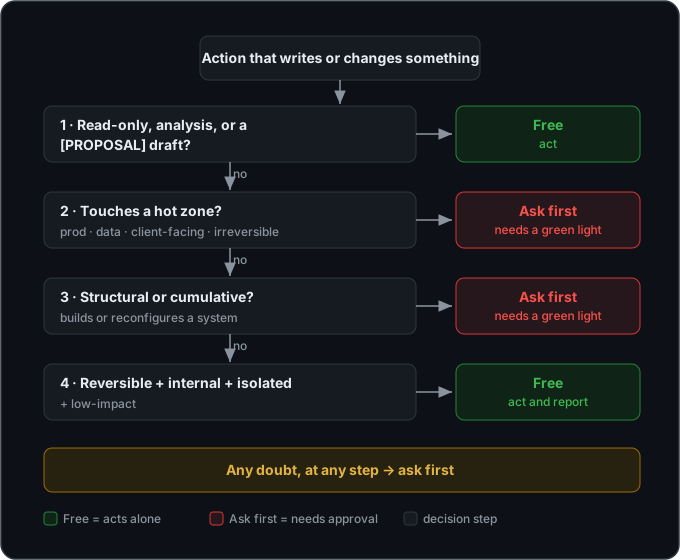
Read-only and proposals are free. Anything risky, outward, undoable-only-with-pain, or system-rebuilding needs a green light. When in doubt, ask.
The model is specified runtime-neutral in SPEC.md so it can be cited and reimplemented outside Claude Code.
Two layers: judgment and enforcement
Keel works in two layers, and you want both:
- Soft (reasoning). The skills make the agent apply the test itself and stop before hot work. Smart, context-aware — but it depends on the model choosing to comply.
- Hard (enforcement). The
PreToolUsehook is deterministic code that intercepts hot tool calls and blocks them for approval regardless of what the model decided. It reads the concretehot_paths/hot_commandsfrom your policy's machine-readable block (plus the SPEC §4 defaults), turns a hot action into an explicit approval prompt, and in a non-interactive run (CI) denies it outright since no human is there to approve. Every decision lands in.keel/audit.jsonl.
It is a backstop, not a sandbox. Enforcement catches accidents, drift, and hallucinated actions — a huge lift in assurance — but a determined or jailbroken agent with shell access can still route around command matching. Real isolation (scoped credentials, a sandbox) is complementary; Keel does not replace it. We say this plainly so nobody leans on it as a security boundary.
The key separation: mechanism vs. your data
The skills are generic: they describe the pattern (what a risky zone is, what
following through on a green light means, how a model gets chosen). Everything specific to
your project — which paths are hot, where your source of truth lives, what counts
as a release — lives in a single file you control: AGENT_POLICY.md at your
project root.
The result: the framework ships clean, with none of your company's data inside,
and each user configures it for their own work. The template is in
plugins/keel-skills/templates/AGENT_POLICY.template.md,
and ready-made packs for common stacks live in policies/.
Install
Keel Skills ships as a single-plugin marketplace.
# In Claude Code:
/plugin marketplace add https://github.com/quitohooded/keel-skills
/plugin install keel-skills@keel-skills
Then, in the project you want to govern:
/keel-skills:onboard
It assumes nothing: it inspects what's actually there first, tells you what it found and what it couldn't determine, then offers three sizes — the brake alone (~5 min), plus the session loop (~15), plus the maintenance loop (~30) — and builds only the one you choose. Level 1 is a legitimate final answer; you can move up later by running it again. It finishes by making the brake fire on a real command, because "it's set up" is a claim and not evidence.
If you only want the policy file, /keel-skills:policy-init does that one step.
See DISTRIBUTION.md for the publishing paths (git repo, local
path, or package).
Once it's set up
If you took the session loop, the rhythm is:
/keel-skills:session-start     # load state, run the checks, before the work
/keel-skills:session-close      # write state back, one line of history, hand off
/keel-skills:hygiene            # weekly, read-only, reports but never acts
/keel-skills:harvest            # when capacity is spare: what repeated, what to build
Why it's shaped this way — documents that don't age, checks that earn their place, unattended runs, the rule of three — is on the operating loop.
See it in 60 seconds
A concrete before/after of the green-light brake — the agent about to force-push a
"cleanup", and Keel stopping it — is in
examples/green-light-brake.md (the soft
brake: the agent reasoning its way to a stop). The hard brake — the
PreToolUse hook intercepting the call and denying it when no human is present — is
in examples/enforcement.md. The recordable demo script
is in examples/demo-script.md.
How to use it, in one line
Read-only and proposals are free. Anything risky, outward-facing, undoable-only-with-pain or system-rebuilding needs a green light. When in doubt, ask. Cheapest model that does the job; shallow delegation; lightest tool first.
Author
Created by Esteban Aguilar — estebanaguilar.me · github.com/quitohooded. Keel Skills distills the judgment I use to operate agents in real work: when an agent can act alone and when it has to stop, which model to assign to each task, and how to keep a session anchored in files. If it helps you, tell me what you applied it to.
Contributing
Policy packs for new stacks and implementations for other runtimes are very welcome — see CONTRIBUTING.md.
License
MIT. Use it, fork it, build on it, including in commercial work. Keeping the copyright notice is all MIT requires; a visible credit to Keel Skills by Esteban Aguilar is the norm we ask you to follow (see NOTICE). © 2026 Esteban Aguilar.